
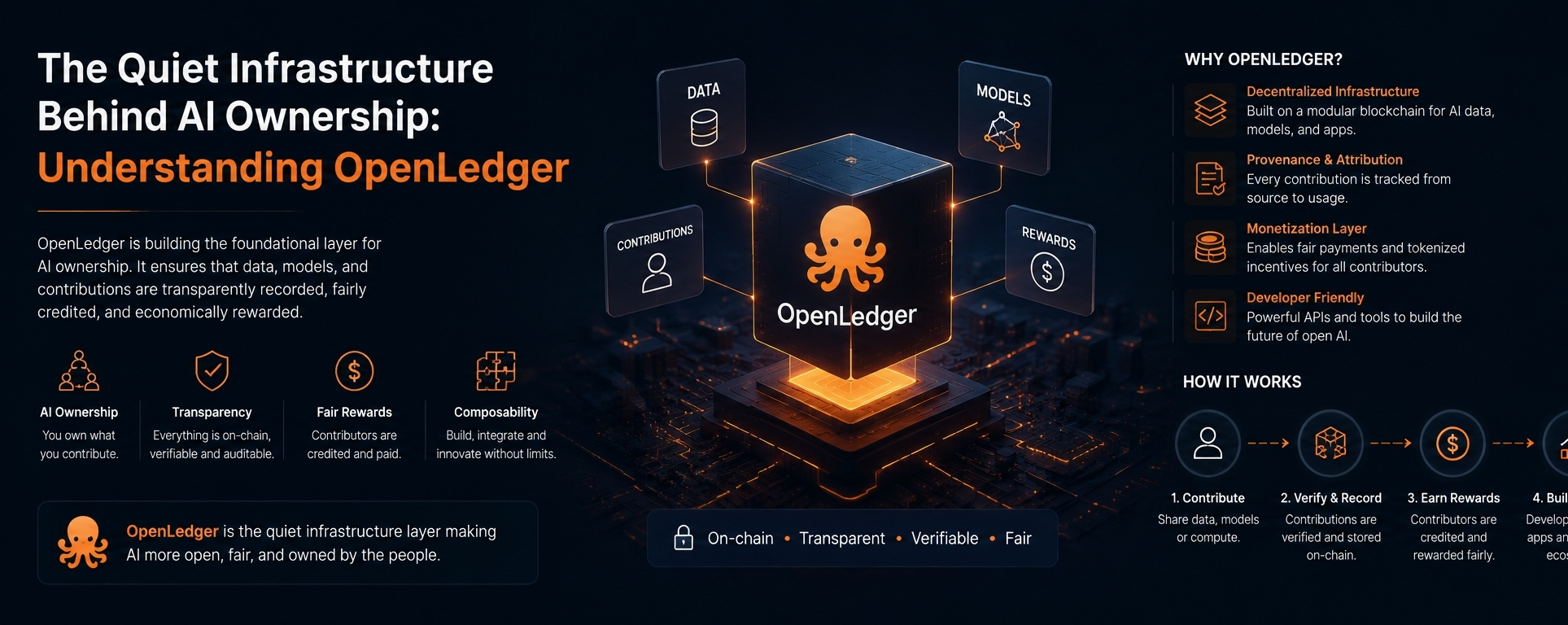
I didn’t understand what was missing from the current AI ecosystem until I spent enough time watching how people actually behaved inside it. Everyone talked about intelligence as if better models alone would solve the future but underneath all the progress there was a quieter pattern forming. The people contributing the most valuable data were rarely the ones building long-term leverage. Developers created useful systems only to become dependent on platforms they could not control. Even the strongest AI communities slowly drifted toward centralization because ownership and coordination were never designed carefully enough from the beginning.
That was the first thing that made OpenLedger feel different to me.
It did not look like a project chasing attention. It looked more like a response to accumulated frustration. The kind of frustration that only appears after watching intelligent systems scale while contributors remain economically disconnected from the value they help create. OpenLedger seemed to emerge from a slower realization: AI infrastructure cannot remain healthy if data providers, model builders, and autonomous agents all operate inside systems where ownership eventually concentrates upward.
What makes the ecosystem interesting is not the combination of AI and blockchain itself. That description has become too easy. The more important detail is the mindset behind the structure. OpenLedger appears to treat intelligence as an economic coordination problem before treating it as a technology problem. That changes the entire design philosophy. Instead of asking how to build larger systems faster the network seems focused on how value should move between participants over long periods of time without collapsing into dependency.
You can see this difference clearly in how early users behaved.
In the beginning participation felt careful and almost skeptical. Developers tested integrations slowly. Contributors avoided overcommitting resources. Nobody acted as though the ecosystem had already proven itself. That caution turned out to be healthy. Systems built entirely through excitement often optimize for growth before resilience. OpenLedger instead appeared to absorb hesitation directly into its evolution. The network had to earn deeper participation through consistency rather than through aggressive momentum.
That process shaped the culture around it.
Over time, users started behaving less like temporary participants and more like long-term builders. That shift matters more than people realize. In most ecosystems, users optimize for visibility because they assume the environment itself is unstable. Here, there seems to be a gradual movement toward utility-focused behavior. Developers care more about interoperability. Contributors think more carefully about attribution. Integrations become deeper because participants begin believing the system may actually persist long enough to justify serious commitment.
Trust inside infrastructure systems is rarely created through incentives alone.
People often assume token rewards are enough to build strong communities, but experienced users eventually look beyond rewards. They observe governance behavior during difficult moments. They watch whether attribution mechanisms remain fair when scale increases. They pay attention to how edge cases are handled, especially when resolving them creates friction for the protocol itself. OpenLedger appears to understand that credibility forms through repeated observation, not through marketing language.
One of the more mature aspects of the ecosystem is its visible restraint.
There are areas where the protocol could probably move faster especially around unrestricted automation and autonomous agent interactions. But moving carefully in these environments is often a sign of structural awareness rather than weakness. Once economic incentives become programmable user behavior changes rapidly. Poorly designed systems attract optimization faster than governance can respond. OpenLedger seems aware that decentralizing intelligence without controlling incentive quality can create fragile systems very quickly.
That discipline may become one of its most important characteristics later.
Another thing that stands out is how liquidity is framed within the ecosystem. In many crypto systems, liquidity becomes disconnected from utility and turns into speculation alone. OpenLedger appears to approach liquidity differently. Data, models, and agents are treated as economic participants capable of retaining relationships and value across the network. That changes how contributors think about what they are building. Instead of creating isolated outputs for short-term attention, participants begin designing systems meant to remain useful inside a larger economic structure.
The token itself also feels more connected to coordination than excitement.
Its long-term importance will likely depend less on price narratives and more on whether it successfully aligns contribution governance and participation across the ecosystem. Infrastructure tokens only matter when communities believe they represent durable influence inside the network. That belief cannot be manufactured quickly. It forms slowly through operational consistency and fair system behavior over time.
The transition from experiment to infrastructure is always difficult.
Eventually every protocol reaches a point where narrative stops mattering. Users stop listening to vision statements and begin evaluating reliability instead. They care about uptime integration quality interoperability governance responsiveness and whether the system continues functioning under pressure. OpenLedger appears to be entering that stage gradually. The conversation around it increasingly feels operational rather than ideological which is usually a sign of maturity.
There are still risks ahead. AI ecosystems evolve faster than governance structures. Open contribution systems always face quality control problems. Economic incentives can distort user behavior in unexpected ways. Regulatory environments will continue changing. None of those challenges disappear simply because the architecture is thoughtful. The real test will be whether OpenLedger can maintain discipline as growth creates pressure for speed.
But if that discipline holds, the project could quietly become something far more important than another AI protocol. It could become part of the underlying economic structure that determines how intelligence is owned coordinated and shared across open systems. Not through hype. Not through aggressive promises. But through slow credibility built over time by proving that contributors can remain participants instead of eventually becoming replaceable.
