

Recently I’ve been going through a lot of AI-related crypto projects, and I’ll be honest, most of them start feeling quite similar after some time. Same patterns, same wording, same big claims. It gets a bit repetitive, and you stop paying attention unless something actually feels different.
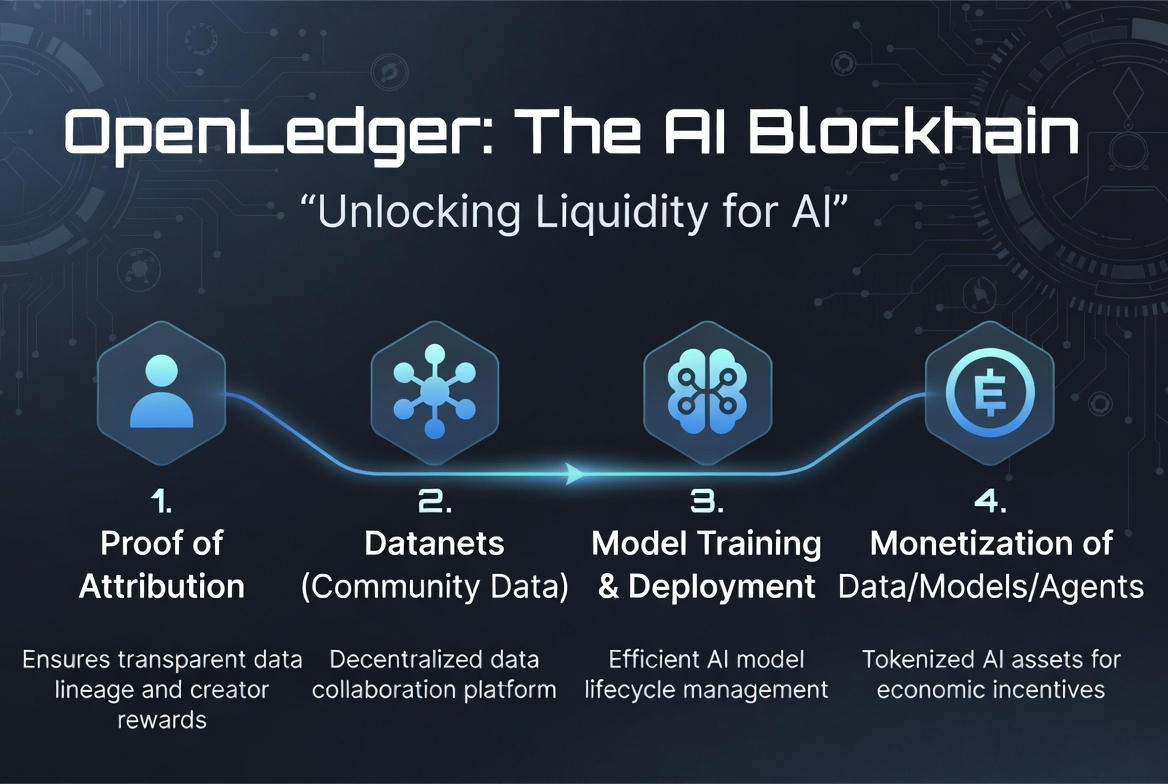
But @OpenLedger did catch my attention in a quieter way. Not because it was shouting for attention, but because the idea behind it felt more structured and less chaotic than usual.
OpenLedger is trying to connect AI and blockchain in a way where the people contributing to AI systems don’t get left out of the value they help create.
In simple terms, it’s about making AI more open, more trackable, and more fair for contributors.
Right now, most AI systems work in a very centralized way. Big platforms collect huge amounts of data, train their models, improve their systems, and monetize everything internally. Regular users are part of that data flow, but they don’t really see any direct benefit from it.
OpenLedger is trying to question that structure. Not by promising something unrealistic, but by suggesting a system where contributions can actually be recorded and potentially rewarded.
At first, “AI + blockchain” sounds like one of those phrases people throw around. But in this case, it becomes a bit easier to understand if you simplify it.
AI is basically the system that learns from data and makes decisions. Blockchain is the system that records information in a transparent and verifiable way.
So when you combine them, the idea is pretty straightforward. AI needs data to improve, and blockchain can help track where that data comes from and who contributed it.
The problem OpenLedger is pointing at is simple: most of this contribution process is invisible right now.
If you help improve AI systems—through data, models, or tools—you usually don’t have visibility or ownership over that contribution.
With a blockchain layer involved, those contributions can at least be recorded in a transparent system. And in theory, that opens the door for rewards or value sharing.
Data is the starting point. Without data, AI has nothing to learn from. It’s basically the fuel behind everything.
Then you have AI models, which are the trained systems that actually process that data. They become the “thinking layer” that powers chatbots, prediction tools, and all sorts of AI applications.
And then there are AI agents. This is where things start to feel more real in everyday usage.
AI agents don’t just respond—they can actually do tasks. They can browse, automate actions, manage workflows, or interact with systems on behalf of users.
Now imagine this at scale. AI agents doing real digital work across the internet. That naturally raises a question: who benefits from all that activity?
Monetization just means whether people can earn from what they contribute. If users are providing data or helping improve AI systems, but there’s no reward or benefit for them, then participation usually drops over time. That’s just how human behavior works.
Liquidity, in this context, is about making sure AI-related contributions aren’t just sitting idle. They should be usable, active, and part of a functioning system where value can move.
OpenLedger is trying to create an environment where AI contributions don’t just disappear into closed systems, but instead stay part of something that has real economic activity around it.
I’m not looking at this like it’s guaranteed to succeed or anything like that. In crypto, things can go in very different directions depending on execution.
But the interesting part here is the focus. OpenLedger isn’t only talking about hype or fast growth. It’s trying to touch on deeper questions like ownership, contribution, and value distribution in AI systems.
Those are not small topics. And they’re only going to become more relevant as AI keeps growing.
If AI continues expanding at the pace we’re seeing now, it’s going to become part of almost every digital system we use. Workflows, apps, automation—everything.
And if AI agents become widely used, they might start handling a lot of tasks that humans currently do manually.
In that kind of future, ownership becomes a real issue. Not just who builds AI, but who benefits from its output and who gets rewarded for enabling it.
If OpenLedger or similar projects manage to build a system where contributions are fairly tracked and rewarded, then they could fit into that future quite naturally. But of course, that depends heavily on real-world execution, not just the idea.
Right now, I’m just observing the project like many others in the AI + crypto space. Nothing rushed, nothing emotional. Just trying to understand where it fits.
What I do like is that it’s asking the right kind of questions about how AI value should be distributed in the long run.

Whether it becomes important later or not is something time will decide.
For now, it stays on the watchlist.