
The cryptocurrency market has always been driven by cycles of optimism, speculation, liquidity, and brutal corrections. Few assets represent this phenomenon more dramatically than Terra Luna Classic (LUNC), the remnant ecosystem left behind after the historic collapse of the original Terra Luna network in 2022.
While LUNC continues to maintain a passionate community and periodic speculative rallies, there are increasing macroeconomic, technical, structural, and psychological signals suggesting that the token could still face a further correction of up to 75% from local highs before any meaningful long-term stabilization occurs.
This analysis explores the major reasons behind such a scenario.
1. The Psychological Legacy of the Terra Collapse
The original Terra Luna collapse destroyed tens of billions of dollars in market value and became one of the most catastrophic events in crypto history. The collapse permanently damaged institutional confidence in the ecosystem.
Even though Terra Luna Classic survives as a decentralized community-driven chain, the psychological overhang remains severe:
Many investors still associate LUNC with catastrophic losses.
Institutional funds remain cautious.
Retail traders largely dominate the volume.
Speculative trading outweighs fundamental adoption.
This creates an unstable market structure where rallies are often momentum-driven rather than utility-driven.
Historically, assets that suffer catastrophic collapses rarely recover sustainably without:
major institutional support,
revolutionary utility,
or completely new economic models.
LUNC currently struggles to demonstrate all three simultaneously.
2. Excessive Supply Remains a Structural Problem
One of the biggest long-term bearish arguments for LUNC is the enormous circulating supply.
Despite burn mechanisms introduced by the community, the supply remains extremely high compared to market demand. Burn rates are often celebrated by the community, but mathematically the reduction pace is still relatively slow compared to the trillions of tokens in circulation.
The problem becomes simple economics:
�
For LUNC to achieve major price appreciation:
either demand must grow exponentially,
or supply must shrink aggressively.
At current burn trajectories, meaningful scarcity may take years unless exchange-supported burns accelerate significantly.
This leaves LUNC vulnerable to speculative exhaustion.
3. Weak Real-World Utility Compared to Modern Layer-1 Competitors
The crypto market of 2026 is radically different from 2021.
Modern Layer-1 ecosystems now compete aggressively:
AI-integrated chains,
high-speed payment rails,
institutional tokenization networks,
real-world asset ecosystems,
and scalable DeFi infrastructures.
Compared with competitors like:
Solana
Sui
Near Protocol
Avalanche
LUNC still faces challenges in proving:
superior scalability,
dominant developer growth,
meaningful ecosystem expansion,
or enterprise adoption.
Without sustained utility growth, speculative capital tends to rotate elsewhere during risk-off periods.
4. Technical Analysis Suggests Distribution Rather Than Accumulation
Many long-term chart analysts argue that LUNC frequently displays characteristics of a classic speculative distribution cycle:
Characteristics observed:
rapid vertical rallies,
declining volume after spikes,
repeated failure at resistance zones,
whale-driven liquidity sweeps,
retail FOMO-driven entries.
In many historical crypto cycles, such behavior precedes sharp retracements.
A hypothetical 75% correction is not unusual in crypto history:
Bitcoin itself has repeatedly corrected 70–85%.
Altcoins commonly fall 80–95% during extended bear phases.
If liquidity dries up globally, smaller speculative assets are usually hit hardest.
5. Macroeconomic Liquidity Risks
Crypto markets remain deeply tied to global liquidity conditions.
Key macro risks include:
high global interest rates,
tightening monetary policy,
recession fears,
geopolitical instability,
reduced speculative capital.
When liquidity contracts:
investors flee high-risk assets first,
meme/speculative tokens suffer disproportionately,
leveraged positions unwind violently.
LUNC remains highly retail-driven and sentiment-sensitive, making it especially vulnerable during macro downturns.
6. Whale Concentration and Volatility Risks
A major concern within smaller-cap crypto ecosystems is concentration risk.
If a significant percentage of supply is held by:
whales,
exchanges,
or coordinated trading groups,
then price action can become highly manipulated.
Large holders can:
trigger panic selling,
exploit low liquidity,
engineer volatility,
or induce liquidation cascades.
This creates an environment where corrections can become self-reinforcing.
7. Burn Narrative May Already Be Partially Priced In
The LUNC community strongly supports token burns as the primary long-term bullish catalyst.
However, markets often price narratives in advance.
If burn expectations:
fail to accelerate,
slow down,
or disappoint traders,
the resulting loss of momentum can trigger sharp downside pressure.
Crypto history repeatedly shows that narrative exhaustion often precedes major corrections.
8. Retail Speculation Alone Cannot Sustain Long-Term Valuation
The harsh reality in crypto markets is that sustainable valuation usually requires:
institutional participation,
developer activity,
network usage,
transaction demand,
and ecosystem growth.
Retail enthusiasm can create explosive rallies, but these rallies often collapse when momentum fades.
Without deep structural adoption, price appreciation becomes increasingly fragile.
9. The 75% Correction Scenario
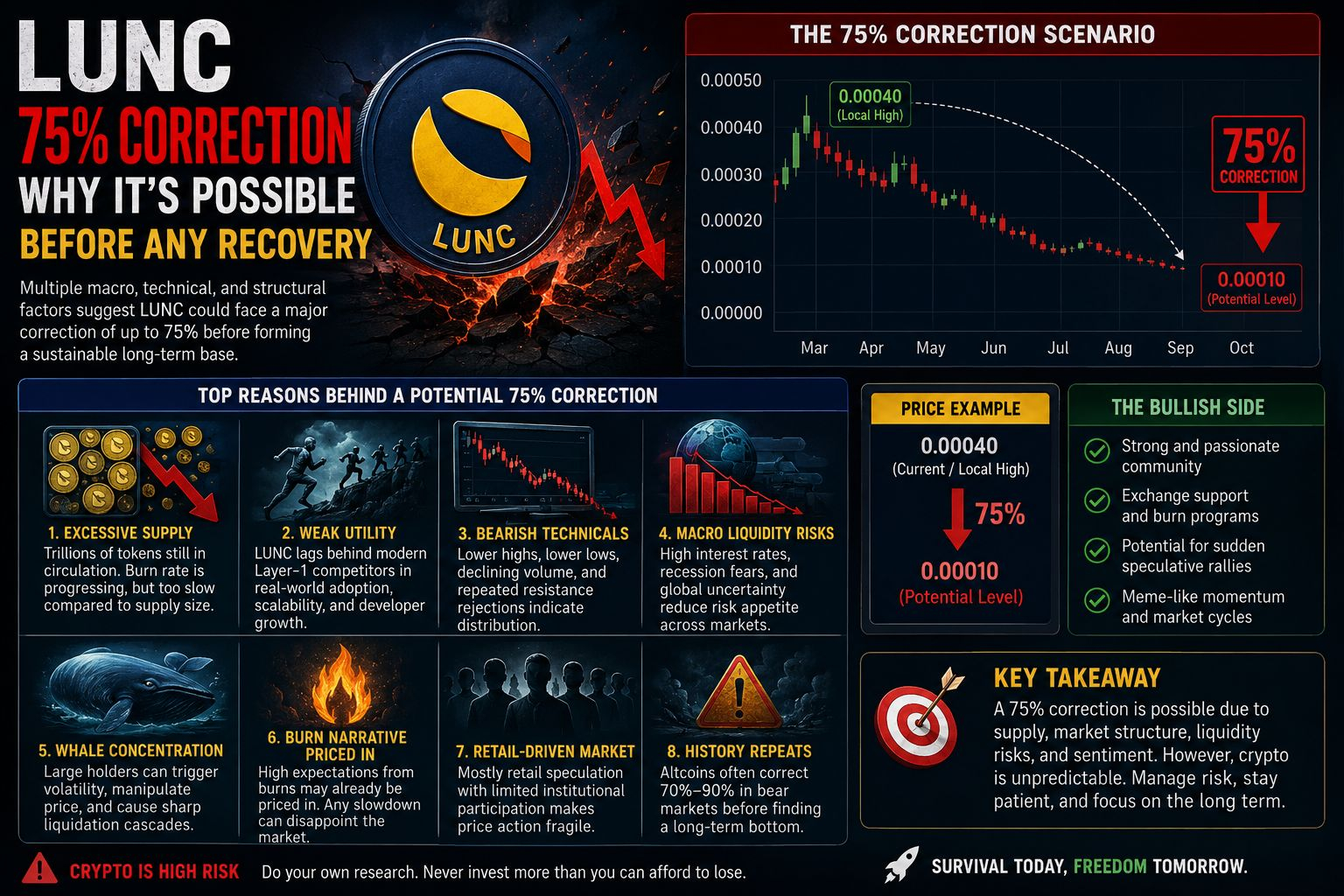
A 75% correction sounds extreme, but in crypto mathematics it is surprisingly common.
For example:
�
This means:
a token trading at 0.0004 falling 75%
would decline to approximately 0.0001.
Historically, many altcoins undergo such retracements before forming long-term accumulation bases.
10. The Bullish Counterargument
Despite the bearish scenario, it is important to acknowledge that LUNC still possesses several strengths:
Strong Community
The Terra Luna Classic community remains among the most passionate in crypto.
Exchange Support
Some exchanges continue supporting burn programs and trading activity.
Speculative Potential
Crypto markets can remain irrational for extended periods, especially during altcoin seasons.
Meme-Like Momentum
Assets with strong emotional communities can experience sudden explosive rallies regardless of fundamentals.
Thus, while a 75% correction is plausible, it is not guaranteed.
Final Perspective
LUNC remains one of the most emotionally charged assets in cryptocurrency markets. It represents both:
the dangers of speculative excess,
and the resilience of decentralized communities.
However, from a macroeconomic, technical, and structural perspective, the probability of a major correction cannot be ignored.
A 75% retracement scenario would likely emerge from:
declining liquidity,
weakening momentum,
slow burn progress,
lack of institutional adoption,
and broader crypto market weakness.
At the same time, crypto markets are notoriously unpredictable. Extreme bearishness can sometimes precede violent reversals.
For investors, the key lesson is risk management:
avoid emotional trading,
understand volatility,
and never assume community enthusiasm alone guarantees long-term appreciation.
In the crypto market, survival often matters more than prediction.