
Artificial intelligence is evolving much faster than most people expected. At first, the industry focused almost entirely on model capability, computational power, and the race to build smarter systems. Every major discussion centered around speed, automation, and scale. But over time, I noticed another issue quietly becoming more important beneath the surface. The deeper challenge was no longer only about building intelligence. It was about understanding how value created by intelligence could be tracked, verified, distributed, and trusted over long periods of time.
That shift is where OpenLedger begins to feel relevant in a much more serious way.
OpenLedger describes itself as an AI blockchain focused on unlocking liquidity for data, models, and agents. On the surface, that may sound similar to many infrastructure projects entering the artificial intelligence sector. But after studying the direction they’re taking, it becomes clear that the project is attempting to solve a more structural problem connected to the future economic architecture of AI systems.
The central issue is surprisingly straightforward.
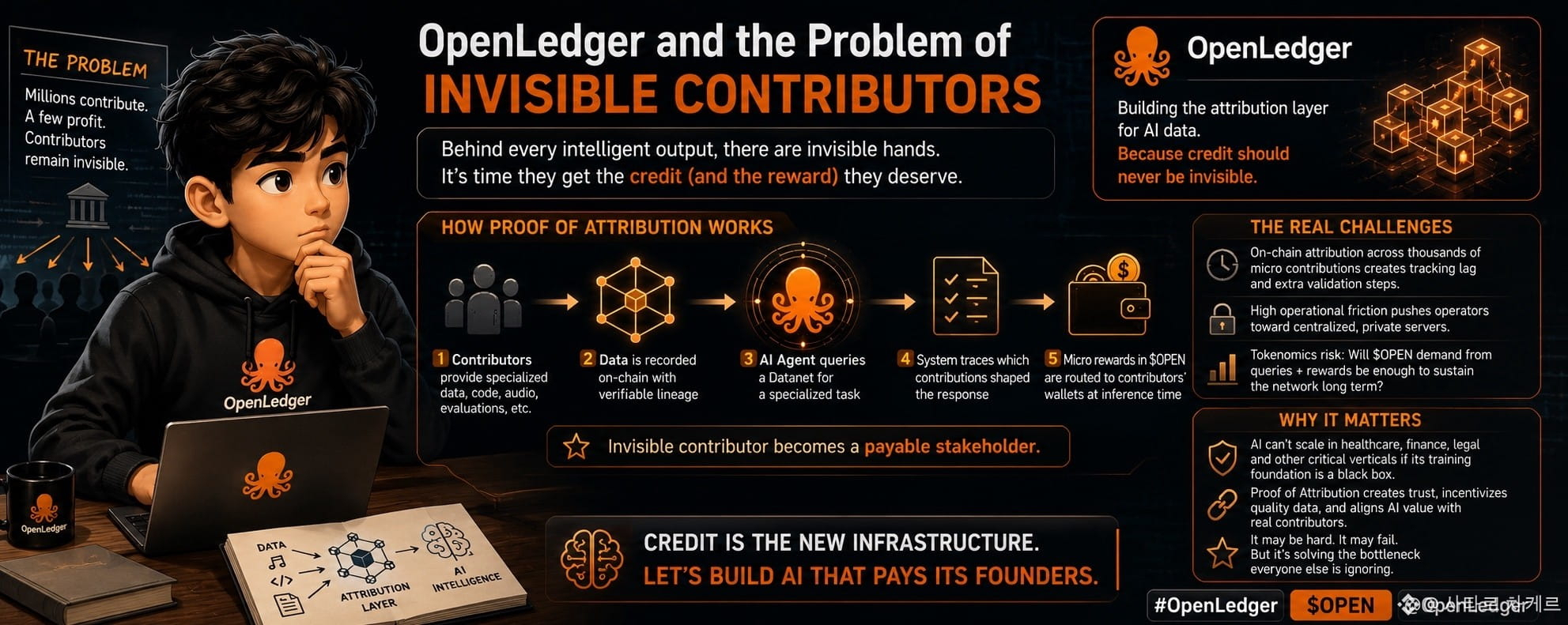
Artificial intelligence systems rely on enormous layers of contribution. Data providers create training inputs. Researchers optimize models. Developers build applications. Infrastructure operators provide computational support. Autonomous agents interact with external systems. Yet in most existing environments, the connection between contribution and compensation remains unclear. I started thinking about how difficult it has already become to determine who deserves economic recognition when an AI system produces valuable output. In many cases, attribution disappears entirely once models scale beyond their original creators.
That problem may become even larger as AI systems become increasingly autonomous.
OpenLedger appears to be designed around the idea that future AI ecosystems will require transparent economic coordination instead of opaque centralized ownership structures. Rather than treating intelligence as a closed corporate asset, the project is attempting to create blockchain-based systems where contributions can be recorded, verified, and monetized directly within an open ledger environment.
This changes the conversation surrounding AI infrastructure.
Most projects connected to artificial intelligence and blockchain tend to focus heavily on computational marketplaces or decentralized GPU coordination. OpenLedger seems to approach the sector from a different angle. They’re concentrating more on attribution, accountability, and economic traceability surrounding AI-generated value itself.
That distinction matters because the project is not simply focused on producing intelligence. They’re trying to build economic memory around intelligence.
When I examined the broader philosophy behind the system, I noticed that OpenLedger treats AI less like isolated software and more like an emerging economic network. That perspective feels increasingly important because modern AI systems are becoming deeply interconnected with finance, information flows, automation layers, and digital labor structures. If these systems continue expanding into larger parts of everyday economic activity, then questions around ownership and value distribution become unavoidable.
Who benefits from successful AI outputs?
How are contributors recognized?
How can provenance be verified?
What happens when autonomous systems create economic consequences without transparent accountability?
These are no longer theoretical questions.
We’re already seeing industries struggle with attribution disputes, synthetic content concerns, dataset ownership problems, and uncertainty surrounding AI-generated outputs. It becomes clear that infrastructure for verification may eventually become just as important as infrastructure for computation itself.
OpenLedger appears positioned directly within that growing challenge.
One of the most interesting aspects of the project is its focus on liquidity surrounding AI-related assets. Traditionally, datasets and models have existed inside closed systems controlled by large organizations. Valuable information often remains locked within private institutions, while contributors rarely participate in the downstream value generated from their work. Models become monetized through centralized APIs, and economic participation remains concentrated.
OpenLedger seems to be exploring whether blockchain systems can create more open economic structures around those resources. If it becomes successful, datasets, models, agents, and inference activity could potentially function as economically active assets within transparent on-chain environments rather than remaining trapped inside isolated corporate ecosystems.
That does not automatically guarantee fairness or decentralization. But it introduces an important structural possibility that deserves attention.
I wondered whether blockchain technology might eventually become more valuable for economic verification than for speculation alone. In earlier years, much of the crypto industry revolved around trading cycles and financial experimentation. Over time, however, the strongest infrastructure narratives have increasingly shifted toward transparency, coordination, settlement, and trust minimization. OpenLedger appears aligned with that broader evolution.
The project’s design direction also reflects a growing realization that AI ecosystems may become too complex for traditional centralized management structures. As autonomous agents interact with models, external data providers, decentralized computation layers, and independent applications, coordination becomes fragmented very quickly. Blockchain infrastructure offers one possible mechanism for creating auditable relationships between these participants without depending entirely on centralized control.
That is where OpenLedger becomes more conceptually interesting.
They’re attempting to use blockchain not merely as a payment system, but as an economic accountability layer for machine-driven ecosystems.
.At first, that idea can sound abstract. But the implications become easier to understand when considering the long-term direction of artificial intelligence. Imagine a future where AI agents negotiate services autonomously, where models continuously evolve through distributed contribution, and where millions of interactions occur between machine-operated systems every hour. Under those conditions, transparent accounting becomes extremely important. Without reliable systems for attribution and verification, economic disputes and trust failures could become widespread.
I’m beginning to think that one of the biggest infrastructure problems in AI may not actually be intelligence itself. It may be the absence of durable trust surrounding intelligence.
OpenLedger seems to recognize this early.
Another important detail is how the project approaches contribution visibility. In most traditional AI environments, contributors are often invisible once systems scale. Smaller participants rarely maintain meaningful economic alignment with the long-term value created by their inputs. Even open-source ecosystems frequently struggle with sustainable compensation structures.
OpenLedger appears to be experimenting with systems where contribution trails remain visible and economically connected over time. If implemented carefully, this could potentially create stronger alignment between participation and reward distribution within AI ecosystems.
Still, realistic limitations exist, and they should be acknowledged honestly.
The relationship between blockchain and artificial intelligence remains technically difficult. Scalability challenges, verification complexity, governance coordination, regulatory uncertainty, and data authenticity problems are all significant obstacles. OpenLedger is operating inside a sector where many ambitious concepts remain untested at meaningful scale.
Adoption also remains one of the largest long-term challenges.
Building infrastructure is not the same as building usage. Even if OpenLedger successfully develops technically functional systems, developers, enterprises, and ecosystem participants must still choose to integrate with those systems consistently. That process takes time, especially when industries are still defining standards around AI accountability itself.
This is why credibility becomes more important than short-term visibility.
I noticed that many AI-related blockchain projects focus heavily on immediate narratives surrounding automation and explosive future growth. OpenLedger, by comparison, appears more focused on foundational coordination infrastructure. That approach may develop more slowly, but infrastructure projects often require patience because their value is measured through reliability and adoption rather than attention cycles alone.
Real progress for OpenLedger will likely become visible through ecosystem participation, integration quality, transaction reliability, contribution tracking effectiveness, and long-term developer engagement. Those indicators matter far more than temporary speculation or market excitement.
Another reason the project feels increasingly relevant is because it acknowledges an uncomfortable reality surrounding artificial intelligence. AI systems do not operate outside economics. Every dataset, model, agent, and output exists within incentive structures. If those incentives are poorly designed, concentration and imbalance become likely outcomes.
OpenLedger appears to be attempting to build transparent coordination systems before those problems become impossible to manage at larger scale.
That approach may become increasingly important as governments, enterprises, and technology companies demand stronger auditability surrounding AI-generated outcomes. We’re already seeing growing discussions around provenance verification, synthetic media identification, data ownership, and accountability mechanisms for automated systems.
OpenLedger sits close to the center of those conversations.
At the same time, the future remains uncertain, and uncertainty should be treated carefully. Blockchain infrastructure alone cannot solve every coordination challenge inside artificial intelligence ecosystems. Governance quality matters. Incentive alignment matters. Technical execution matters. Community trust matters. Most importantly, long-term sustainability depends on whether the system can remain genuinely useful beyond narrative cycles.
That is why the project feels more meaningful when viewed as a long-term experiment in economic infrastructure rather than a short-term market theme.
I started thinking about how many digital systems today operate without durable economic memory. Large amounts of value are created online every day, yet attribution frequently disappears as platforms scale. OpenLedger is essentially exploring whether blockchain systems can preserve transparent economic relationships around artificial intelligence in ways that remain verifiable and open over time.
That question alone makes the project worth studying carefully.
They’re attempting to build an environment where intelligence is not only generated, but economically understood.
Whether OpenLedger fully succeeds remains uncertain, and that uncertainty is normal for emerging infrastructure sectors. But even with those risks, the direction of the project reflects a broader realization that may become increasingly important in the coming years.
The future of artificial intelligence may not depend only on who builds the most advanced systems.
It may also depend on who builds the most trustworthy systems surrounding contribution, attribution, accountability, and economic coordination.
In that sense, OpenLedger represents something larger than a standard blockchain application. It reflects an evolving understanding that intelligence itself may eventually require transparent economic infrastructure capable of recording contribution, distributing value fairly, and preserving trust at scale.
As the AI economy continues maturing, projects focused on infrastructure rather than temporary attention may ultimately shape the systems that last the longest. OpenLedger is still early in that process, but the questions it is attempting to solve already feel increasingly important.
And perhaps that is the strongest foundation any long-term infrastructure project can have.
Not promising certainty, but recognizing critical problems early enough to begin building systems capable of addressing them responsibly.