
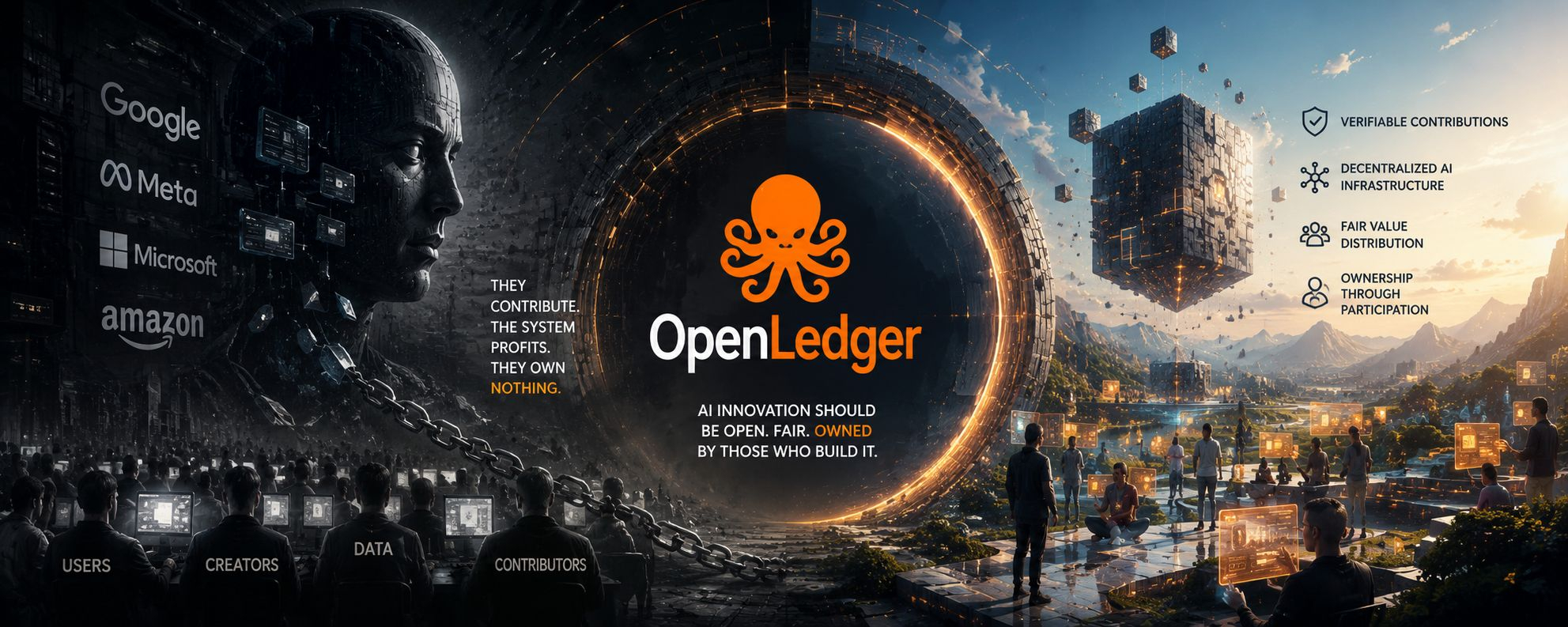
There’s something deeply unsettling about watching millions of people build systems they will never truly own.
A driver spends ten hours feeding data into a ride-sharing algorithm. A designer uploads years of creative work onto platforms that slowly absorb style, behavior, and attention. Ordinary users train recommendation engines every single day just by scrolling, clicking, reacting, speaking. The system improves because people participate inside it. But the ownership rarely flows back to the people creating the value.
Most of modern technology feels strangely dependent on invisible labor.
The more I look at today’s digital systems, the more I notice how contribution and ownership have become separated almost by design. Participation is everywhere. Control is concentrated somewhere else.
AI has only intensified this imbalance.
Everyone talks about intelligence now. Faster models. Bigger infrastructure. Better automation. But very few conversations focus on the underlying economics quietly forming beneath these systems. Who provides the data? Who coordinates the information? Who improves the models through usage? And most importantly, who captures the long-term value once the system becomes powerful?
The uncomfortable reality is that modern AI often behaves less like collaboration and more like extraction at scale.
Users generate behavior. Communities generate knowledge. Contributors generate refinement. Platforms aggregate all of it into centralized systems that become increasingly difficult to challenge. Efficiency improves. Convenience improves. But ownership narrows.
I keep noticing how the internet rewards aggregation more than genuine contribution. Visibility becomes centralized. Infrastructure becomes centralized. Even intelligence itself is beginning to consolidate around a small number of actors with enough computational power, proprietary data, and distribution control to shape entire digital ecosystems.
That is partly why OpenLedger feels intellectually interesting.
Not because it promises some perfect decentralized future. Most projects in crypto already overpromise. They sell narratives about freedom while quietly rebuilding familiar power structures underneath speculative excitement. Token activity often becomes more important than meaningful coordination. Branding becomes louder than infrastructure. Short-term attention replaces long-term economic design.
OpenLedger seems to be asking a deeper question instead.
What happens if AI systems are built around verifiable contribution rather than invisible extraction?
Its focus on decentralized AI infrastructure, measurable participation, and contributor ownership attempts to challenge the assumption that intelligence must inevitably centralize. The idea is not simply about open-source development. It is about whether the people helping systems grow can remain economically visible inside the systems they improve.
That changes the conversation from pure technological capability to incentive alignment.
But difficult questions remain.
Can decentralized coordination actually remain efficient once systems scale globally? Can contributor-based economies resist manipulation once financial incentives become large enough? Will ownership become meaningful in practice, or merely symbolic participation wrapped in governance language? And perhaps the hardest question of all: does decentralization truly reduce concentration of power, or does it simply redistribute power toward different kinds of coordinators?
These questions matter because AI is no longer just software. It is becoming economic infrastructure.
The systems being built now may quietly determine who owns intelligence, who benefits from automation, and who remains permanently trapped as unpaid infrastructure beneath digital growth.
That is why projects like OpenLedger matter beyond hype cycles or market narratives. Not because they have solved these problems already, but because they force people to confront them honestly.
And the more I think about the future of AI, the more I suspect the biggest battle will not be about intelligence itself.
It will be about whether the people feeding intelligence into the system are finally allowed to own part of what they helped create.
