
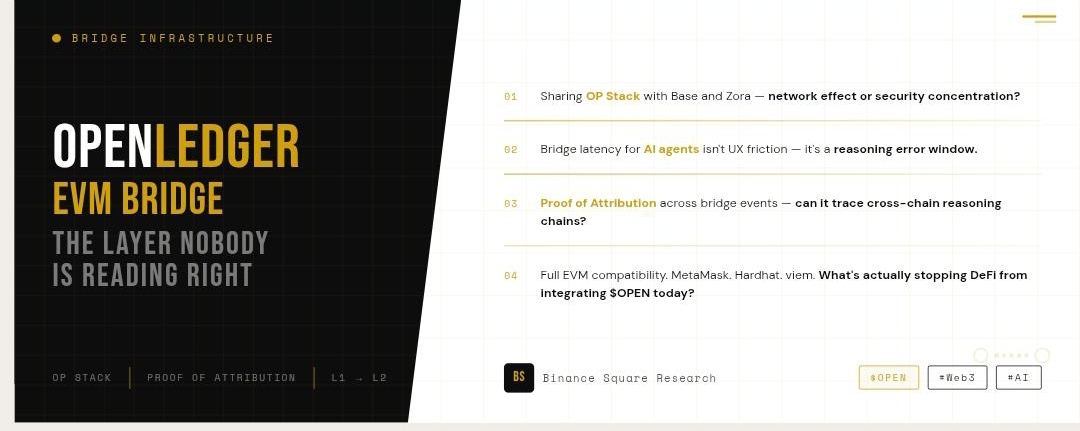

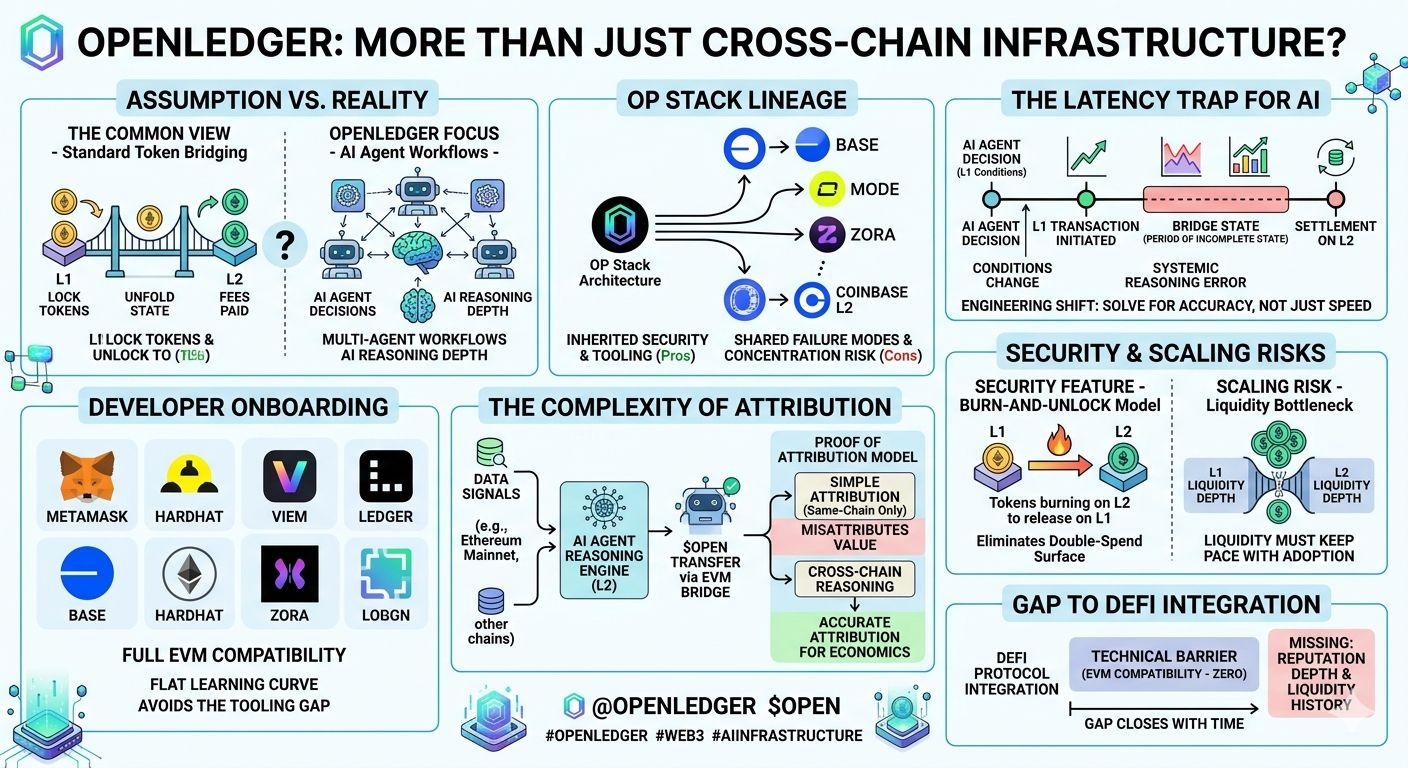
There is a version of cross-chain infrastructure that everyone understands. You lock tokens on one side. You unlock them on the other. Liquidity moves. Fees get paid. Nobody thinks too hard about what is underneath.
I kept assuming @OpenLedger EVM bridge was that version.
The more I read into how it actually works the more that assumption started feeling lazy.
Most people see OP Stack and immediately relax. Base runs on it. Mode runs on it. Zora runs on it. Coinbase's entire L2 strategy runs on it. So when OpenLedger inherits the same bridge architecture the instinct is to categorize it quickly. Proven stack. Familiar tooling. Move on.
That instinct might be right about the infrastructure layer.
I do not think it captures what is actually interesting here.
The shared OP Stack lineage does something unusual for a project this early. It borrows network effects from an ecosystem that already has billions in liquidity and thousands of deployed contracts. The confidence floor is higher than it would be with a custom bridge. But that same shared architecture means security assumptions and failure modes are also shared. Concentration risk travels with the confidence.
That tradeoff is not automatically bad.
It just means the interesting question is not whether the bridge is technically sound. It probably is. The interesting question is what happens when AI agents start moving through it at volume.
Traditional bridge latency is mostly a UX problem. You wait a few minutes, sometimes longer, the transaction settles, you continue. Annoying occasionally. Rarely critical.
For high-frequency AI agent transactions that calculus breaks completely.
If an agent is executing a cross-chain strategy the latency window between initiating a move from Ethereum L1 and confirmation on OpenLedger L2 is not just a wait time. It is a period of incomplete state. The agent made a decision based on conditions that may no longer exist by the time the bridge settles. Multiply that across coordinated multi-agent workflows and latency stops being friction and starts being a source of systemic reasoning error.
That is a different engineering problem than traditional bridge design ever had to solve.
The developer onboarding story is genuinely clean though. Full MetaMask compatibility. Hardhat support. Viem. Ledger. If you have ever deployed anything on Ethereum the learning curve here is nearly flat. That removes one of the usual early-stage barriers where interesting infrastructure dies because integration is too painful.
Most protocols with interesting architecture lose momentum in the tooling gap.
OpenLedger seems to have avoided that problem by not reinventing it.
What gets complicated is the attribution layer. When an AI agent on OpenLedger executes a strategy using the EVM bridge and that decision was influenced by on-chain data from a completely different chain how does Proof of Attribution actually trace that? The bridge moves $OPEN. The reasoning that triggered the move may have been downstream of signals from Ethereum mainnet or another connected ecosystem entirely.
Attribution systems that only track same-chain behavior will systematically misattribute value in cross-chain agent workflows.
If OpenLedger's attribution model cannot follow reasoning chains across bridge events the economic layer starts misfiring precisely in the scenarios where accurate attribution matters most.
The burn-and-unlock withdrawal model handles one part of the security equation well. Burning $OPEN on L2 before releasing on L1 eliminates the classic double-spend surface that has destroyed hundreds of millions in other bridge exploits. That design decision alone signals genuine security awareness rather than speed-to-launch thinking.
Liquidity scaling is where most bridges quietly break down over time. Both sides of a bridge need depth. The L1 side and the L2 side. If OpenLedger's adoption grows faster than liquidity provisioning the bridge becomes a bottleneck that punishes exactly the agents who are using it most.
Markets usually figure this out too late.
And here is the thing that keeps sitting at the back of my mind. Full EVM compatibility means existing Ethereum DeFi protocols could theoretically integrate $OPEN as collateral right now. The technical barrier is not there. What is missing is reputation depth and liquidity history.
That gap closes with time assuming the product holds.
Bridges rarely get written about until something breaks.
Maybe that means the interesting infrastructure gets missed while it is still being built.