
I keep noticing a strange pattern in myself.
The more I read about new crypto or AI projects, the less I react at first. It is not excitement anymore. It is more like a pause. A quiet hesitation before deciding whether something is actually different or just another version of something I have already seen before.
Most things feel familiar now.
Different branding, different wording, same underlying ideas.
That is why I did not expect OpenLedger to stay in my mind for long.
At first, it looked like another concept trying to position itself around AI and blockchain. I have seen enough cycles to know how this usually goes. Big ideas, strong language, early attention, and then slowly the noise moves somewhere else.
But this one did not leave immediately.
It stayed in the background of my thinking in a way I could not fully ignore.
Not because it felt perfect.
Actually, nothing about it felt perfect.
It felt more like a question than a product.
And questions are harder to forget than answers.
The question that stayed with me was not about technology.
It was about people.
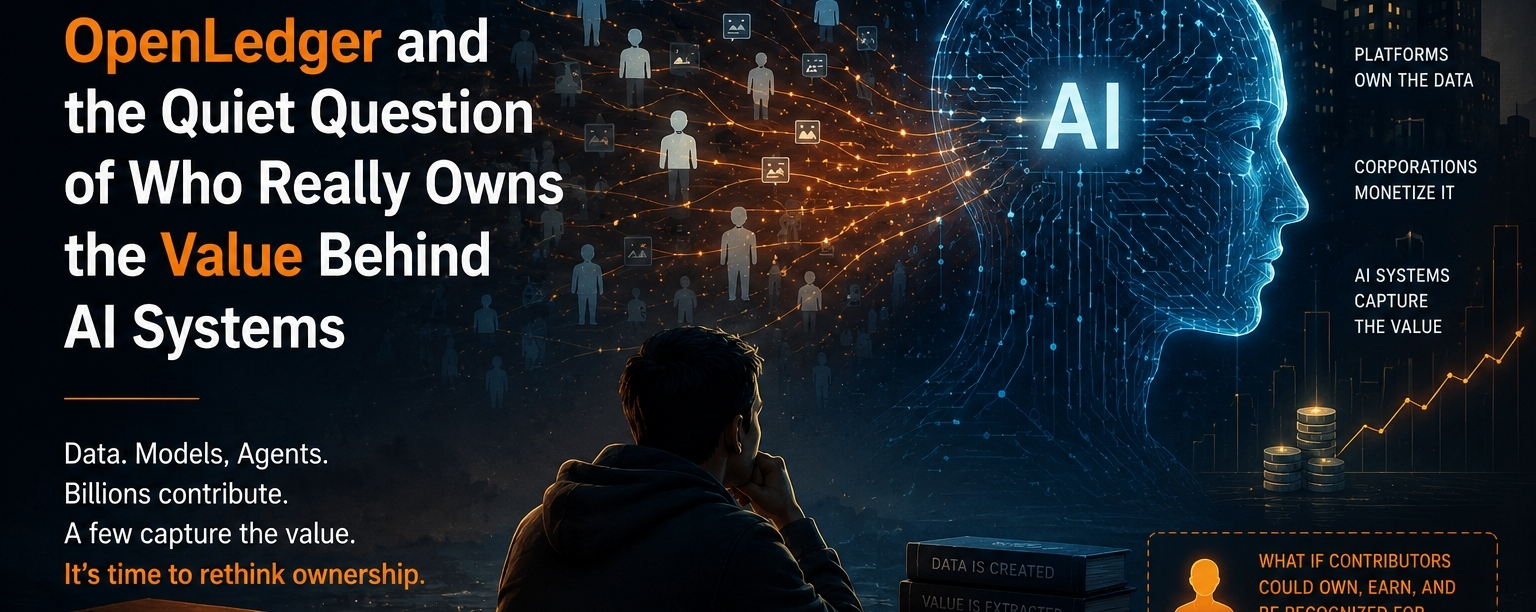
Every day, without really thinking about it, people create an enormous amount of value online.
They write things that help others understand.
They share experiences that save time for someone they will never meet.
They explain problems they were not asked to solve.
They correct information that was almost lost in noise.
Most of this happens without recognition.
Without ownership.
Without anything clearly returning back to the person who created it.
It has been like this for so long that it feels normal.
Almost invisible.
But when AI enters the picture, that normal starts to look different.
Because AI does not create from nothing.
It learns from everything that people have already created.
Every explanation.
Every correction.
Every small piece of human thought that was left scattered across the internet over years.
All of it becomes part of something much larger.
And yet the original contributors rarely remain part of the value that emerges later.
That imbalance is what I keep thinking about.
Not in a dramatic way.
More like a slow realization that builds over time.
I have been in this space long enough to stop trusting excitement.
I have seen enough cycles to know how quickly strong narratives can disappear.
One moment something feels inevitable.
The next moment it is barely mentioned.
That experience changes how you look at new ideas.
You stop asking whether something sounds impressive.
You start asking whether it survives without attention.
Whether it still matters when people stop talking about it.
Whether it depends on hype or on real behavior.
When I think about OpenLedger through that lens, I do not see certainty.
I see a direction.
A direction toward something that has not been properly solved yet.
How value should flow back to the people who create the raw material for intelligence systems.
It sounds simple when written like that.
But in reality, it is not simple at all.
Because systems are already built.
Incentives are already set.
Most people are already used to participating without expecting anything back.
Changing that pattern is not a technical challenge alone.
It is a behavioral one.
And behavior is the hardest thing to change in any market.
Still, there is something about this moment that feels slightly different from earlier cycles.
The rise of AI makes the question harder to avoid.
The more capable these systems become, the more obvious it becomes that human contribution is not a background detail.
It is the foundation.
Without it, nothing works.
And yet the recognition of that foundation still feels incomplete.
Maybe that is where the real tension sits.
Between what is being created and who is being acknowledged.
Between contribution and ownership.
Between value generated and value returned.
I do not know if OpenLedger solves any of this.
Most projects do not solve the full version of the problem they aim at.
But sometimes they sit close to a question that refuses to disappear.
And that alone is worth paying attention to.
Because in this space, attention usually goes to whatever is loudest.
But meaning often sits somewhere quieter.
I find myself less interested in predictions now.
They rarely survive contact with reality.
I am more interested in patterns that keep repeating across different cycles, even when the names change.
Human contribution being extracted quietly.
New systems built on top of it.
Value concentrating somewhere else.
Then the slow realization that something in that structure feels unfinished.
That pattern is older than crypto.
Older than AI.
It is just becoming harder to ignore now.
And that is probably why OpenLedger stayed with me longer than expected.
Not because it answered anything.
But because it pointed directly at something I think a lot of people feel, even if they do not say it out loud.
That the systems we build are getting smarter.
But the question of who actually benefits from that intelligence is still not fully resolved.
And until that changes, the question will keep coming back.