
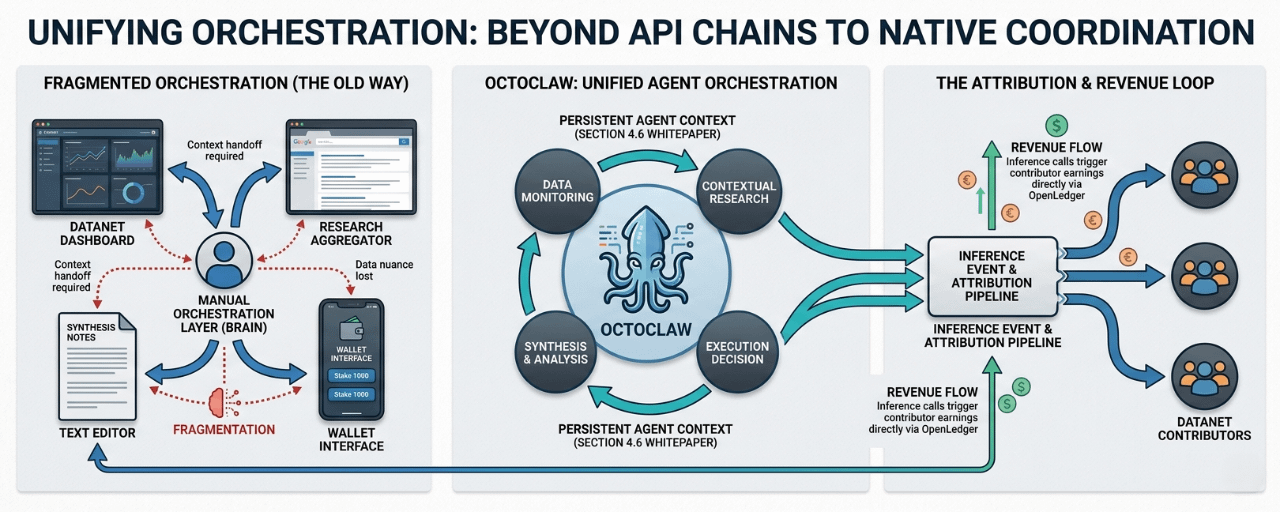
about eight months ago i was trying to do something that should have been straightforward.
monitor a specific DataNet's influence sc0re. pull research context from two external sources about the domain it covered. generate a brief analysis. execute a staking decision based on that analysis.
four steps.one compound task.
i had the tools to do each step individualy.a dashboard for monitoring. a research agregator. a text editor for synthesis. a wallet interface for execution.all perfectly functional in isolation 😂
the actual work took me forty minutes. not because any individual step was hard. because i was the orchestration layer. my brain was managing the context handoffs between four seperate tools that had no awareness of each other. every time i moved from one to the next i lost something - a nuance ,a data point,,a connection i'd noticed two steps back that was gone by the time it became relevant.
the coordinasion overhead was larger thanthe cognitive work of the actual decison.
i think about that afternoon constantly when i read about OctoClaw...
because OctoClaw as an orchestration layer is sollving precisely that problem. not by building better individual tools.by eliminating the space between them.
here's what orchestrasion actually means in the OpenLedger context specifically...
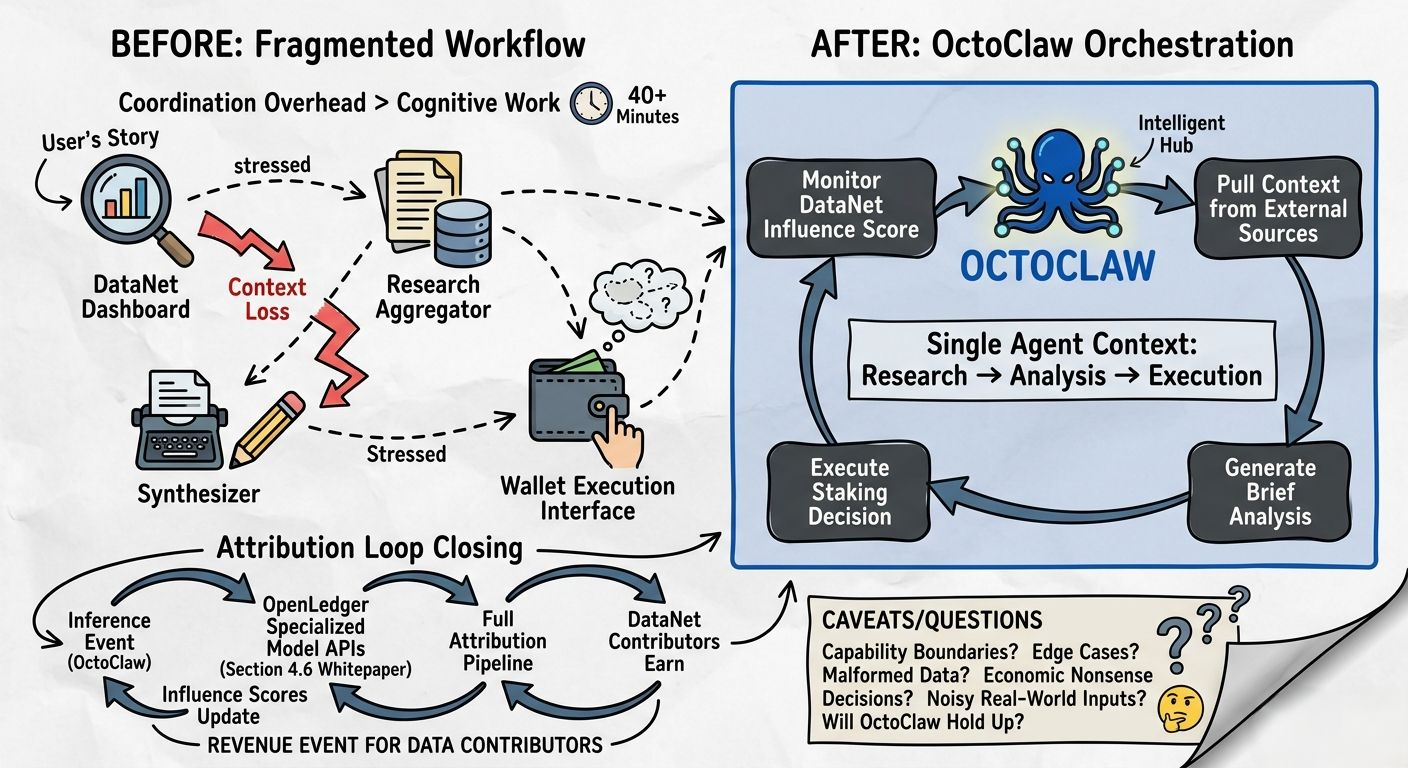
OctoClaw connects to OpenLedger's specialized model APIs- the same APIs described in Section 4.6 of the whitepaper that allow fine-tuned models to power agent decison-making. when you assign OctoClaw a compound task, it doesn't hand off between tools. it maintains a single agent context across the entire workflow.the research it conducts informs the analysis it generates. the analysis informs the execution parameters it proposes. the execution triggers attribution events that flow back to the DataNet contributors whose data p0wered the model that informed the decison.
every step connected. nothing dropped between handoffs.
and the attribution loop closing through OctoClaw is something i find genuinly remarkable...
when OctoClaw calls a specialized OpenLedger model to generate analysis or inform a decison, that inference event triggers the full attribution pipeline. influence scores fire. DataNet contributors earn fromthecall.the agent isn't seperate from the economic layer - it runs through it. every automated workflow OctoClaw executes is simultanously a revenue event for the data contributors who trained the models it relies on.
i've spent enough time in the AI tooling space to be skepticel of orchestration claims. most "agents" are just API chains dressed up with a chat interface. the context doesn't actually persist.the tools don't actually coordinate.you end up with a slightly more automated version of the same fragmentation problem you started with...
what makes OctoClaw's position diferent is that it's not trying to orchestrate generic external tools.it's orchestrating a stack that was architected specifically for attribution, provenance, and on-chain execution from the ground up.the coordination isn't retrofitted. it's native.
the open question for me is always capability boundaries.orchestration agents are impressive untill they hit an edge case the designer didn't anticipate. what happens when a DataNet influence score behaves unexpectedly.what happens when an external data source returns malformed context.what happens when the staking decision the agEnt proposes is technically valid but ecconomicaly nonsensical given information it didn't have access to...
honestly dont know if OctoClaw's orchestration holds up elegantly across complex multi-step workflows with noisy real-world inputs, or if the coordination breaks down in exactly the messy situations where it would matter most?? 🤔
