
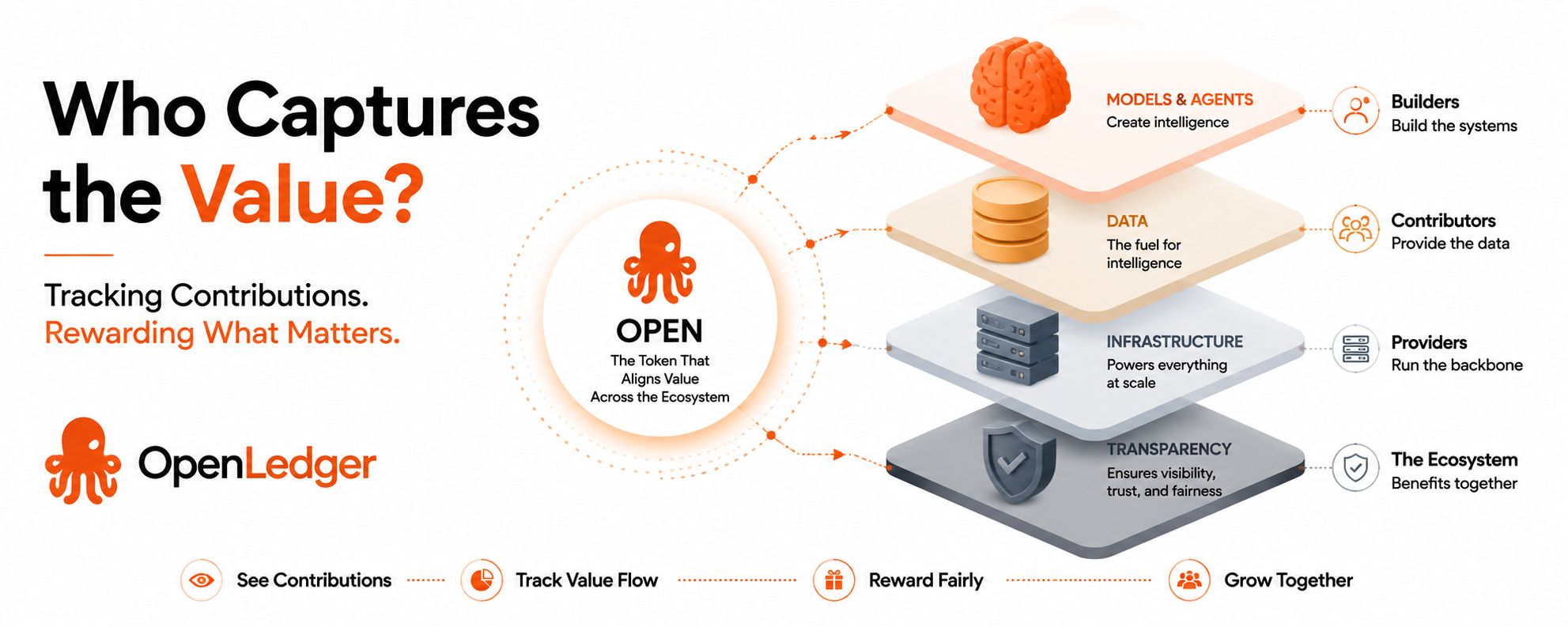

There is something interesting happening in the tech world right now. The technology is moving fast, the hype is even faster, but one question keeps coming back again and again in my mind: who actually captures the value in all of this?
Some people say it’s the model builders. They created the intelligence, so they should earn the most. Others strongly disagree and argue that without data, none of this would exist at all. Then there are those who point to infrastructure, saying nothing runs without chips, servers, storage, and electricity. The more I listen, the more it feels like everyone has a valid point… but no one has the full answer.
That confusion is exactly where new ideas start to appear, and this is where OpenLedger started getting my attention.
Instead of focusing only on who builds the model or who owns the platform, OpenLedger is trying to answer a more uncomfortable question: how do I actually track who contributed what in the system in the first place? Because right now, most of the system is invisible. Data goes in, intelligence comes out, and the people behind the data usually disappear from the story.
This is where recent thinking around OpenLedger feels important to me. The project is built around the idea that contribution should not be hidden. If data improves a system, that contribution should be visible. If a dataset adds value, there should be a way to recognize it. If a system grows because of collective input, then the rewards should not stay locked in one place.
And honestly, this idea feels closer to reality than most people admit.
Because if I look at the market today, it already feels crowded at the top. Big model builders are everywhere, competition is increasing, and performance differences are shrinking in many areas. What used to feel like a strong advantage is slowly turning into a standard expectation. That is usually the moment when markets start looking for value somewhere else.
OpenLedger’s approach connects directly to that shift for me. Instead of focusing only on building bigger systems, it focuses on building a structure where data, models, and agents can actually interact with clear rules of contribution. In simple words, it is trying to bring fairness into a system that has mostly operated without visibility.
Recent discussions around the project also highlight something even more important: transparency. In this space, trust is becoming a real problem. People are using systems they don’t fully understand, built on data they can’t see, with outputs they can’t always verify. OpenLedger’s direction is aimed at making that chain more open, so the flow of value can actually be tracked instead of guessed.
And this is where things start to feel more serious than just theory.
Because data is not just “input” anymore in my view. It is becoming a real asset. Every improvement, every smarter output, every system behavior is connected back to data in some way. But the strange part is that the people contributing that data rarely see any return. That gap is what OpenLedger is trying to highlight and possibly fix.
At the same time, I cannot ignore the role of infrastructure. This entire system is not light or cheap. It needs massive computing power, storage systems, and constant scaling. That means infrastructure providers naturally sit at a powerful point in the system. And OpenLedger’s idea is not to replace that reality, but to connect it into a more visible structure where each layer can be seen and valued properly.
Now, the OPEN token becomes part of this bigger picture.
From my perspective, the token is not just a symbol. It represents participation inside an ecosystem where contributions are meant to be tracked and rewarded. As more activity moves through the network, the idea is that OPEN becomes a way to align incentives between people who provide data, people who build systems, and people who support infrastructure.
In simple terms, it tries to turn a complex black-box system into something where value flow is more readable.
And this is why attention around OpenLedger is growing in my opinion. Not because it is promising something unrealistic, but because it is pointing at something the industry is already struggling with: nobody fully agrees on how value should be shared.
Some believe the model layer will always dominate. Others think data will become the most important asset of the next decade. A few argue infrastructure will quietly control everything in the background. But the truth might be more complicated than any single answer.
Maybe value is not going to sit in one place at all.
Maybe it will move across layers depending on where the real bottleneck is at that time.
And that is the part OpenLedger is trying to capture. Not by claiming certainty, but by building a system where contributions can actually be seen, measured, and rewarded instead of ignored.
As this technology continues to grow, these questions are not going away for me. They are only going to get louder. Who owns the data? Who controls the output? Who gets paid when systems improve? And most importantly, how do I see a fair system that people can actually trust?
OpenLedger sits right inside that conversation, and whether it becomes a major piece of the future economy or not, it is already part of a bigger shift happening across the industry.
Because at the end of the day, the real debate is not just about technology.
It is about value, visibility, and who the future actually rewards.
@OpenLedger #openledger #OpenLedger
