
it was a lending protocol. about two years ago.
nothing dramatic hapened on the surface. no major announcment. no celebrity endorsement. no airdrop campaign. just a quiet week where the TVL chart started doing something it hadn't done before-compounding upward without a coresponding spike in new user acquisition 😂
i spent time trying to understand what had changed. eventually traced it to a single structural shift. their liquidity incentive loop had quietly connected to their governance participation loop.liquidity providers were earning governance tokens. governance token holders were voting to increase liquidity rewards. increased rewards were attracting more liquidity. more liquidity was making the protocol more useful.more usefulness was attracting more governors with genuine skin in the game.
two loops. one connection. the whole thing started self-reinforcing in a way no individual feature could have produced alone.
i've been looking for that same dynamic in every protocol i study sincethen...
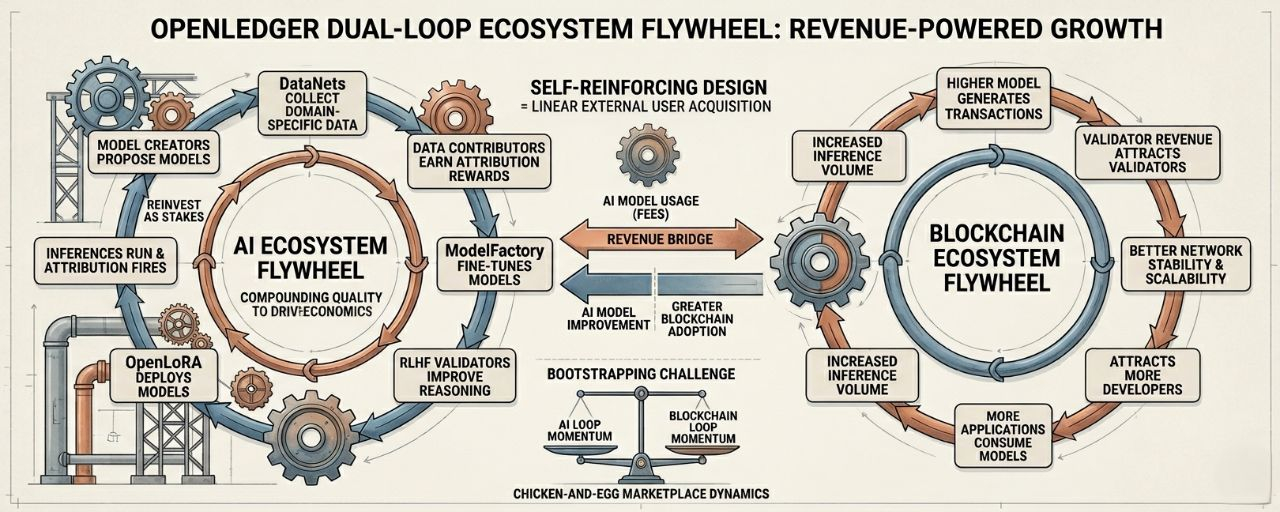
and the OpenLedger flywheel is the most deliberatley architected version of it i've encountered. Section 6 of the whitepaper lays it out explicitley -two distinct growth lOops, the AI ecosystem flywheel and the blockchain ecosystem flywheel, dessigned to reinforce each other through a specific set of connection points.
here's how the AI ecosystem loop actualy works...
model creators propose specialized models. they collect domain-specific data through DataNets.DataNet contributors upload high-quality data and earn attribution rewards. models get fine-tuned on that data using ModelFactory. RLHF validators improve model reasoning and earn stake incentives. models get deployed through OpenLoRA.,inferenses run. atribution fires.contributors earn. those earnings get reinvested as stakes into new DataNet contributions.higher-quality DataNets attract more model proposals.the loop continues and compounds.
every step feeds the next. no step is terminal
the blockchain ecosystem loop is seperate but connected...
higher model usage generates more on-chain transactions. more transsactions means more validator revenue. more validator revenue attracts more validators.more validators means better network stability and scalability. better infrastructure attracts more developers. more developers build more applications consuming OpenLedger models.more consumption means more inferenses.more inferenses means more attribution events. more attribution events means more contributor rewards. more contributor rewards means more DataNet contribution. the AI loop acceleratse again.
the connection point between the two loops is revenue...
blockchain transaction fees from AI model usage flow back into funding AI innovation. AI model improvements drive greater blockchain adoption which generates more fees. the whitepaper describes this as mutual reinforcment -each ecosystem strengthening the 0ther through the economic bridge between them.
i find this architecturaly compelling in a way that most protocol designs are not...
most protocols have one growth loop.attract users, generate fees, use fees to attract more users.linear.fragile. dependent on continuous external user acquisition to maintain momentum.
OpenLedger's design creates a situation where AI quality improvement and blockchain adoption reinforce each other without requiring the same external growtth input at every stage. a better model means more usage means more fees means more infrastructure means more developers means more models. the compounding is internal.
the thing i keep stress-testing is the botstrapping problem though...
a flywheel only works once it's spinning.getting it to the minimum viable velocity requires simultaneous momentum in both loops at once. if DataNet contribution is thin, model quality suffers.if model quality suffers, inferense volume stays low.if inferense volume stays low, contributor rewards stay low.if rewards stay low,DataNet contribution stays thin.the loop can stall at any point and the stall propagates in both directions...
honestly dont know if OpenLedger has enough genuine ecosystem momentum right now to get the flywheel past the bootstrapping threshold, ,or if the elegance of the design exists mostly on paper while the practical early-stage dynamics are still d0minated by the same chicken-and-egg problems every two-sided marketplace faces?? 🤔
