I've been thinking about something lately.
Every AI discussion seems to revolve around the same things: bigger models, more compute, faster inference, better performance.
And don't get me wrong those things matter.
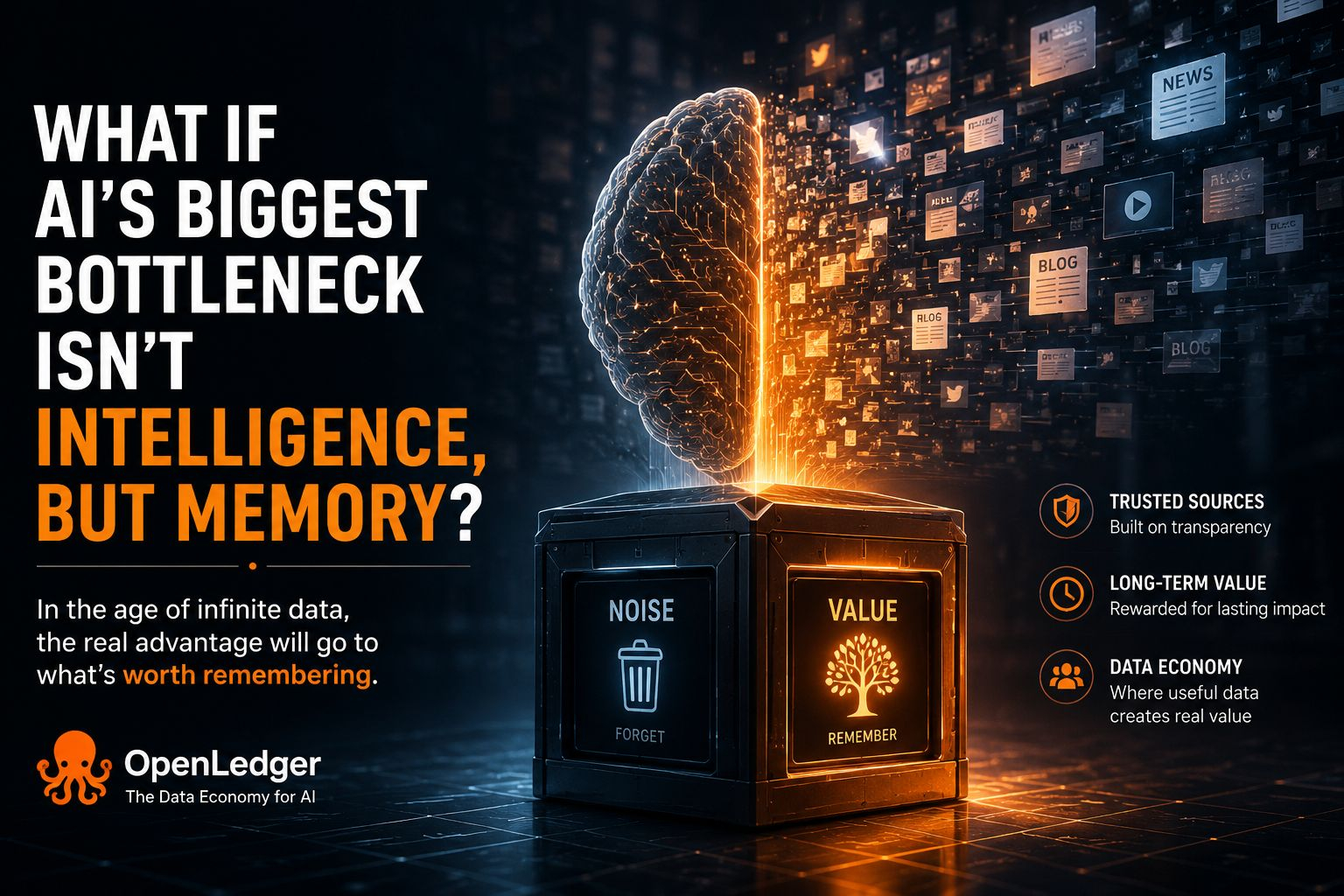
But the more I watch the space evolve, the more I feel like everyone is focused on what AI can learn while spending very little time thinking about what AI should remember.
That's a very different problem.
When people hear the word "memory," they usually think about storage. Databases. Hard drives. Context windows.
I'm starting to think that's not the interesting part.
The interesting part is deciding which information deserves to stay relevant.
Because information is cheap.
Useful information isn't.
The internet is already overflowing with data. Every second, more articles, tweets, videos, research papers, and datasets are added to an already massive pile.
The challenge isn't finding information anymore.
The challenge is figuring out what still matters six months from now.
Or a year from now.
Or five years from now.
That's why OpenLedger caught my attention.
Not because it's another AI project claiming to build smarter models.
We've all seen enough of those.
What interests me is the idea that data contributors might eventually be rewarded not simply for contributing information, but for contributing information that continues creating value over time.
That's a subtle difference, but it changes everything.
Think about how the internet evolved.
In the early days, anyone could publish anything.
The problem wasn't content creation.
The problem was knowing what deserved attention.
Search engines solved part of that problem by creating systems that rewarded relevance.
Suddenly, not all information was treated equally.
The most useful information rose to the top.
I wonder if AI is heading toward a similar moment.
Except instead of competing for visibility, contributors may end up competing for longevity.
Which datasets remain useful?
Which sources keep improving outputs?
Which information continues influencing decisions long after it's first introduced?
Those questions feel far more important than people realize.
Because once AI starts playing a bigger role in real-world decisions, memory becomes an economic asset.
Imagine an AI system helping allocate capital, evaluate risk, or make business recommendations.
At some point, someone will want to know why that decision was made.
And eventually they'll ask something even more important:
Where did that knowledge come from?
Who contributed it?
Can it be trusted?
The industry talks endlessly about training models.
I think the next conversation might be about training memory.
Not storing everything forever.
Not remembering everything equally.
But creating systems where information earns its place over time.
The reality is that most data doesn't age well.
Most information loses value surprisingly fast.
Only a small percentage continues proving itself again and again.
That's why I keep coming back to the idea that retention could eventually become a market of its own.
Not all knowledge deserves the same influence.
Not all data deserves the same weight.
And maybe the winners in AI won't simply be the ones building the smartest systems.
Maybe they'll be the ones building systems that can identify what is worth remembering.
That's a much harder problem.
And honestly, it might be the more important one.