
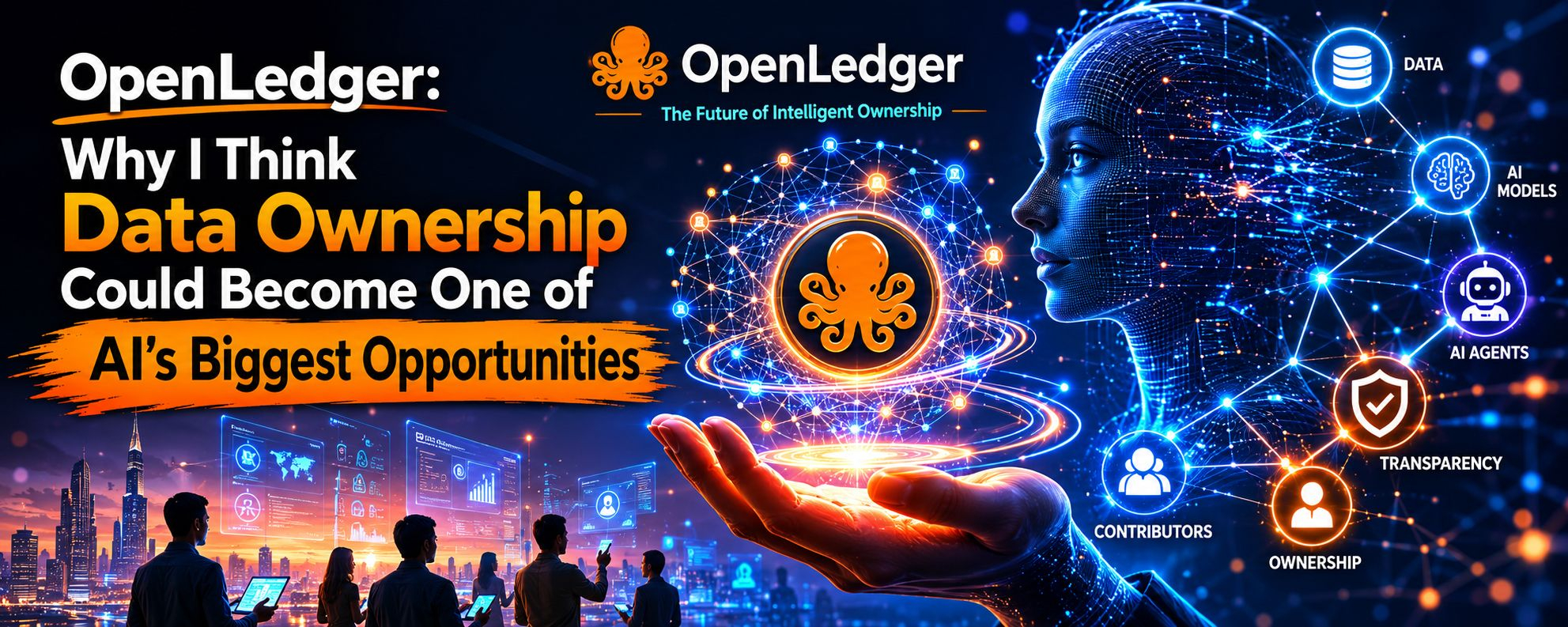

Over the past year, I've spent a lot of time exploring AI projects, decentralized networks, and the technologies shaping the future of the digital economy. One thing I've noticed is that most conversations focus on AI models themselves. People talk about performance, capabilities, and how quickly artificial intelligence is evolving.
But the more I research the industry, the more I believe that data may be even more important than the models.
Every AI system depends on information. Without data, there is no training, no learning, and no intelligence. Whether it's text, images, market activity, research, or user interactions, data forms the foundation of modern AI. Yet despite its importance, the people contributing valuable information often receive little recognition for their role in the process.
This is one of the reasons OpenLedger caught my attention.
Rather than focusing solely on building AI applications, OpenLedger is exploring how data, AI models, and intelligent agents can operate within a transparent ecosystem where contributions are easier to track and verify.
Why Data Matters More Than Ever
In my view, the future of AI will not be determined only by who builds the largest model. Access to high-quality and specialized data may become an even greater competitive advantage.
Today, companies are searching for unique datasets that can improve model performance and provide insights that general-purpose systems cannot offer. As AI becomes more advanced, the demand for trusted and verifiable information is likely to increase.
This creates an important challenge.
How can contributors remain connected to the value they help create?
Traditional systems were designed to store information, but they were not necessarily designed to track contribution, attribution, or economic participation. As a result, many contributors become invisible once their data enters larger systems.
I think this is one of the biggest problems the AI industry will need to solve in the coming years.
What Makes OpenLedger Interesting
What I find interesting about OpenLedger is its focus on transparency and accountability.
Instead of treating data as a resource that disappears into a training process, the project aims to create infrastructure where contributions can be recorded and verified. The idea is to build an ecosystem where participants have greater visibility into how intelligence assets are created and used.
From my perspective, this approach reflects a broader shift taking place across the AI industry.
The conversation is gradually moving beyond model performance and toward questions about ownership, attribution, and value distribution. These topics may become increasingly important as artificial intelligence becomes integrated into more industries.
OpenLedger appears to be positioning itself around that long-term trend.
AI, Blockchain, and Coordination
When I first started learning about blockchain technology, I thought its primary purpose was financial transactions. Over time, however, I realized that blockchains can also function as coordination systems.
They allow multiple participants to interact according to shared rules while maintaining transparency and accountability.
This is where I think OpenLedger's approach becomes particularly relevant.
AI ecosystems involve many different participants, including developers, data providers, businesses, and increasingly autonomous AI agents. Coordinating all of these contributors can be difficult without reliable systems for tracking activity and ownership.
By combining blockchain infrastructure with AI-focused applications, OpenLedger is attempting to create a framework where participation can be measured more effectively.
The Growing Role of AI Agents
Another aspect of the project that I find interesting is its focus on AI agents.
Many experts believe autonomous AI agents will play a major role in the next phase of technological development. These systems may eventually perform research, manage workflows, analyze information, and interact with digital services on behalf of users.
As these agents become more capable, questions about accountability and transparency will become increasingly important.
Who created the agent?
What data was used?
How is value generated and distributed?
I believe projects exploring these questions today may have an advantage as the AI industry continues to mature.
Challenges Ahead
Of course, every ambitious project faces challenges.
Having a strong vision is only the first step. Long-term success depends on adoption, utility, and the ability to create real value for participants.
In my opinion, OpenLedger's biggest challenge will be building a network that attracts both contributors and users. A successful ecosystem needs high-quality resources as well as demand from developers and applications.
Without that balance, even innovative ideas can struggle to achieve long-term growth.
Final Thoughts
After researching OpenLedger, I see it as more than just another blockchain project connected to AI.
What stands out to me is its focus on the economic side of intelligence. As artificial intelligence continues to expand, ownership, attribution, and contributor recognition may become some of the most important topics in the industry.
I believe the future AI economy will require systems that not only support innovation but also encourage participation through transparency and accountability.
Whether OpenLedger ultimately achieves its vision remains to be seen. However, I think the project is asking an important question that the entire industry will eventually need to answer:
As AI creates more value across the digital economy, how can contributors remain connected to the value they help create?
For me, that is what makes OpenLedger a project worth watching.
@OpenLedger #OpenLedger #openledger $OPEN
