
@OpenLedger There are days in the market that don’t really feel like anything. No panic, no excitement, no obvious direction—just a kind of flat silence where you keep checking things out of habit more than intention. That was the kind of mood today. Charts didn’t say much, sentiment didn’t shift anywhere meaningful, and it felt easier to drift than to decide. In that slow drift, I ended up looking at OpenLedger and the $OPEN narrative, mostly because it kept popping up in passing conversations. At first it looked like another version of a familiar idea: a data marketplace where people contribute information, AI systems consume it, and value gets distributed back into the ecosystem. Simple loop, clean logic, easy story. The kind you usually scroll past without thinking too deeply because it sounds complete on the surface.
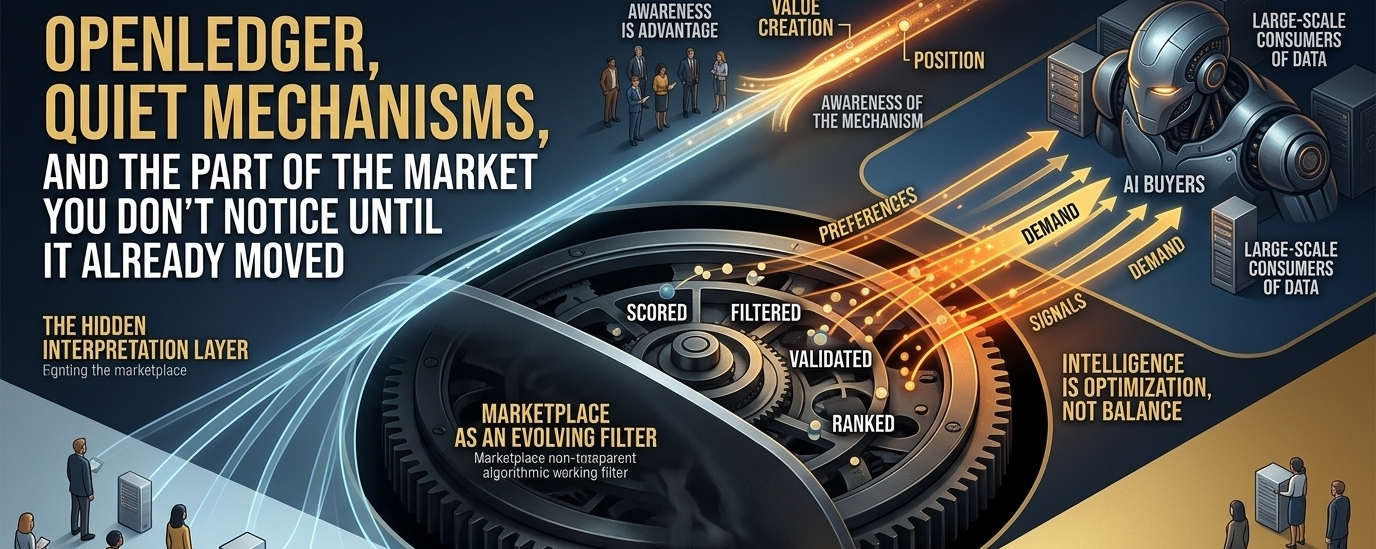
But the longer I stayed with it, the more the simplicity started to feel like a layer on top of something more structural. The real shift in perspective came when I stopped focusing on the idea of “buying and selling data” and started paying attention to what happens before any exchange actually takes place. Because nothing in that system is truly direct. Contributions don’t just go in and get priced. They get processed first—scored, filtered, validated, ranked. And that part is where things start to quietly change shape. The marketplace doesn’t just connect supply and demand; it interprets supply before demand even sees it. That interpretation layer is not equally visible to everyone participating in it, especially not to the people contributing data. Most contributors experience the system as if they are directly plugged into a fair exchange, but in reality there is a layer in between deciding what matters more, what gets amplified, and what fades out.
That distinction is small in wording but large in consequence. Because once you realize that the system is not only exchanging value but also deciding how value is seen, the entire idea of participation shifts. The intelligence in an “intelligent marketplace” is not neutral by default. It is trained on objectives, and those objectives tend to lean toward whoever is creating the strongest demand signal. In this case, that usually means AI buyers, large-scale consumers of data, systems that care about efficiency, precision, and optimization above everything else. So the system becomes very good at serving the side that consumes, while the other side slowly learns that participation alone does not guarantee understanding, and understanding is what actually determines position.
That is where it starts to feel less like a marketplace in the traditional sense and more like an evolving filter. People contribute thinking they are early, thinking early equals advantage, but early participation without clarity of the internal ranking logic is not really advantage—it is just early input into a system that has not yet revealed how it will value that input. And that gap between contributing and understanding is where outcomes quietly diverge. Some participants eventually learn how the scoring behaves, how weighting shifts, what gets amplified, what gets ignored. Others stay at the surface level, assuming consistency in a system that is actually adaptive underneath.
It reminded me of how often people experience systems like decentralized exchanges in the beginning. Everything feels participatory, almost democratic in tone. You provide liquidity, you engage, you feel like you are part of the core mechanism. But later, once you actually trace how value flows through routing, timing, and positioning, you start noticing that the architecture was never neutral in practice. Not malicious, not necessarily designed to exclude, but structured in a way where awareness of the mechanism itself becomes a form of advantage. And that advantage is rarely evenly distributed because most people never feel the need to look that deeply while everything still appears to be working.
The uncomfortable question around OpenLedger is not whether the idea of a data marketplace works. It probably does in some form. The question is what happens to fairness when the definition of “quality” is continuously shaped by the largest consumers inside the system. Because in any two-sided network, the side with the most consistent demand tends to influence the scoring logic over time, even without explicit control. Preferences become signals, signals become training data, and eventually the system reflects those patterns back as “objectivity.” At that point, intelligence is still there, but it is no longer independent. It is aligned with the strongest behavioral input it receives.
That is also where the language around it starts to matter more than people realize. Calling something an “intelligent marketplace” creates a sense that the system has reached a kind of resolved fairness, like intelligence naturally implies balance. But intelligence in systems is not balance—it is optimization. And optimization always needs a target. The question is never whether the system is getting smarter, but what it is getting smarter at, and who benefits from that direction over time.
What feels unresolved in all of this is not the existence of the marketplace or even the legitimacy of the model. It is the transparency of the layer where decisions actually happen. If contributors can eventually see how scoring works, understand how ranking shifts, and adapt in real time, then the system becomes something closer to an open skill-based economy. But if that layer remains partially hidden, then participation becomes something else entirely—less like contribution to a shared system and more like input into a machine whose internal logic is only readable from the inside.
And that is the part I keep coming back to. Not the idea of whether this works in theory, but whether the people feeding the system ever truly get to see how their value is being interpreted while it is still being formed.