
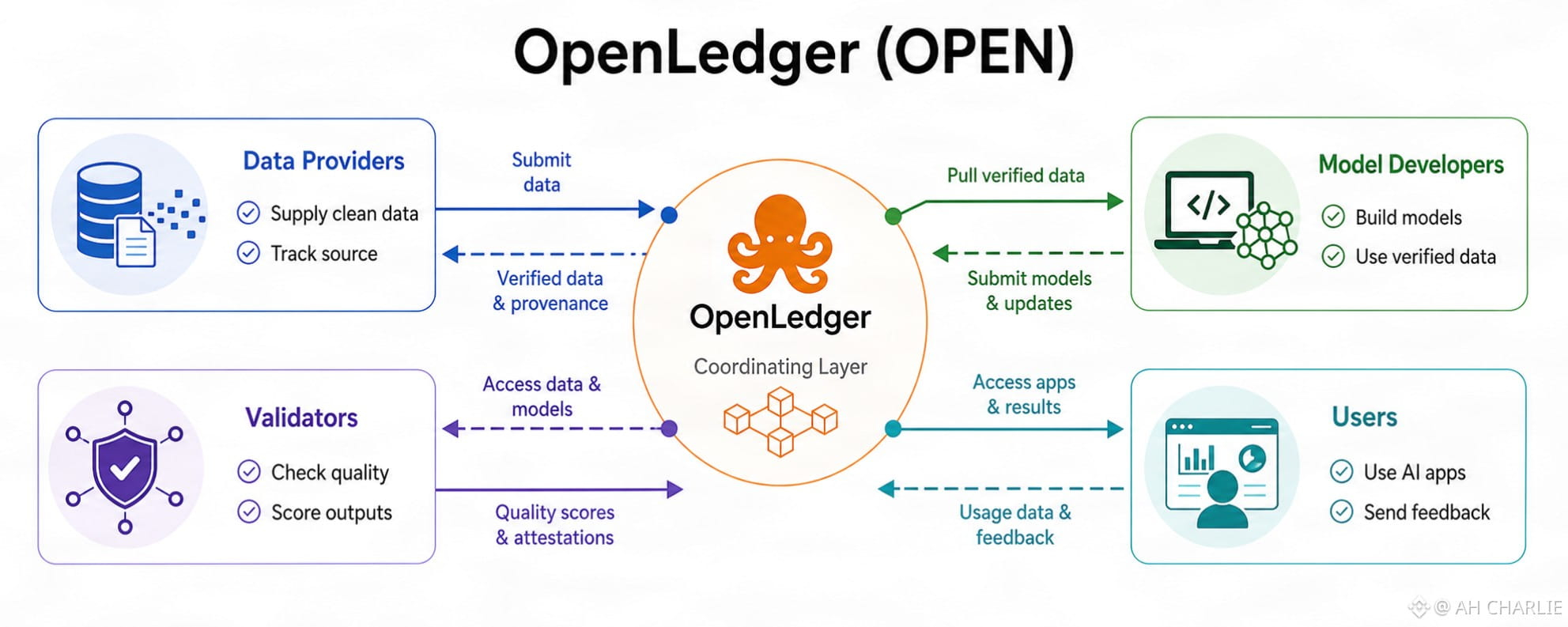
I’ve sat through enough crypto decks to know when a pitch is just hot air in a neat suit. At first, @OpenLedger felt like one more AI-chain pitch trying to sound deep. Data, models, proof, users, token flow. Fine. I’ve heard that chant. Then I looked at what it’s trying to link.That’s where it got less cute and more worth a hard look.
OpenLedger is built around a plain pain point, AI needs data, but raw data by itself is a mess. Some of it is stale. Some is junk. Some is good but hard to track. Data providers bring fuel to system, but fuel still needs a meter. With OpenLedger, data isn’t just tossed into a black box. It has a role. It can be checked, scored, and tied back to source. That matters because in AI, bad input doesn’t just waste time. It bends output.
Model devs sit on next layer. They’re not here for vibes. They need clean data, clear rights, and a way to build without begging for closed stacks. OpenLedger gives them a lane to tap data in a more open way while still keeping track of who brought what. That’s a big deal, but not magic. It still comes down to how good data flow is, how fair rules are, and whether devs can ship work that real users touch.
They’re not mascots. They’re check posts. In this setup, validators help keep data and model work from turning into trust-me-bro sludge. They help review, verify, and keep score so network isn’t just run by loud claims. In crypto AI, that’s where many plans break. If no one checks, spam wins. If checks are weak, fake value leaks in.
Users sit at end of chain, but they’re not just end points. They’re final stress test. If apps built on OpenLedger don’t help users do real work, whole loop gets soft. Data providers won’t care. Devs won’t stay. Validators won’t mean much. $OPEN may sit at center of that loop, but token alone can’t save weak use.
OpenLedger’s idea makes sense because it tries to tie four groups that often move like strangers. Data providers want credit. Devs want raw stuff they can use. Validators want rules they can enforce. Users want tools that don’t waste time.
But if OpenLedger can keep that loop tight, fair, and hard to game, it has a real shot at being more than AI-chain talk. Not because of buzz. Because good markets need pipes, checks, and real demand. That’s where I’m watching.
