
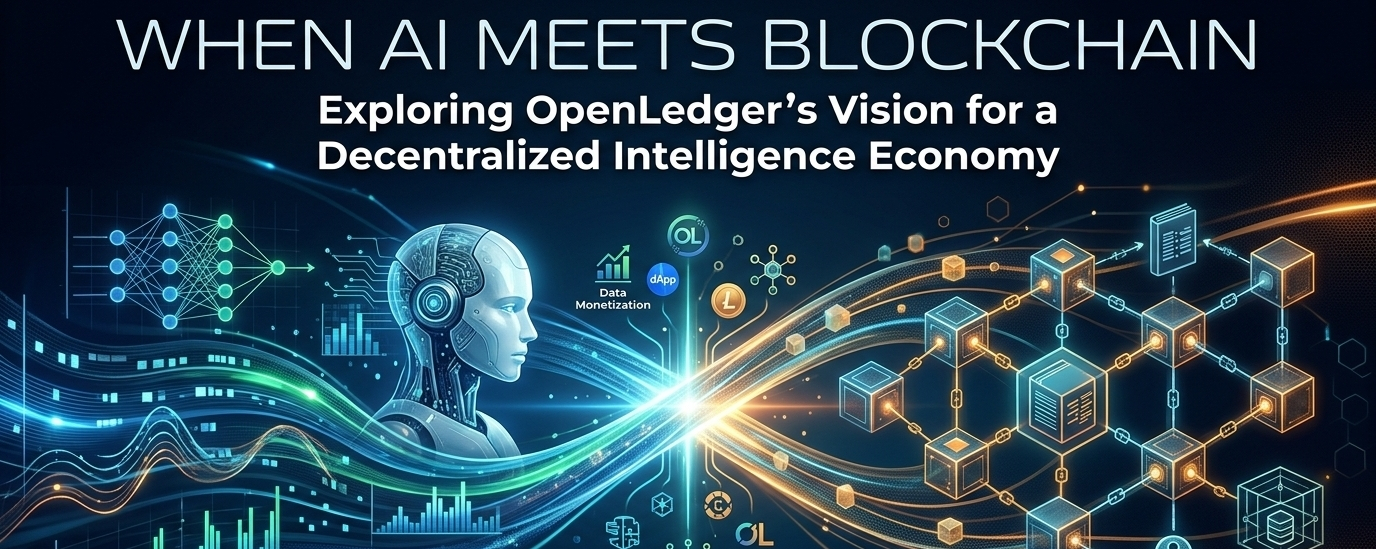
I’ve been thinking about how quickly artificial intelligence has moved from being a futuristic concept to something that quietly influences everyday life. Whether it’s the recommendations we receive online, the tools helping people write, create, analyze, or automate tasks, AI has become deeply connected to the digital world around us. At the same time, another technology has been evolving on a parallel path—blockchain. For years, these two fields seemed to exist in separate conversations, but recently I’ve found myself wondering what happens when they begin to intersect in a meaningful way. More specifically, what happens when data, AI models, and intelligent agents become assets that can be owned, exchanged, and monetized within decentralized systems?
That question naturally leads me to concepts like OpenLedger, an AI blockchain designed around the idea of unlocking liquidity for data, models, and agents. The idea sounds ambitious at first, maybe even a little abstract. Yet the more I think about it, the more it feels like an attempt to address a problem that has existed for a long time in the digital economy.
Today, data is often described as the new oil, but I sometimes wonder whether that comparison misses something important. Oil has established markets, clear ownership structures, and systems for valuation. Data, on the other hand, is generated constantly by individuals, businesses, devices, and applications, yet much of its value remains trapped within isolated platforms. People create information, contribute knowledge, train systems indirectly, and generate digital activity every day, but the economic benefits often flow toward a relatively small number of centralized entities.
An AI blockchain framework introduces an interesting possibility. Instead of data remaining locked within individual organizations, it could become part of a broader ecosystem where contributors, developers, and AI systems participate in a shared economic network. In simple terms, it is almost like transforming digital intelligence into something that can move through an economy rather than staying trapped inside silos.
I sometimes compare it to a marketplace in a city. Imagine hundreds of skilled craftspeople producing valuable goods, but each person is isolated behind closed doors. Their work exists, but buyers cannot easily discover it, and creators struggle to capture fair value. A functioning marketplace changes that dynamic by creating visibility, trust mechanisms, and exchange opportunities. In a similar way, an AI blockchain ecosystem aims to create a marketplace not for physical products, but for data, models, and intelligent services.
The concept becomes even more interesting when thinking about AI models themselves. Building useful AI systems requires enormous amounts of data, computational resources, expertise, and continuous refinement. Traditionally, these models are owned and controlled by specific organizations. But what if smaller contributors could participate as well? What if individuals, research groups, or specialized communities could contribute valuable datasets or niche AI models and receive compensation based on the value they create?
In theory, this could create a more inclusive digital economy. Rather than concentrating innovation in a few large organizations, value could potentially be distributed across broader networks of contributors. Someone with specialized medical knowledge, agricultural expertise, language datasets, or industry-specific information might find ways to participate in AI ecosystems that previously seemed inaccessible.
Of course, theory and reality are often two very different things.
One question I keep coming back to is trust. Blockchain systems are frequently praised for transparency, but transparency alone does not automatically solve every problem. How do participants verify the quality of data? How can a network determine whether a model genuinely performs as claimed? How do users distinguish useful AI agents from ineffective ones?
These questions become even more important as AI systems grow increasingly complex. A decentralized environment may reduce dependence on centralized gatekeepers, but it also introduces new challenges around validation, reputation, and accountability. In many ways, building trust at scale may prove just as difficult as building the technology itself.
Then there is the issue of adoption. Technology enthusiasts often understand concepts like tokenized assets, decentralized networks, and AI marketplaces, but everyday users typically care about practical outcomes rather than technical architecture. They want tools that are easy to use, reliable, affordable, and capable of solving real problems.
Yahan par asli challenge shuru hota hai.
A sophisticated blockchain infrastructure means very little if the user experience remains complicated. People generally do not wake up in the morning wanting to interact with cryptographic protocols. They want solutions that work seamlessly in the background. If AI blockchain systems hope to achieve mainstream relevance, they will likely need to hide much of the underlying complexity and focus instead on delivering clear value.
Scalability presents another layer of uncertainty. AI workloads can be computationally intensive, while blockchain networks often face limitations related to speed, storage, and transaction costs. Combining these two technologies creates exciting possibilities, but it also raises difficult engineering questions. Can decentralized infrastructures handle the demands of increasingly sophisticated AI systems? Can they remain efficient while maintaining security and transparency? The answers are still evolving.
At the same time, I find it difficult to ignore the potential upside. As AI becomes more integrated into society, questions about ownership and value distribution become increasingly important. If data contributes to training intelligent systems, should contributors receive some form of economic participation? If AI agents perform useful work autonomously, how should that value be measured and distributed? If models continuously improve through collective contributions, who benefits from the resulting growth?
These are not merely technical questions. They are economic and social questions as well.
What makes concepts like OpenLedger interesting is that they attempt to create infrastructure for addressing these questions before they become even more significant. Rather than viewing AI solely as a technological achievement, they encourage us to think about the surrounding economy—the incentives, ownership structures, marketplaces, and governance systems that may shape how intelligent technologies evolve.
Still, I think it is important to remain realistic. Not every ambitious technology vision succeeds. History is full of innovations that looked compelling on paper but struggled to gain practical traction. Regulatory uncertainty, market conditions, technical limitations, and human behavior all influence outcomes in ways that are difficult to predict.
Perhaps the most useful perspective is neither blind optimism nor excessive skepticism. Instead, it may be worth viewing AI blockchain ecosystems as ongoing experiments. They are attempts to explore whether decentralized networks can support new forms of intelligence-driven economic activity. Some ideas will work, others will fail, and many will likely evolve in unexpected directions.
As I continue thinking about OpenLedger and similar concepts, what stands out most is not any single feature or technological promise. It is the broader question they represent. We are entering a period where data, models, and autonomous agents may become some of the most valuable digital resources in existence. The systems we build today could influence who owns that value, how it moves through economies, and who ultimately benefits from the growth of artificial intelligence.
Whether AI blockchains become foundational infrastructure or remain niche experiments is still an open question. But the conversation itself feels increasingly important. The intersection of AI and blockchain is no longer simply about technology; it is about creating frameworks for participation, ownership, and value creation in a world where intelligence itself is becoming a digital asset. And the more I reflect on that possibility, the more it feels like a subject that deserves continued attention, continued questioning, and perhaps most importantly, continued observation as the story unfolds.
