
Look, I've been covering technology long enough to recognize a familiar sales pitch when I hear one.
The vocabulary changes. The branding gets refreshed. A few new buzzwords are attached to whatever trend is attracting capital that year. But underneath the glossy presentations, many of these projects are trying to solve the same problem they were trying to solve ten years ago.
OpenLedger is a good example.
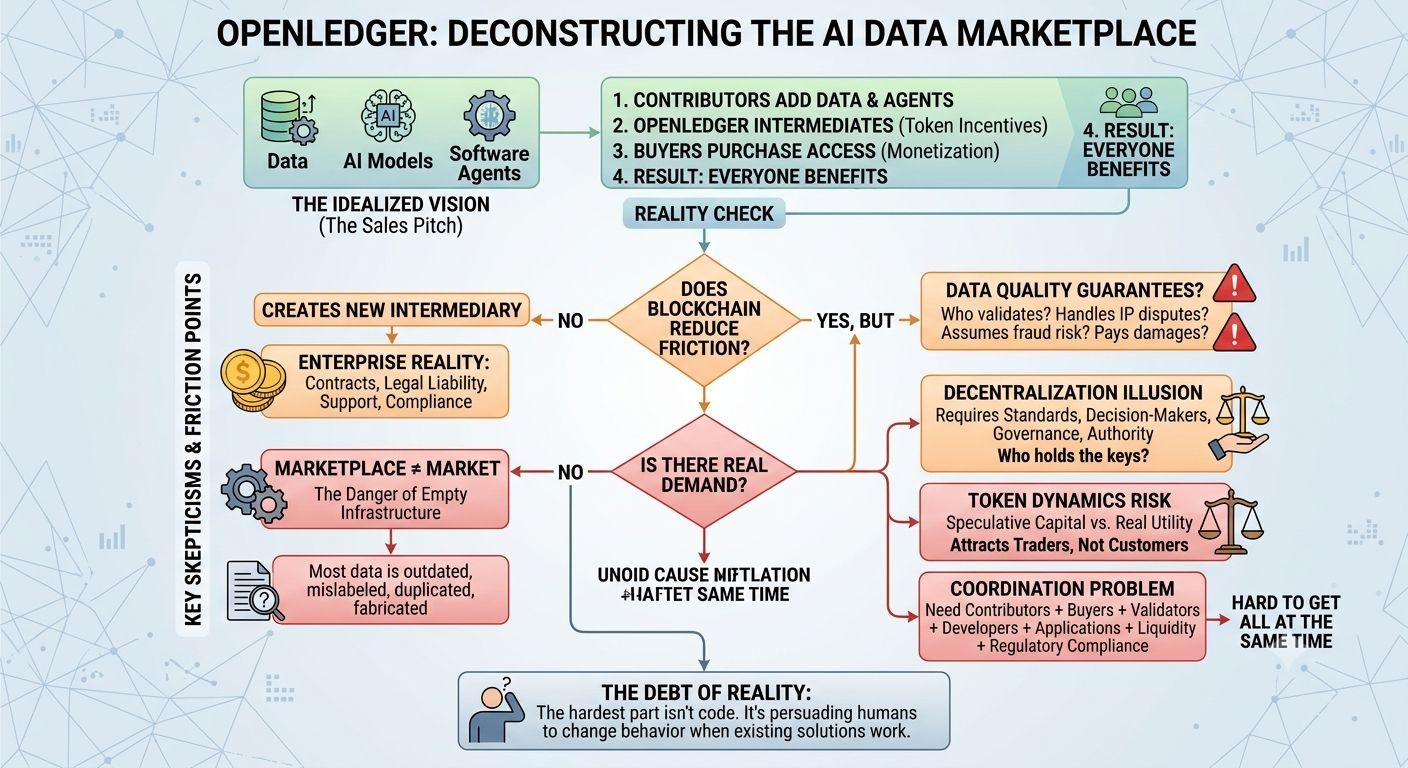
The company talks about building an AI blockchain where data, models, and software agents can be monetized. The pitch sounds attractive. Data creators get rewarded. AI developers get access to information. Autonomous agents transact with one another. Everyone participates. Everyone benefits.
It sounds tidy.
On paper, at least.
But I've seen this movie before.
A lot of people hear the OpenLedger story and immediately focus on artificial intelligence. That's understandable. AI is where the money is flowing. AI is where investors are looking. AI is where headlines are being written.
The more interesting question is not the AI part.
The more interesting question is why blockchain needs to be involved at all.
Because that's where things start getting uncomfortable.
The core problem OpenLedger claims to solve is straightforward. AI systems need data. Good data is expensive. The people who own useful data are often different from the people building AI models. Therefore, according to the argument, we need a marketplace where data can be contributed, tracked, verified, and monetized.
Fair enough.
That's a real problem.
Data has become one of the most valuable resources in the technology industry. Hospitals possess medical records. Manufacturers possess operational information. Financial institutions possess transaction histories. Research organizations possess proprietary datasets. Most of these assets are difficult to access, difficult to verify, and difficult to price.
Nobody disputes that.
What deserves scrutiny is the proposed solution.
Because OpenLedger's answer is essentially to place a blockchain layer between data owners and data buyers.
And that's where my skepticism begins.
When you strip away the technical language, OpenLedger is attempting to become an intermediary. A very sophisticated intermediary, perhaps. But an intermediary nonetheless.
The question is whether that intermediary actually reduces friction or simply creates a new kind of friction.
Think about how valuable data is exchanged today.
Large companies don't buy critical datasets because a token exists. They buy them because contracts exist. Legal liability exists. Customer support exists. Compliance departments exist. If something goes wrong, somebody can be sued.
That's not a small detail.
That's the foundation of enterprise commerce.
Now compare that with a blockchain marketplace.
Who guarantees data quality?
Who handles intellectual property disputes?
Who is responsible if data turns out to be fraudulent?
Who pays damages if an AI model trained on purchased information creates legal problems?
Marketing decks rarely linger on these questions.
Lawyers certainly do.
And that's before we reach the quality problem.
This is the issue that many AI infrastructure projects quietly dance around.
Not all data is valuable.
Actually, most data isn't.
The internet is drowning in duplicated information, outdated information, mislabeled information, fabricated information, and information that nobody wants to pay for.
Creating a marketplace for data does not magically create demand for that data.
A marketplace is not the same thing as a market.
That distinction matters.
Very few people wake up in the morning thinking, "I wish there were more places to buy datasets."
They wake up wanting solutions to business problems.
The danger for OpenLedger is that it may build excellent infrastructure before proving there are enough participants who genuinely need it.
Technology history is full of beautifully engineered systems that nobody cared about.
Then there is the decentralization question.
Let's be honest.
Whenever a project uses the word "decentralized," I immediately start looking for the people holding the keys.
Because somewhere, someone usually is.
The reality is that AI data marketplaces require standards, validation mechanisms, dispute resolution systems, governance processes, and quality control. These functions rarely emerge spontaneously.
They require decision-makers.
They require authority.
They require rules.
At some point, someone decides what qualifies as good data. Someone decides which contributors are trustworthy. Someone decides how rewards are distributed. Someone decides how disputes are resolved.
The more important those decisions become, the less decentralized the system starts to look.
This isn't necessarily dishonest.
It's simply reality.
Human systems need human management.
The marketing material often emphasizes autonomous agents as another major opportunity. Software agents buying services from other software agents. Agents paying for information. Agents coordinating economic activity without human intervention.
Maybe.
But this part of the story often feels several chapters ahead of reality.
For OpenLedger's vision to work at scale, businesses first need widespread adoption of autonomous agents. Then those agents need to require blockchain-based coordination. Then OpenLedger must convince developers to use its infrastructure instead of alternatives.
Every one of those steps introduces risk.
Stack enough assumptions together and you stop building a business model.
You start building a wish list.
The token raises another set of questions.
Who actually benefits if the network grows?
The answer is not always the people creating value.
Many blockchain ecosystems develop a strange dynamic where token holders become economically disconnected from the users generating real utility. Developers build. Contributors contribute. Companies provide data.
Meanwhile, speculative capital captures a large share of the upside.
This doesn't happen every time.
But it happens often enough to deserve attention.
If the token becomes the primary focus, the network risks attracting traders instead of customers.
And traders are loyal to price action.
Not infrastructure.
Then comes the catch that rarely appears in promotional material.
OpenLedger's success depends on solving a coordination problem that has defeated countless marketplaces before it.
You need data contributors.
You need buyers.
You need validators.
You need developers.
You need applications.
You need liquidity.
You need regulatory compliance.
And all of these groups must arrive at roughly the same time.
If contributors show up but buyers don't, the marketplace fails.
If buyers show up but quality data doesn't, the marketplace fails.
If regulators intervene, the marketplace faces another obstacle.
If enterprises decide traditional contracts remain simpler, the marketplace faces another obstacle.
The challenge is not building the technology.
The challenge is convincing enough people to change their behavior.
That is usually where reality starts collecting its debt.
Because the hardest thing in technology isn't writing code.
It's persuading humans.
And humans have a habit of ignoring elegant systems when existing solutions are already good enough.
