

I used to think the hardest problem in AI infrastructure was coordination.
How do systems connect?
How do agents communicate?
How do tools exchange information?
How do contributors interact with networks efficiently?
That felt like the obvious bottleneck.
Then I kept watching what happens after systems scale.
And the problem started looking different.
Because coordination doesn’t stay expensive forever.
Memory does.
The weird thing about modern AI systems is that they’re designed to keep accumulating.
More context.
More history.
More interactions.
More attribution layers.
More dependencies.
Everything gets stored because everyone assumes keeping information is automatically valuable.
I’m not completely convinced anymore.
The more I think about AI infrastructure, the more it feels like information behaves less like an asset and more like liability.
Because stored information isn’t free.
Someone pays for maintaining it.
Someone validates it.
Someone governs it.
Someone absorbs risk when systems remember things they probably shouldn’t.
That’s where my thinking around OpenLedger changed.
At first, I viewed OpenLedger mainly as attribution infrastructure.
Track contributors.
Track models.
Track participation.
Distribute rewards.
Simple idea.
Until I started thinking about what attribution actually looks like once millions of interactions happen simultaneously.
That’s where things become messy.
AI systems don’t operate through clean ownership lines.
Contributions overlap.
Training signals mix together.
Models inherit influence from countless sources.
Feedback loops interact with previous feedback loops.
Over time, contribution history starts looking less like accounting and more like archaeology.
And archaeology gets expensive.
This is why I keep coming back to a different question:
What happens when AI systems remember too much?
People still discuss AI infrastructure as if larger memory automatically means stronger systems.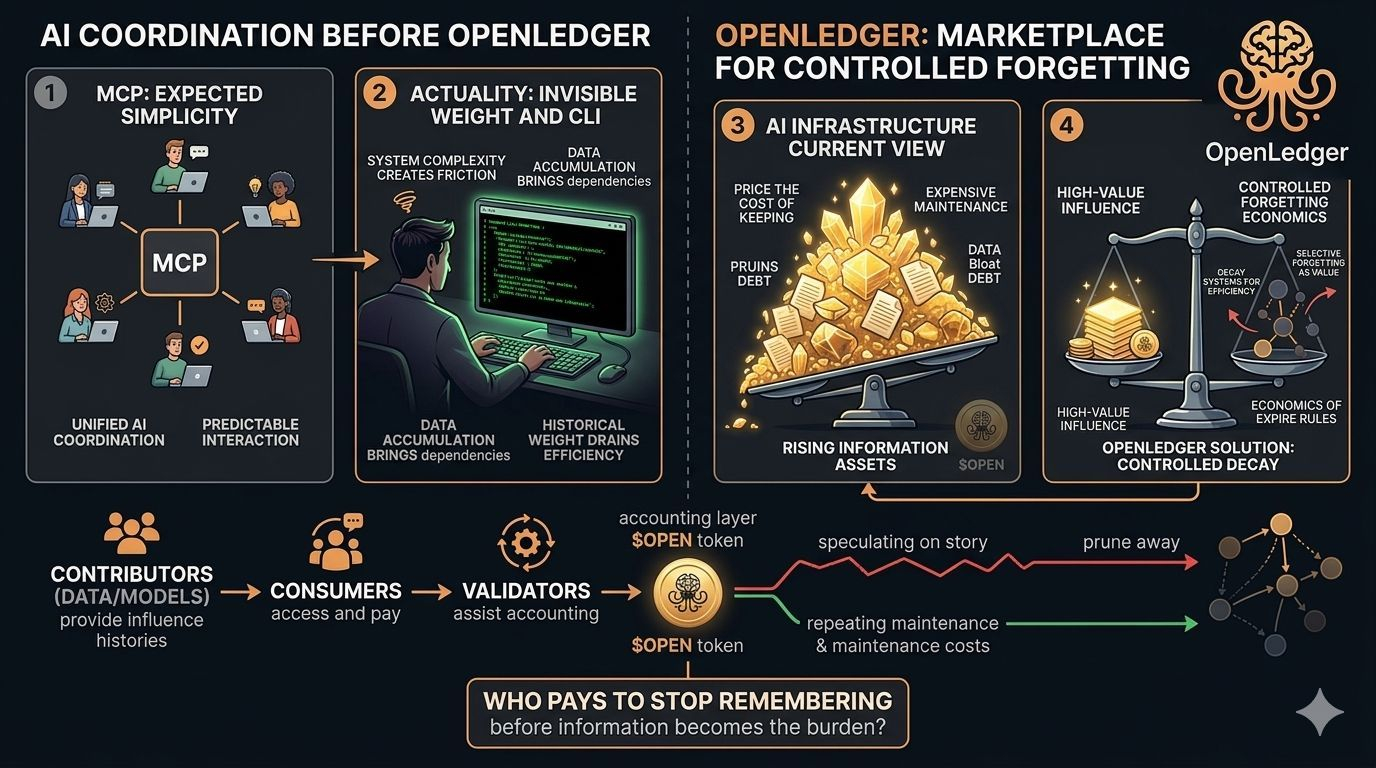
I’m not sure that survives reality.
Imagine contributor histories existing permanently.
Old datasets remain attached forever.
Dead relationships stay inside attribution systems.
Outdated influence keeps affecting reward distribution.
Low-quality contributions never disappear.
Eventually systems become dense.
Not intelligent.
Dense.
That’s when infrastructure starts looking different.
Maybe future networks won’t compete on who remembers the most.
Maybe they compete on who manages memory better.
This is where OpenLedger started feeling more interesting to me.
Not because attribution disappears.
Because attribution probably needs lifecycle management.
Information enters systems.
Information creates value.
Information loses relevance.
Information eventually expires.
That cycle feels unavoidable.
And if expiration becomes necessary, then forgetting itself becomes infrastructure.
That changes how I think about token demand too.
Speculation is temporary.
Maintenance repeats.
Systems continuously require validation.
Coordination repeats.
Storage repeats.
Cleanup probably repeats too.
Recurring actions usually create stronger infrastructure demand than temporary narratives.
That may become important later.
Because crypto markets are still heavily pricing AI around accumulation.
More users.
More models.
More data.
More tracking.
Maybe that works for now.
But eventually someone pays for preserving all those relationships.
And I’m starting to think the future AI economy won’t only reward intelligence.
It may reward efficiency.
Especially information efficiency.
Curious what everyone thinks:
As AI systems grow larger —
Will remembering everything become an advantage?
Or will selective forgetting eventually become more valuable than unlimited memory?
$US $ESPORTS $FLNC #StrategySellsBTCForFirstTimeIn4Years #SolanaDEXVolumeFalls82Pct #Binance #TrendingTopic #crypto