
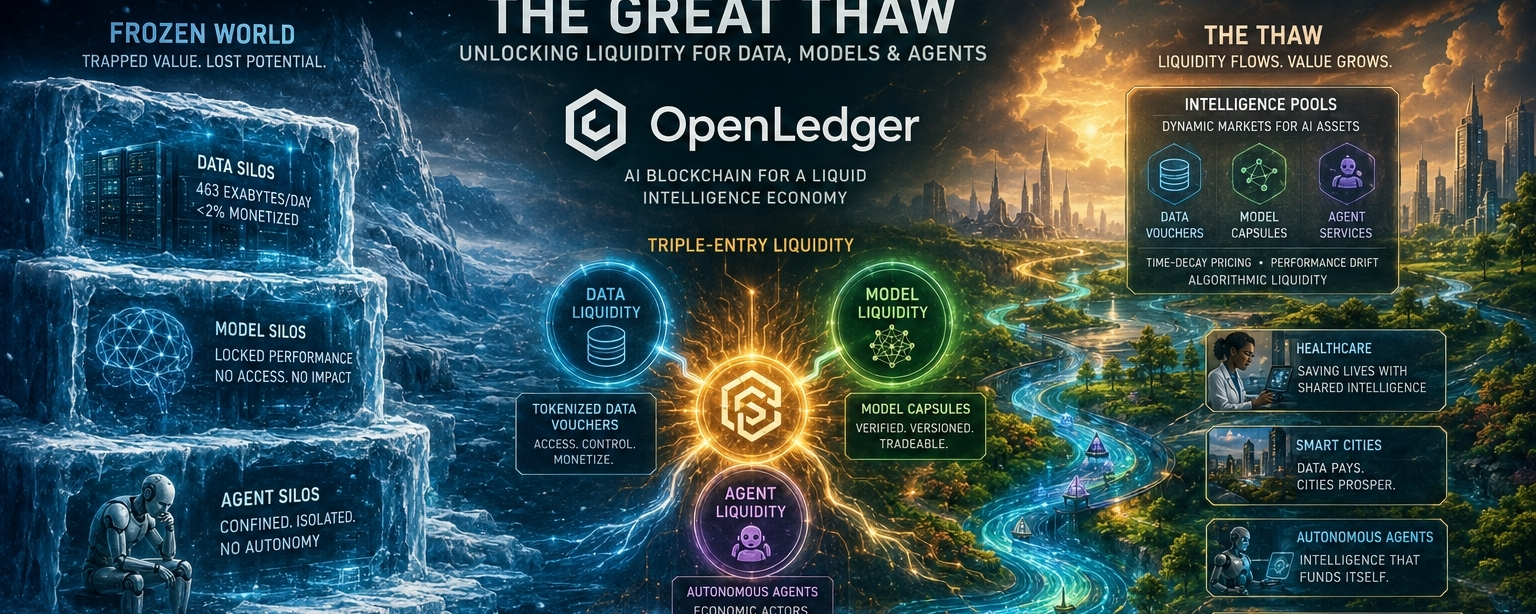
Beneath the digital crust of our world lies a frozen ocean—not of water, but of potential. Every query typed, every sensor tripped, every model trained in a siloed GPU cluster, every intelligent agent confined to a single narrow task. These are assets of immense worth, yet they remain trapped in ice: inaccessible, illiquid, inert. The age of artificial intelligence has been, paradoxically, a winter for value. While machines learn at unimaginable speeds, the data that feeds them, the models that emerge, and the agents that act stay locked in proprietary vaults, their economic vitality frozen solid. What if there were a way to thaw this permafrost—not with blunt force, but with a new kind of financial and technological heat? That quiet revolution is what OpenLedger, an AI blockchain built to unlock liquidity for data, models, and autonomous agents, sets in motion. It is not another blockchain searching for a problem; it is a solution engineered for a crisis we are only beginning to name: the great value stagnation of the intelligence era.
To grasp why this matters, we must first take in the frozen landscape as it truly exists, then follow the meltwater as it carves fresh rivers of monetization, trust, and autonomous collaboration.
Imagine a city where every library, every laboratory, every creative studio is encased in a block of unmelting ice. You can see the treasures inside—ancient texts, experimental results, half-finished symphonies—but you cannot touch them, share them, or build upon them. This is the state of the global data economy. We now produce an estimated 463 exabytes of data daily, yet less than two percent of enterprise data is ever analyzed or monetized. The rest sits in frozen vaults: hospital records that could train diagnostic AIs but never move, IoT streams from smart factories that evaporate into cost centers, consumer behavior logs that enrich only the platforms that hoard them. This is not a storage problem; it is a liquidity crisis. Assets of enormous worth cannot flow to where they are most needed. Artificial intelligence deepens the tragedy. A cutting-edge model trained on proprietary radiology images in São Paulo could save lives in rural Indonesia, but there is no safe, incentivized pathway for that model to be shared, licensed, or even discovered. The very concept of a market for AI models remains embryonic because three immense barriers stand like glaciers: trust, attribution, and dynamic pricing. How do you trust that a model will perform as claimed without exposing your own data? How do you prove ownership of something that can be copied in seconds? How do you price an asset that improves with use, or a dataset whose value decays with time? Traditional blockchains offered ledgers but not understanding. They could record ownership, but not verify quality. They could move tokens, but not encapsulate the nuanced rights of a data stream that is partly personal, partly derived, and partly temporal. OpenLedger enters this frozen expanse not as a shovel, but as a climate shift.
The protocol’s architecture can be felt as a distributed warmth, a way of melting rigidity into flow. At its core lies a concept of triple-entry liquidity, a leap beyond traditional double-entry bookkeeping. Instead of merely tracking debits and credits, OpenLedger’s state machine tangles together three asset classes simultaneously. Data liquidity turns raw datasets, real-time streams, and privacy-preserving proofs into tokenized liquidity vouchers—cryptographic attestations that a specific dataset exists, meets quality metrics, and can be accessed under defined terms, decoupling exposure from possession. Model liquidity wraps trained AI systems into model capsules: fingerprinted, versioned packages that include not only weights but a zero-knowledge proof of performance on a hidden validation set, enabling trustless evaluation. A capsule can be fractionally owned, licensed for inference, or staked into liquidity pools. Then there is agent liquidity, where autonomous AI agents become first-class economic actors with their own wallets and reputation scores. They can be commissioned, rented, or allowed to self-fund by accessing data and model markets on behalf of human principals. An agent spotting arbitrage in energy grids can autonomously purchase data feeds and sell optimization models, paying for its own existence. The interplay of these three creates something extraordinary: a market for the means of intelligence production, not just the outputs. A healthcare startup can stake its proprietary model capsule into a liquidity pool alongside anonymized patient data vouchers, and a diagnostic agent can plug into both, paying micro-royalties to all contributors as it serves a clinic in Nairobi. The flow is continuous, automated, auditable.
To validate transactions when value is subjective and quality paramount, OpenLedger uses Proof-of-Contribution consensus. Nodes are rewarded for providing verifiable utility—hosting encrypted data fragments, serving access proofs, or executing model inferences inside trusted execution environments. The network evaluates contributions through statistical sampling and peer challenges, a perpetual tournament where nodes randomly prove they performed a task correctly. Successful contributions are batched into blocks, and rewards are shared proportional to the economic value generated, measured by on-chain fee flows. The blockchain thus transforms from a passive ledger into an active computational fabric. It does not merely record that Alice sent Bob a token; it verifies that Alice’s data improved Bob’s model by three percent in a blinded test, then automatically releases payment from an escrow contract. The exhaustion of negotiating data-sharing agreements with legal teams melts into a programmable trust system.
Building on decentralized finance’s innovation, OpenLedger implements Intelligence Pools—specialized automated market makers for AI assets. Data vouchers, model capsules, and agent service tokens are paired with a stablecoin or the native OPEN token, but the pricing curve is alive. It integrates a time-decay parameter for data freshness and a performance drift monitor for models. A new high-quality dataset initially sits on a steep bonding curve, expensive to access, rewarding early contributors while deterring predatory arbitrage. As the data ages or is replicated, the curve flattens algorithmically, keeping it affordable for training long-tail models. If a model’s performance degrades—verified by on-chain oracle challenges—its capsule price adjusts downward, protecting consumers. Liquidity providers stake OPEN tokens and earn fees in proportion to usage, creating a yield-bearing asset class tied directly to the AI economy’s growth, not just speculation. A pension fund could allocate capital to a pool of medical imaging models, earning returns as hospitals worldwide query them.
This engineered thaw reshapes human stories, and a few vignettes—fictional but grounded in early pilot trends—bring the transformation into emotional focus. A cancer researcher in Lagos has a model that detects retinopathy with high accuracy, but she needs diverse global data to reach clinical thresholds. Through OpenLedger, she packages her model as a capsule with a zero-knowledge proof and creates an intelligence pool with a privacy-preserving data voucher from a Mumbai health collective. An agent deployed by a global health nonprofit stakes liquidity, triggers a federated learning cycle, and the model improves without raw data ever moving. Data providers earn micro-royalties, the nonprofit earns a spread, and the researcher gains a deployable model—the thaw has saved sight. In a small European city, a decade of traffic sensor readings lies dormant on a municipal server. An IT manager mints the dataset as a liquidity voucher with dynamic access policies, and swarms of autonomous vehicle agents bid on the stream. The city earns enough in months to fund free public Wi-Fi for all parks; data becomes a civic endowment instead of a liability. And an AI agent deployed by a retail supply chain, Tesseract, discovers an untapped pool of satellite imagery and a lightweight object-detection model. It negotiates access, spins up a new composite model capsule, and stakes its own earned tokens into a liquidity pool, soon generating enough fees to sustain itself and pay dividends to its creators. It becomes an autonomous economic micro-entity, intelligence running its own capital cycle. These narratives dissolve the friction of trust and the illiquidity of intangible assets by design.
Beneath these flows, the OPEN token operates as the thermodynamic medium. It is not a speculative coin but a four-layered fluid carrying value. As a medium of exchange, all fees, staking rewards, and pool trades are priced in OPEN, creating constant demand. For staking and security, validators lock OPEN, so more economic activity increases the value at stake and strengthens the network. In governance, token holders vote on upgrades and curate which data schemas, evaluation metrics, and privacy technologies become network standards, creating a recursive quality loop. And as a liquidity backstop, a protocol treasury funded by a small percentage of fees can act as a buyer of last resort in critical intelligence pools during stress, preventing a cascade of illiquidity that would disrupt ongoing AI services—algorithmically triggered and transparent. The emission schedule aligns incentives over decades, with half of the token supply allocated to contribution rewards across twenty years, following a decay function that honors early risks while still attracting later builders. A value-add rebasing mechanism measures total economic throughput and adjusts staking yields to target a sustainable ratio of network value to real utility, making the currency elastic with respect to the intelligence economy’s breath.
OpenLedger does not stand alone. It is embedded in a wider transformation that turns AI infrastructure into a public utility animated by private incentives. Data unions and decentralized autonomous organizations use it as a settlement layer to license collective data directly to AI firms, bypassing extractive intermediaries. A pilot in Kenya’s agricultural sector saw thousands of smallholder farmers earn meaningful income boosts by contributing anonymized crop yield data. In decentralized science, researchers escape walled gardens by staking model capsules and data vouchers, earning ongoing royalties while proving provenance immutably—easing the replication crisis. The supply chains for generative AI, now mired in lawsuits over training data rights, find resolution through a provenance chain where every piece of training data carries a micropayment trail back to original creators. A poet whose work is ingested by a foundational model receives a stream of tokens each time a derivative fine-tuned model is used, not out of charity but cryptographic necessity. Even at the edge, billions of IoT devices become profit centers: a smart camera mints data vouchers directly, and a maintenance agent buys them for predictive failure models, all without a centralized server. The ecosystem expands in concentric rings—core protocol, developer tooling, identity and reputation oracles, and vertical-specific marketplaces for healthcare, mobility, climate—fueled by a grant program that has already seeded dozens of projects, from decentralized GPU rendering to model insurance against performance drift.
Looking ahead, OpenLedger intertwines with the very definition of economic activity. If data is the new oil, liquidity is the refinery turning it into the fuel of progress. The next decade will shift from data ownership as a static legal concept to data participation as a dynamic economic flow. We will witness autonomous economic alliances: swarms of agents forming ad-hoc corporations on the network, combining data, models, and capital to solve transient problems, then dissolving back into the pool. A flash-loan-funded consortium of agricultural agents might predict a locust swarm, hedge crop futures, and fund pesticide distribution within a single block time. The roadmap envisions inter-chain intelligence pools where liquidity cascades across multiple blockchains, creating a global mesh for AI assets, with the OPEN token as universal settlement. Culturally, this thaws more than economics; it thaws the frozen postures of a world where data feudalism seemed inevitable. OpenLedger embodies a liquid democracy of intelligence, where anyone can contribute and be rewarded not through platform charity but through the iron logic of an open protocol. The emotional arc runs from anxiety to agency. The researcher no longer begs for data but accesses it programmatically. The artist no longer sees her style mimicked without credit but receives a stream of acknowledgment and income. The city planner no longer views sensors as cost centers; they become revenue-generating assets. The ice is melting, and the rivers are beginning to flow.
At its deepest level, OpenLedger reimagines the ledger itself. Historically, ledgers were records of what already happened—backward-looking, static, extractive. This new blockchain is a generative ledger, a living system that does not just record value but catalyzes its creation. It transforms the chain from a machine for proving the past into an engine for financing the future. The world is awash in frozen intelligence, and every idle dataset, every siloed model, every underutilized agent represents a failure of imagination and a leakage of human potential. To thaw this frozen sea, we need more than technology; we need a new economic grammar. OpenLedger provides the syntax and the liquidity. The rest is up to us—to trust the melt, to build on the flow, and to navigate the rivers of a truly liquid intelligence economy. The ice age of AI is ending, and in its waters, a verdant continent of shared prosperity may yet rise from the depths.