
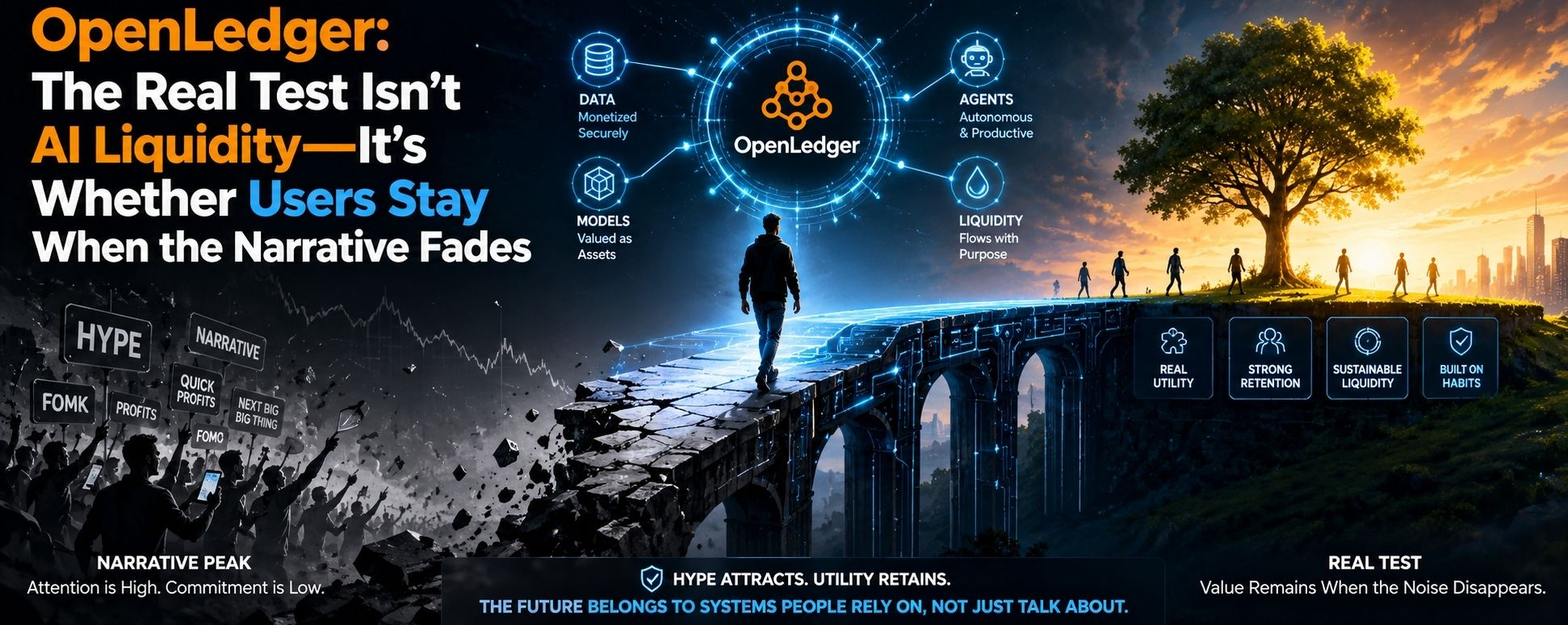
I’m watching OpenLedger, and the more time I spend observing it, the less interested I become in the big claims surrounding it. I’ve been noticing that whenever a project sits at the intersection of AI and blockchain, the conversation tends to accelerate far ahead of reality. People start talking about the future as if it has already arrived. I keep seeing confidence everywhere, but I’m tracking something much slower. I’m trying to understand what people actually do once the excitement settles and the novelty wears off. That has always felt like the more honest signal to me. Narratives can create attention overnight. Habits take much longer to form.
What keeps pulling me back to OpenLedger is that it is attempting to build an economy around things that were previously difficult to value. Data, models, and AI agents are no longer being treated as background components. They're being positioned as assets that can participate in an economic system. It's an interesting idea, but ideas alone rarely tell the full story. What matters is how people behave once those ideas collide with incentives.
I've seen enough cycles to know that activity can be misleading.
A network can look alive because rewards are attractive. Liquidity can appear strong because everyone expects someone else to arrive tomorrow. Engagement can look organic until incentives are reduced and participation suddenly drops. That's why I spend less time looking at growth and more time looking at consistency. Consistency is harder to fake.
The question I keep returning to is simple: are people building real dependence on the system, or are they simply passing through it?
There's a subtle difference between users who need a platform and users who are temporarily benefiting from it. In the early stages, both groups behave almost identically. They contribute, interact, and remain active. But eventually the gap appears. One group stays because the platform has become useful. The other leaves when a better opportunity appears elsewhere.
That tension feels important here.
OpenLedger is trying to create an environment where intelligence itself becomes part of a marketplace. If it works, it could encourage entirely new forms of participation and ownership. But every new economic layer creates new incentives, and incentives have a habit of shaping culture in ways nobody expects.
People learn quickly. They learn what gets rewarded, what attracts attention, and what generates returns. Over time those behaviors become normal. Eventually they become the identity of the network itself.
That's why I find user behavior more interesting than technology.
Technology tells us what a system can do.
Behavior tells us what a system actually becomes.
Right now, I see potential, but I also see uncertainty. The AI sector is moving incredibly fast, and blockchain ecosystems move even faster when narratives are strong. In environments like that, it becomes difficult to separate genuine utility from temporary momentum. Everything looks important while attention is flowing.
The real challenge begins later.
It begins when participation is no longer exciting.
It begins when users have already explored the platform, when rewards feel ordinary, and when the market has moved on to newer stories.
That's when systems reveal their true strength.
Because durability isn't measured by how many people arrive during periods of enthusiasm. It's measured by how many remain when enthusiasm is no longer doing the work.
As I continue watching OpenLedger, I find myself paying attention to the quieter signals. Are users returning because they genuinely need what the network provides? Is liquidity circulating because there is real economic activity underneath it? Are contributors developing habits that survive beyond incentives?
Those answers take time.
And time has a way of exposing weaknesses that hype can temporarily hide.
My personal conclusion is that OpenLedger is still in the stage where possibility is speaking louder than proof. That isn't necessarily a negative thing. Every meaningful system begins that way. But eventually every project reaches a moment where vision must be replaced by evidence. For me, the real test isn't whether OpenLedger can attract attention today. It's whether the people, the liquidity, and the behavior remain connected to the network after the excitement fades. If they do, then something durable may be forming beneath the surface. If they don't, then the market will eventually reveal that much of the activity was momentum rather than conviction. That's the part I'm most interested in watching unfold.