
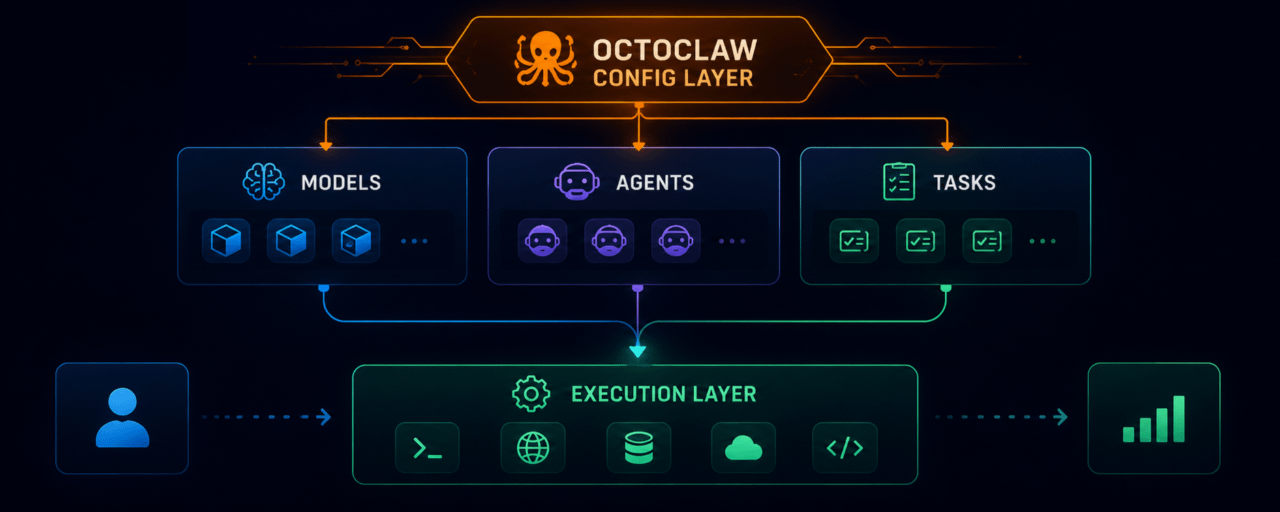
The more I explore AI infrastructure, the more I realize that scaling AI is not only about bigger models or more compute.
It's also about configuration.
Most discussions around AI focus on parameters, GPUs, training datasets, and model performance. Those things matter. But once AI starts operating in real environments, another challenge appears:
How do you make AI systems behave consistently at scale?
A powerful model without proper configuration is difficult to reproduce, difficult to manage, and difficult to trust.
That's why I find the infrastructure layer around AI increasingly important.
With projects like OpenLedger and Octoclaw, the focus isn't only on intelligence itself, but on creating structured environments where AI agents can operate under predefined rules, permissions, workflows, and configurations.
Why does this matter?
Imagine deploying one AI agent.
That is relatively simple.
Now imagine deploying:
🔹 Hundreds of agents
🔹 Different data sources
🔹 Multiple workflows
🔹 Various permission levels
🔹 Distinct execution environments
Without configuration standards, complexity grows exponentially.
Configuration becomes the mechanism that transforms AI from an experiment into infrastructure.
In my view, scalable AI systems require three things:
1️⃣ Consistency
The same inputs should produce predictable behavior.
Configuration helps define how agents access tools, process information, and execute tasks across different environments.
2️⃣ Reproducibility
One of the biggest problems in AI is reproducing successful outcomes.
If an agent performs well, teams need a way to recreate the exact environment that produced those results.
Configuration provides that blueprint.
3️⃣ Governance
As AI gains more autonomy, oversight becomes increasingly important.
Who can access what?
Which actions are allowed?
What resources can be used?
These questions are answered through configuration layers rather than model intelligence alone.
Why Octoclaw Caught My Attention
What I find interesting about Octoclaw is the emphasis on structured execution.
The conversation around AI often focuses on making models smarter.
But smarter models alone don't solve operational challenges.
To scale AI reliably, systems need repeatable environments, clear permissions, defined workflows, and transparent execution paths.
In many ways, configuration becomes the operating system for autonomous agents.
Final Thoughts
The future of AI may not be determined solely by who builds the largest model.
It may also depend on who builds the most reliable environments for those models to operate in.
Because at scale, intelligence is only part of the equation.
Configuration is what turns intelligence into a system.