
One of the most remarkable achievements in human history happened so gradually that most of us barely noticed it.
The internet made knowledge infinitely distributable.
An idea written in one country could reach millions of people across the world.
A research paper could travel across continents in seconds.
A useful insight could be copied, shared and reused endlessly.
Information became abundant.
And for a while, that felt like the final destination.
But while following OpenLedger's work around DataNets, Proof of Attribution and Payable AI, I found myself thinking about a much larger question.
What if we only solved half of the problem?
Because distributing knowledge and rewarding knowledge are not the same thing.
The internet became extraordinarily good at the first.
It remained surprisingly inefficient at the second.
Every day, enormous amounts of value are created by people contributing expertise, datasets, observations, corrections and domain-specific knowledge.
Researchers share discoveries.
Experts contribute specialized information.
Communities generate insights.
Developers build tools.
Writers explain ideas.
Yet once that knowledge enters a system, something curious often happens.
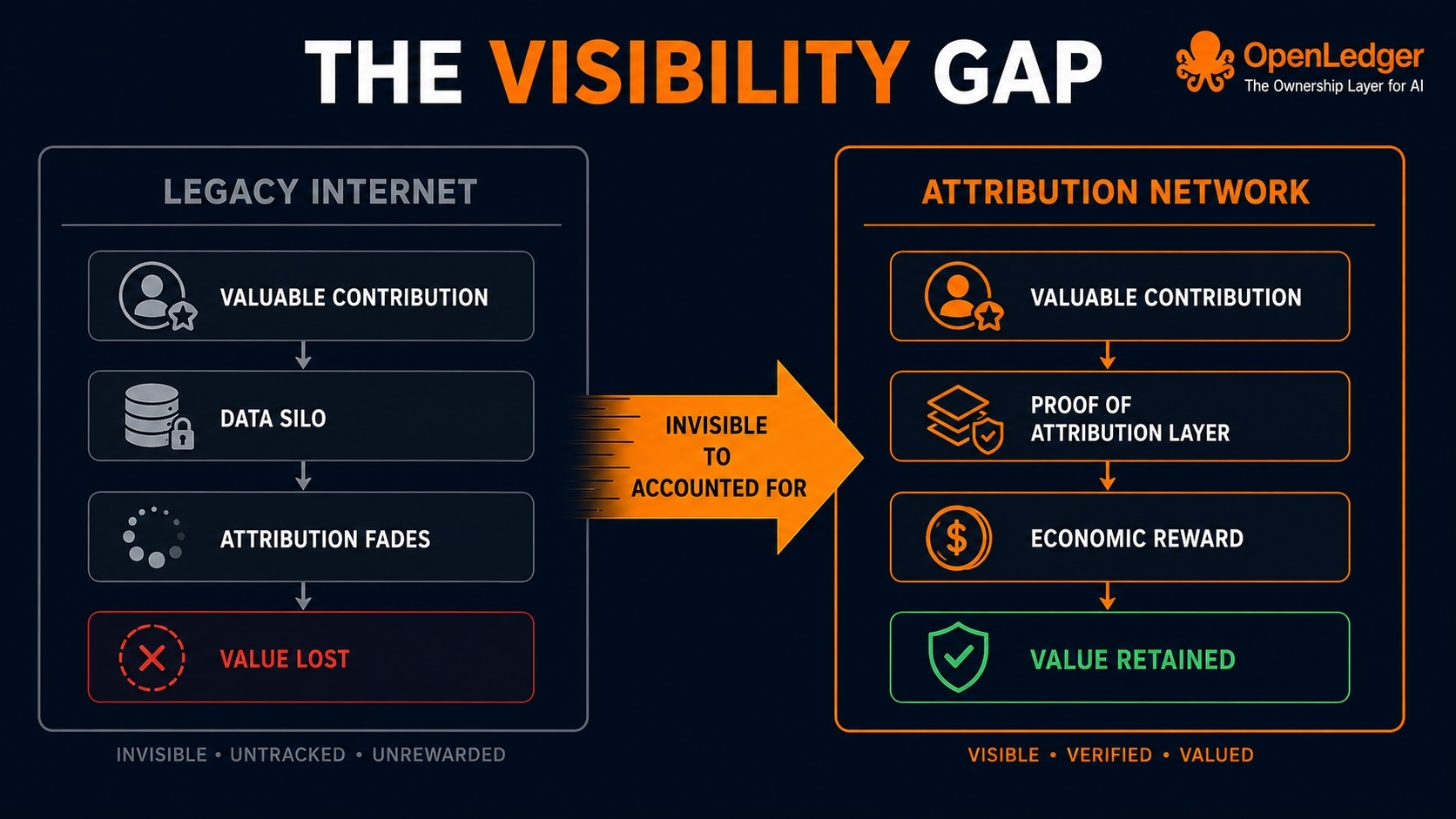
The knowledge remains.
The contributor disappears.
For years, that was largely accepted as a limitation of the digital world.
Information moved.
Attribution faded.
Value accumulated.
Recognition became increasingly difficult to trace.
The result is a strange paradox.
Modern digital systems depend on human contributions.
Yet the connection between contribution and reward often becomes invisible.
That is why OpenLedger's approach keeps capturing my attention.
Because beneath the discussions about AI agents, marketplaces and automation sits a much deeper idea.
What if knowledge could become economically visible?
At first, that sounds like a technical challenge.
But the more I think about it, the more it feels like an infrastructure challenge.
For years, contribution was assumed.
Rarely measured.
People knew value was being created.
The difficult part was proving where it came from.
And this is precisely where Proof of Attribution becomes interesting.
Not because it is another feature.
But because it attempts to answer a question that digital systems have historically struggled with:
How do we identify meaningful contribution after value has already been created?
That question becomes increasingly important as AI systems become more powerful.
Because intelligence does not emerge from nowhere.
Every model is built on layers of human contribution.
Researchers.
Analysts.
Developers.
Experts.
Communities.
People whose inputs help generate outputs that eventually create value.
The challenge is not recognizing that these contributions exist.
The challenge is building systems capable of recognizing them economically.
Historically, that has been difficult.
Not because contributions lacked value.
Because attribution lacked infrastructure.
And infrastructure often determines what becomes possible.
Roads create trade.
Payment networks create commerce.
Communication networks create information exchange.
Perhaps attribution networks create something else.
Knowledge economies.
This broader vision appears throughout OpenLedger's ecosystem.
The DataNet model treats data as a productive asset rather than a disposable resource.
Proof of Attribution attempts to make contribution measurable.
Payable AI explores mechanisms that connect AI-generated value back to the participants who helped create it.
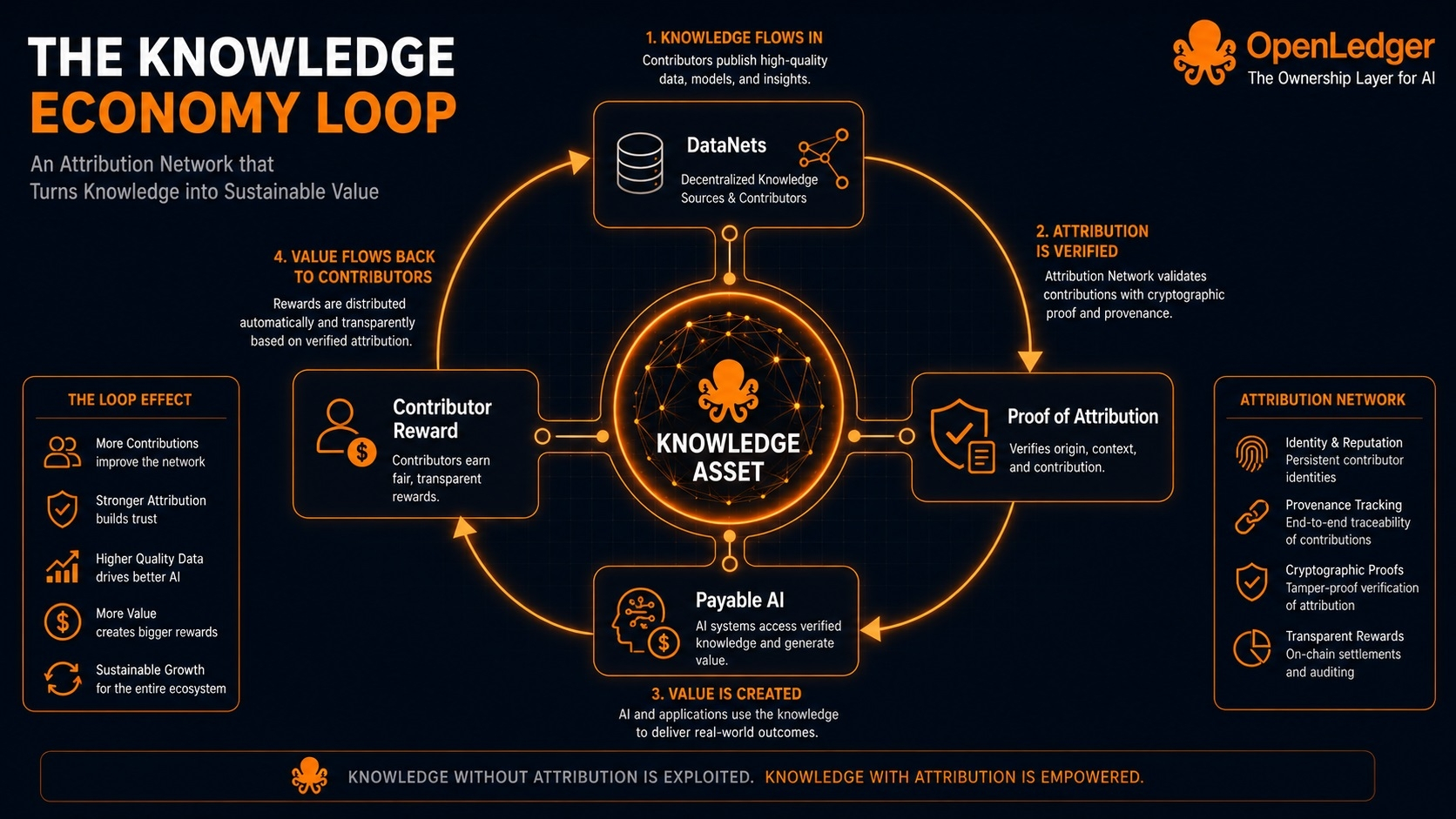
Viewed separately, these look like individual products.
Viewed together, they point toward something larger.
A world where knowledge is not only consumed.
It is accounted for.
That distinction may become increasingly important over the next decade.
Because every technological era eventually faces the same challenge.
Not how to create value.
How to distribute it fairly.
The more I think about it, the more I believe that may be one of the defining infrastructure questions of the AI era.
Not who owns the most data.
Not who trains the largest models.
But how societies recognize the people whose contributions make those systems possible in the first place.
Because the internet learned how to distribute knowledge.
The next challenge may be learning how to recognize it.
Knowledge creates value. Attribution decides who remains visible.