
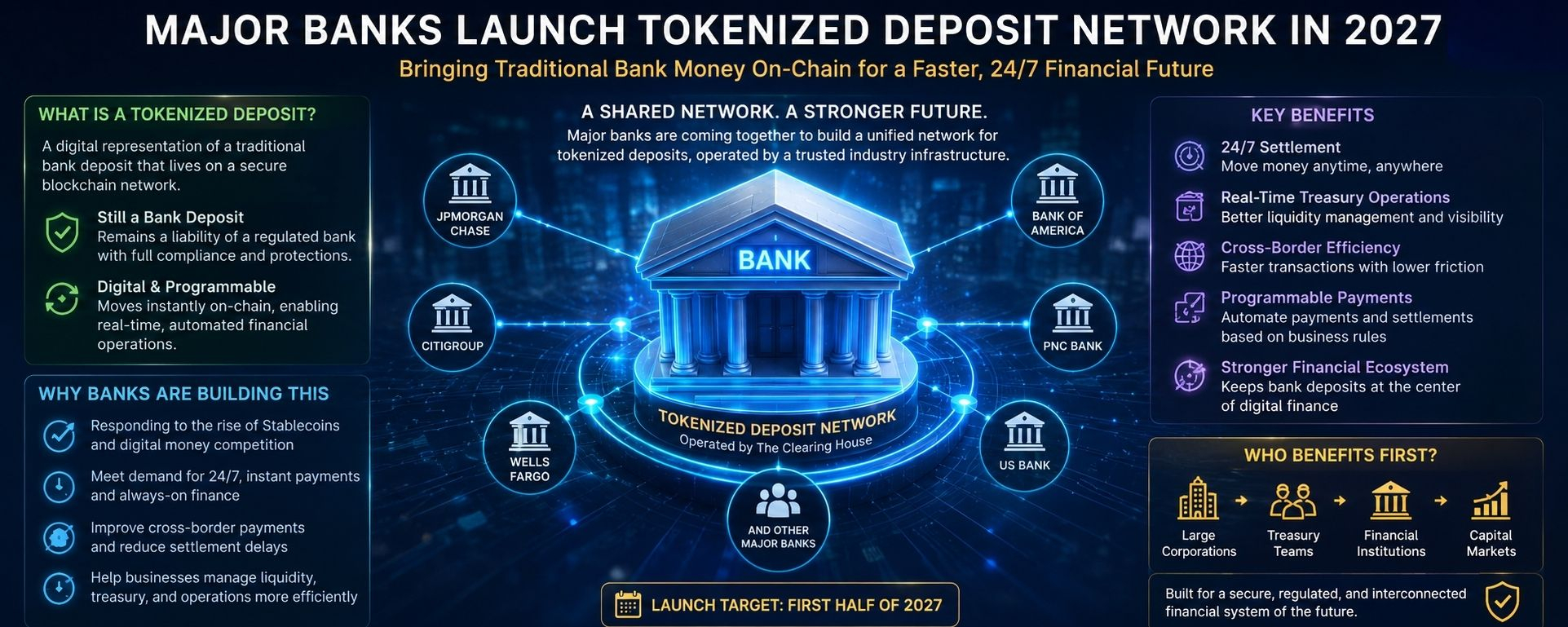

A Quiet Change That Could Reshape How Money Moves
a shift that feels much bigger than another blockchain headline.
For years, digital money was largely a conversation driven by crypto companies, fintech startups, and technology advocates promising faster payments and a more connected financial system. Traditional banks mostly observed from the sidelines, experimenting behind closed doors while publicly maintaining a cautious approach.
That dynamic is beginning to change.
Some of the world's largest banking institutions are preparing to launch a tokenized deposit network in 2027, a move that could represent one of the most significant upgrades to banking infrastructure in decades. While the announcement may sound highly technical, the reality is surprisingly simple. Banks are trying to create a version of digital money that delivers many of the advantages people associate with blockchain technology without leaving the traditional banking system behind.
The result could reshape how businesses move money, manage liquidity, settle transactions, and interact with financial markets in the years ahead.
Why Banks Are Suddenly Moving Faster
The timing isn't accidental.
Over the past several years, financial institutions have watched stablecoins grow from a niche crypto product into a serious part of the global payments conversation. What started as a tool for digital asset traders gradually evolved into a payment mechanism capable of moving billions of dollars around the clock.
That caught the attention of banks.
Stablecoins demonstrated something the traditional financial sector could no longer ignore. Businesses increasingly want money to move instantly. They want payments available twenty-four hours a day. They want fewer delays, fewer intermediaries, and fewer restrictions tied to traditional banking hours.
The challenge for banks is that stablecoins largely operate outside the deposit model that has supported commercial banking for generations.
Rather than allowing that trend to continue unchecked, banks appear determined to build their own alternative.
What Exactly Is a Tokenized Deposit?
On the surface, tokenized deposits and stablecoins may look similar because both involve digital representations of money.
Underneath, however, they are fundamentally different.
A stablecoin is typically issued by a private company and backed by reserves designed to maintain a stable value. A tokenized deposit, on the other hand, remains a traditional bank deposit. It simply exists in a digital token form that can move across modern infrastructure more efficiently.
The customer still has a relationship with a regulated bank.
The deposit still sits within the banking system.
The compliance, reporting requirements, and regulatory protections remain largely intact.
Think of it less as creating a new form of money and more as upgrading how existing money moves.
That distinction explains why banks are investing so heavily in the concept.
They want the efficiency of digital settlement without sacrificing the structure that underpins modern banking.
The Real Goal Isn't Technology
The technology itself is only part of the story.
What banks are really pursuing is faster movement of value.
Today, large businesses often maintain accounts across multiple institutions and jurisdictions. Treasury teams spend enormous amounts of time managing liquidity, coordinating transfers, and ensuring funds are available when needed.
Despite decades of technological progress, moving money between institutions can still involve delays, settlement windows, and operational friction.
Tokenized deposits aim to reduce those inefficiencies.
Instead of waiting for specific processing times, businesses could potentially move funds continuously. Treasury operations could become more responsive. Settlement could occur faster. Reconciliation could become easier because transactions would exist within a more transparent digital framework.
For multinational companies handling billions in daily flows, even small improvements can generate meaningful operational benefits.
The Push Toward Twenty-Four-Hour Finance
One of the biggest forces driving tokenization is the rise of what many executives call the twenty-four-hour economy.
Markets operate globally.
Digital commerce never sleeps.
Supply chains stretch across continents.
Yet much of the banking infrastructure supporting those activities was designed for a different era.
That mismatch is becoming harder to ignore.
Financial institutions increasingly recognize that future payment systems must operate continuously rather than around traditional business hours.
Tokenized deposits provide a pathway toward that goal.
If implemented successfully, they could enable transactions, liquidity transfers, collateral movements, and treasury operations to occur whenever needed rather than when banking systems happen to be open.
For many businesses, that flexibility may prove more valuable than the technology itself.
A Growing Battle With Stablecoins
Behind the innovation narrative lies an increasingly competitive reality.
Banks are not developing tokenized deposits in isolation.
They are responding to growing competition from stablecoin providers and digital payment networks.
For years, banks largely dismissed stablecoins as niche products tied to cryptocurrency markets. Today, that view is much harder to maintain.
Stablecoins have demonstrated real demand for programmable, always-available digital money.
Banks understand that if businesses begin holding large portions of their cash in alternative digital instruments, traditional deposits could face growing pressure.
Tokenized deposits are therefore both an innovation strategy and a defensive strategy.
They allow banks to participate in digital finance while keeping customer funds within the regulated banking ecosystem.
That balance is one of the reasons the industry views tokenized deposits as such an important development.
The Challenges Ahead
Despite growing excitement, success is far from guaranteed.
Financial history is full of promising infrastructure projects that struggled to achieve meaningful adoption.
The biggest challenge may be interoperability.
A payment network becomes more valuable as more participants join. Businesses will expect tokenized deposits to work across institutions, systems, and eventually different digital asset environments.
If networks remain fragmented, many of the expected benefits could be reduced.
User experience will also matter.
Companies will not adopt tokenized deposits simply because the technology sounds innovative. They will adopt them if they are faster, cheaper, simpler, and more useful than existing alternatives.
The infrastructure must solve real problems rather than create new layers of complexity.
That will ultimately determine whether tokenized deposits become mainstream or remain primarily an institutional tool.
More Than Another Blockchain Experiment
What makes this moment different from previous blockchain initiatives is that the conversation has matured.
A few years ago, many financial institutions were still debating whether blockchain technology had meaningful practical applications.
Today, the focus has shifted toward implementation.
Banks are no longer asking whether tokenization is possible.
They are asking how quickly it can be integrated into existing financial systems.
That change in mindset is significant.
It signals that tokenized money is gradually moving from experimentation toward infrastructure.
The launch of a major tokenized deposit network in 2027 may not generate the same excitement as previous crypto booms, but its long-term impact could be far greater.
The Real Test Begins After Launch
The most important question isn't whether banks can launch a tokenized deposit network.
They almost certainly can.
The real question is whether businesses will find enough value in the system to make it part of everyday financial operations.
If tokenized deposits deliver faster settlement, improved liquidity management, better treasury tools, and seamless interoperability, they could become one of the most important developments in modern banking.
If they fail to offer meaningful advantages over existing alternatives, adoption may remain limited.
Either way, 2027 is shaping up to be an important milestone.
For years, digital money was largely a conversation happening outside traditional banking.
Now the banks themselves are stepping directly into that future.
The technology may be new, but the objective is familiar: move money faster, move it more efficiently, and remain at the center of the financial system as it evolves.
That is why this story matters.
It's not simply about tokenization.
It's about who controls the next generation of money movement.