
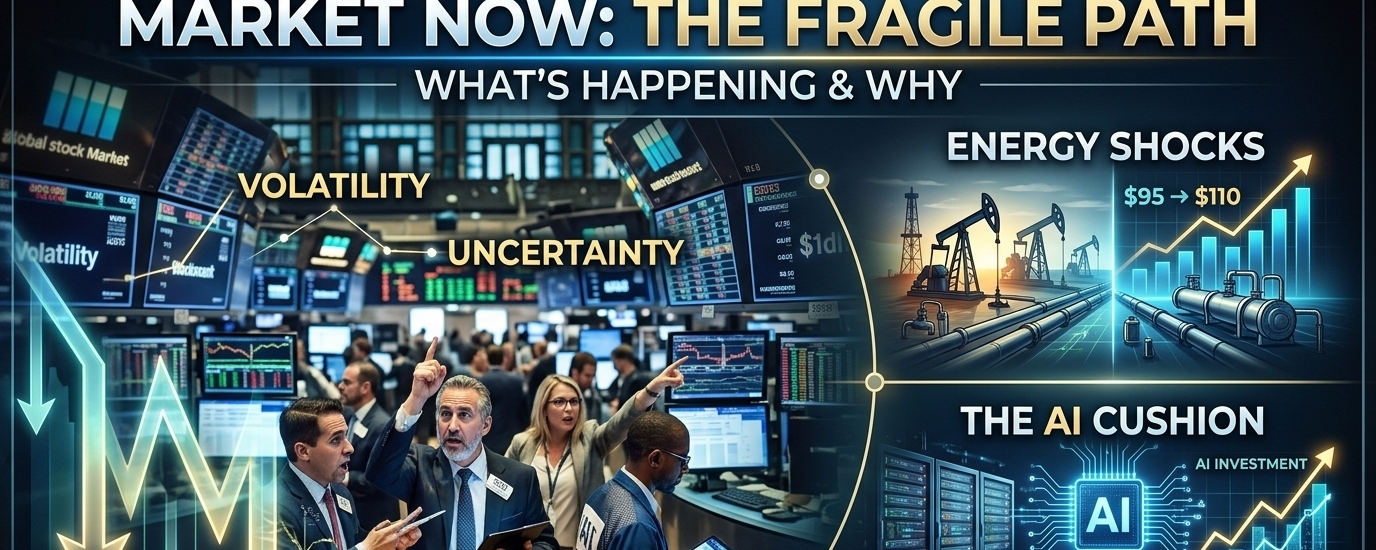
The world economy is currently in a state of "fragile balance." While we are not seeing a massive global recession, the environment feels tighter and more unpredictable than it did just a few months ago. Here is a breakdown of what is happening, why, and what lies ahead.
What is happening right now?
In short, the global economy is slowing down. While some countries—such as the United States and India, remain relatively resilient, many other parts of the world are feeling the pinch of higher prices and widespread uncertainty.
Persistent Inflation: After a period where inflation seemed to be coming under control, it has started to tick back up. This is primarily because energy and food costs have increased recently.
Market Volatility: Financial markets are nervous. Experts expect to see more "ups and downs" in both stock and bond markets as investors react to daily global headlines.
The "Two-Speed" Economy: We are seeing a divide. Some sectors, particularly those tied to Artificial Intelligence (AI) and advanced technology, continue to grow and attract massive investment. In contrast, sectors like traditional manufacturing, construction, and consumer retail are struggling to maintain previous levels of growth.
Why is this happening?
The primary driver of this current uncertainty is geopolitical conflict, specifically in the Middle East.
Energy Shocks: Recent regional conflicts have disrupted critical shipping routes. Because a significant portion of the world's oil and natural gas moves through these areas, disruptions have led to a jump in global energy prices.
Supply Chain Bottlenecks: When energy becomes expensive and shipping routes are restricted, the cost to move goods around the world goes up. This increases the price of everything from fertilizer (which drives up food prices) to industrial raw materials.
Central Bank Caution: Central banks, including the Federal Reserve, are in a difficult position. They want to lower interest rates to encourage economic growth, but because inflation is creeping back up due to energy costs, they are being forced to keep interest rates higher for longer to prevent inflation from spiraling out of control.
What is coming next?
The outlook for the rest of 2026 depends heavily on how these global conflicts evolve:
The "Baseline" Scenario: Most economists believe that if current conflicts remain limited in scope, the global economy will experience a "soft patch" rather than a total breakdown. Growth is expected to remain positive, just slower than many initially hoped.
The AI Cushion: Artificial Intelligence remains a major buffer for the global economy. Massive investment in data centers and AI-related infrastructure is acting as a key growth driver, particularly in the US, which helps prevent a sharper economic downturn.
Looking toward 2027: Current forecasts suggest that if energy price pressures ease by the end of this year, we could see a modest global recovery in 2027 as inflation finally cools down and supply chains stabilize.
We are in a period where "resilience" is the watchword. While the economy is not crashing, the combination of elevated energy prices and global political uncertainty means that businesses and individuals are facing a more expensive and less predictable environment for the next several months.
#NasdaqWorstDayInOverAYear #ADAFallsToLate2020LowsAt$0.16 #IranWarnsOfHormuzStraitClosure