
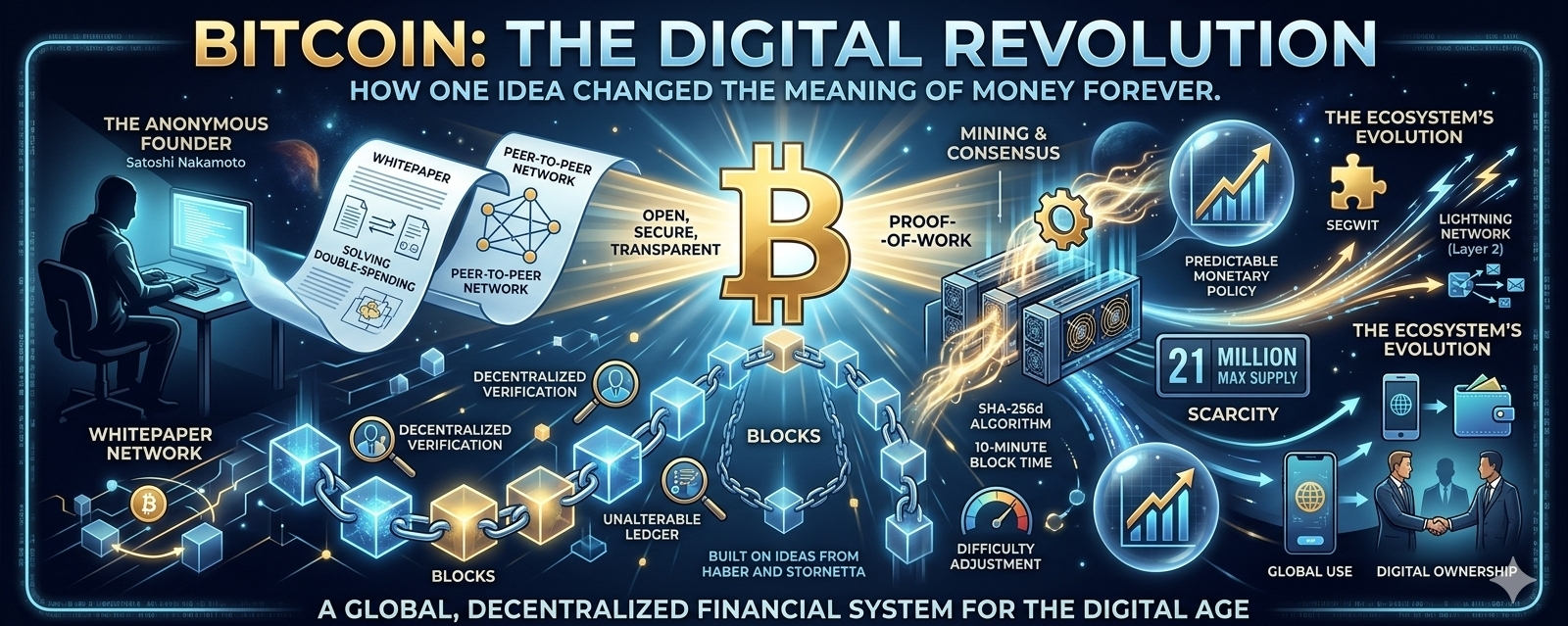
When people talk about the beginning of modern cryptocurrency, the conversation almost always starts with Bitcoin. Introduced in 2009, Bitcoin emerged as a completely new form of digital money designed to operate without the control of governments, banks, or any central authority. Instead of relying on traditional financial institutions to process and verify transactions, Bitcoin allows people to exchange value directly with one another through a peer-to-peer network. Every transaction is recorded digitally, verified by thousands of participants across the world, and stored permanently in a way that is transparent, secure, and extremely difficult to alter.
The idea behind Bitcoin became public in 2008 when a whitepaper was released by a person, or perhaps a group, using the name Satoshi Nakamoto. Even after all these years, the true identity behind that name remains one of the biggest mysteries in technology and finance. What made the proposal so remarkable was that it solved a challenge that had limited digital currencies for decades: the double-spending problem. In simple terms, Bitcoin introduced a method that ensured the same digital coin could not be spent twice. It achieved this by recording transactions in chronological order and broadcasting them across the network, allowing participants to independently verify every movement of funds.
At the heart of Bitcoin is blockchain technology, a concept that built upon earlier research conducted by Stuart Haber and W. Scott Stornetta in the early 1990s. Bitcoin transformed these ideas into a functioning financial system capable of operating on a global scale. Every transaction is grouped into blocks, and each block is linked to the one before it, creating an unbroken chain of records. Because thousands of computers maintain copies of this ledger, altering past information becomes practically impossible, making the system highly resistant to fraud and manipulation.
Bitcoin secures its network through a Proof-of-Work consensus mechanism powered by the SHA-256d cryptographic algorithm. Specialized computers compete to validate transactions and add new blocks to the blockchain, helping maintain the integrity of the entire system. The network aims to produce a new block approximately every ten minutes. To keep this timing consistent despite changes in computing power, Bitcoin automatically adjusts its mining difficulty based on the performance of the previous 2,016 blocks. This self-regulating design allows the network to remain stable while continuously adapting to changing conditions.
One of Bitcoin’s defining characteristics is its limited supply. Unlike traditional currencies that can be printed in unlimited amounts, Bitcoin has a maximum supply of 21 million coins. New bitcoins are introduced into circulation through mining, but the rate of issuance gradually decreases over time. This predictable and transparent monetary policy is one of the reasons many supporters view Bitcoin as a scarce digital asset capable of preserving value over the long term.
As Bitcoin grew in popularity, questions about scalability naturally emerged. The network was designed with a block size limit of one megabyte, which created challenges as transaction volumes increased. To address these limitations while preserving security and decentralization, the ecosystem developed solutions such as Segregated Witness, commonly known as SegWit, which increased transaction efficiency within blocks. Another major innovation was the Lightning Network, a second-layer technology that enables faster and lower-cost transactions by processing payments outside the main blockchain before settling them on-chain.
Today, Bitcoin is far more than just a cryptocurrency. It represents a breakthrough in digital ownership, decentralized finance, and open financial systems. What began as an experimental project has evolved into a global network used by individuals, businesses, institutions, and even governments. Its combination of transparency, scarcity, security, and independence from centralized control continues to attract attention from people seeking an alternative approach to storing and transferring value in the digital age. More than a decade after its launch, Bitcoin remains the foundation upon which the entire cryptocurrency industry was built, proving that a simple idea can redefine how the world thinks about money.
@Binance Earn Official $BTC #BTC走势分析
