
SpaceX: From a Small Startup to a Global Space Powerhouse
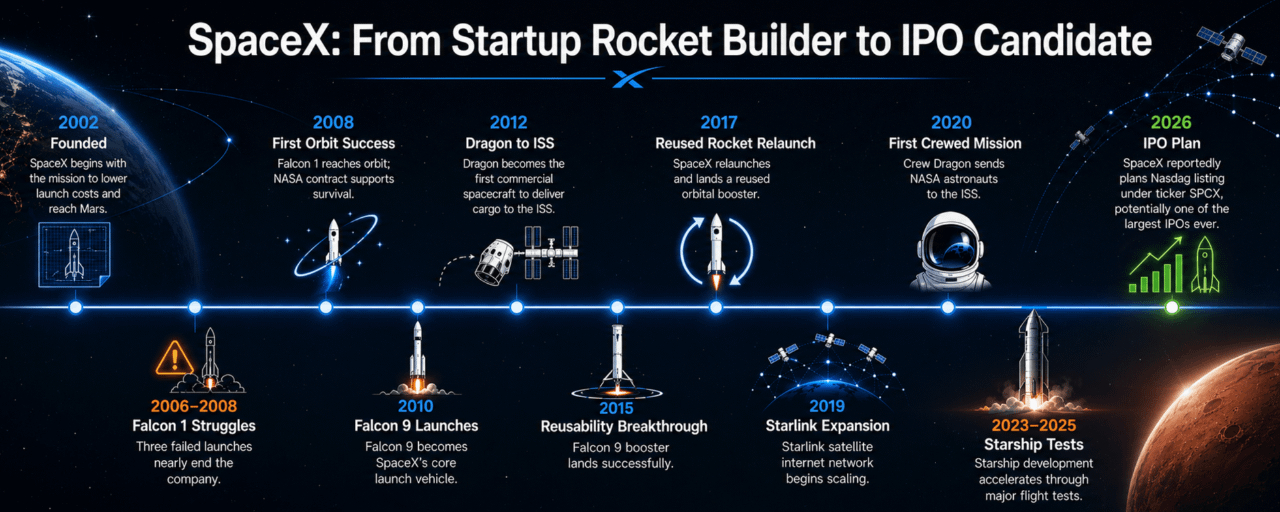
Founded in 2002 by Elon Musk, SpaceX set out with an ambitious mission: to revolutionize space transportation, dramatically reduce launch costs, and ultimately make human life multi-planetary. What began in a modest warehouse in California has evolved into one of the most influential aerospace companies in the world.
The Beginning: Turning a Vision into Reality (2002–2004)
The roots of SpaceX can be traced back to Musk's Mars Oasis concept, a project aimed at sending a small greenhouse to Mars. After discovering how expensive traditional launch systems were, he concluded that building rockets in-house could significantly lower costs. This idea led to the creation of SpaceX in 2002, with a team of experienced aerospace engineers dedicated to transforming the economics of spaceflight.
Falcon 1 and the Survival Years (2005–2009)
SpaceX’s first vehicle, Falcon 1, faced a difficult start. The rocket suffered three consecutive launch failures between 2006 and 2008, placing the company on the brink of collapse. However, on September 28, 2008, Falcon 1 successfully reached orbit during its fourth mission, marking a historic achievement for a privately funded rocket.
The success came at a critical moment. Shortly afterward, NASA awarded SpaceX a Commercial Resupply Services contract, providing financial stability and opening the door to future growth. Falcon 1 was eventually retired as the company shifted its focus to the more powerful Falcon 9.
Entering the Mainstream Space Industry (2010–2012)
In 2010, SpaceX launched Falcon 9 for the first time and introduced the Dragon spacecraft. Two years later, Dragon became the first commercial spacecraft to deliver cargo to the International Space Station (ISS), proving that private companies could successfully support NASA missions.
This milestone transformed SpaceX from an ambitious startup into a serious competitor in the global aerospace sector.
The Reusable Rocket Revolution (2013–2018)
During this period, SpaceX expanded rapidly, securing commercial launch contracts worldwide. The company’s defining breakthrough came in December 2015 when a Falcon 9 first-stage booster successfully landed after launch.
The achievement fundamentally changed the launch industry. By 2017, SpaceX successfully reused a previously flown booster, demonstrating that rocket reusability was commercially viable. This innovation helped reduce launch costs and established SpaceX as the world's leading commercial launch provider.
Expanding Beyond Rockets (2019–2022)
SpaceX entered a new phase with the launch of Starlink, a satellite internet network designed to provide global broadband coverage. The first major deployment took place in 2019, and Starlink quickly became one of the company’s most important business segments.
Another historic moment arrived in May 2020 when Crew Dragon carried NASA astronauts Doug Hurley and Bob Behnken to the ISS. The mission made SpaceX the first private company to send astronauts into orbit and restored human spaceflight capability from U.S. soil.
Meanwhile, development accelerated on Starship, the company’s next-generation fully reusable launch system intended for missions to the Moon, Mars, and deep space destinations.
Starship Era and Rapid Growth (2023–2025)
Starship testing entered a critical phase with a series of increasingly ambitious flight tests. While several early missions ended in explosions or vehicle losses, each test generated valuable engineering data.
By 2024 and 2025, SpaceX achieved significant progress, including successful trajectory demonstrations and advanced booster recovery experiments. At the same time, Starlink continued expanding globally, with new initiatives such as direct-to-cell satellite connectivity.
Investor confidence also surged as SpaceX strengthened its position across three key sectors: launch services, satellite internet, and future deep-space transportation.
Looking Ahead: The IPO Question (2026)
Reports suggest that SpaceX may be moving closer to a public market debut. According to various market discussions, the company has been linked to a potential Nasdaq listing under the ticker "SPCX," with speculation of a fundraising target near $75 billion and a valuation approaching $1.75 trillion.
If such plans materialize, the offering could rank among the largest IPOs ever conducted. However, as of now, SpaceX remains a private company, and any future public listing would represent a historic moment for both the aerospace industry and global financial markets.
Conclusion
Over two decades, SpaceX has transformed from a startup fighting for survival into a company that has reshaped the space industry. Through reusable rockets, commercial astronaut missions, Starlink, and the ambitious Starship program, the company continues to push the boundaries of what is possible in space exploration and transportation.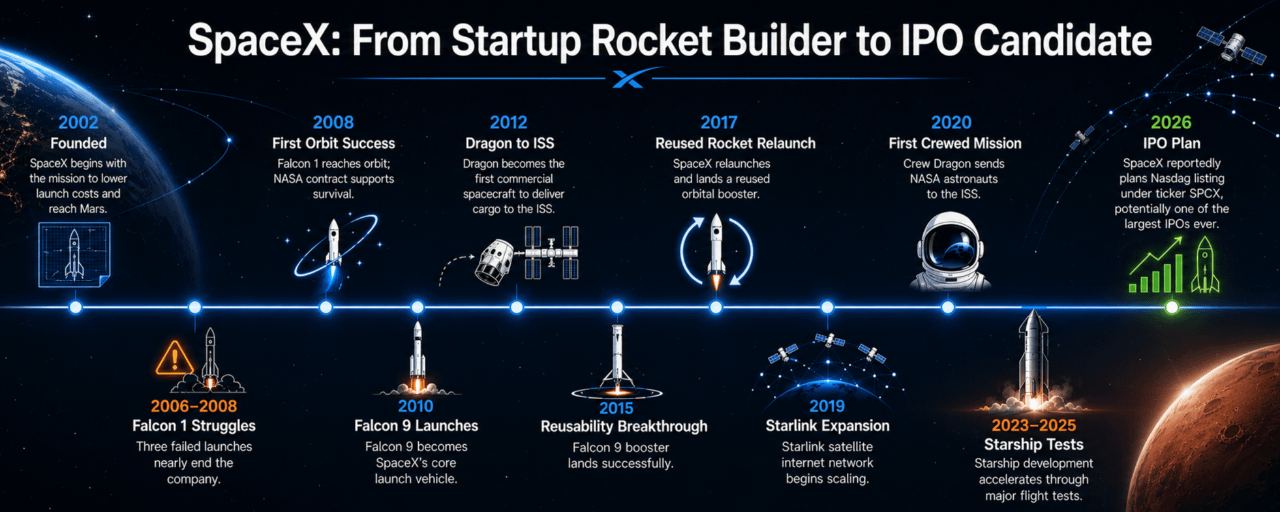
#spacx #alonmask #star #NASDAQ #BTC $BTC
