
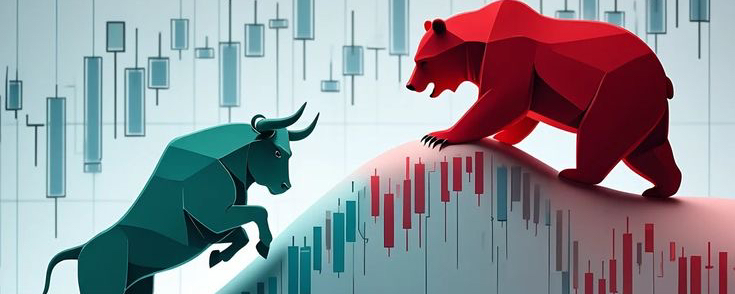
The Psychological Battlefield of Markets
Every market cycle is ultimately a war fought not on charts, but inside the minds of traders. Two emotions — greed and fear — are the most destructive forces in that war. They are opposites, yet they produce the same outcome: poor decisions and lost capital.
GREED: The Bull Market Killer
What It Is
When prices rise consistently, the brain releases dopamine — the same chemical triggered by gambling wins. The market feels safe. Risk feels invisible. Profits feel permanent. This is the neurological foundation of greed.
“The most dangerous words in investing are: ‘This time it’s different.’”
— Sir John Templeton
How It Destroys Traders
• Overleveraging — doubling down because “it can only go up”
• Ignoring exit signals — refusing to take profit because “there’s more left”
• FOMO entries — buying at the top of a rally chasing what already happened
• Position size explosion — risking 50% of capital on one trade after a win streak
• Dismissing risk management — removing stop-losses because “I’ll watch it manually”
📖 True Story: The Dot-Com Collapse (1999–2001)
By late 1999, the NASDAQ had risen 400% in five years. Day traders were quitting their jobs. A famous case: Barton Biggs, then chief global strategist at Morgan Stanley, noted that his own barber, doorman, and dentist were all boasting about their stock picks.
A retail investor named Ruth Langford (documented in John Rothchild’s A Fool and His Money) invested her entire $150,000 retirement savings into three internet companies — none of which had ever turned a profit — in late 1999. Her logic: everyone is making money, I can’t miss this.
By 2002, all three companies were bankrupt. Her savings were gone.
The NASDAQ lost 78% of its value between March 2000 and October 2002. Trillions in wealth evaporated — not because the companies stopped being exciting, but because greed had priced them at levels reality could never justify.
The greed was not born at the peak. It was built slowly, drip by drip, across years of gains — until stopping felt impossible.
📖 True Story: Bitcoin’s $69K Top (November 2021)
In October–November 2021, crypto Twitter was euphoric. Influencers were calling for $100K, $200K, even $500K Bitcoin. The Fear & Greed Index hit 84 (Extreme Greed) on November 8, 2021 — the exact week BTC peaked at $69,000.
Thousands of retail traders took out home equity loans, maxed credit cards, and leveraged 10x–20x on altcoins. On-chain data showed that over 60% of BTC supply was held by wallets that had bought in the prior 6 months — new money, late money, greedy money.
By June 2022, Bitcoin was at $17,500. Most altcoins lost 90–95%. The greed index had flipped to single digits — Extreme Fear.
FEAR: The Bear Market Opportunity Thief
What It Is
Bear markets trigger the brain’s amygdala — the survival response. Pain from losses registers twice as powerfully as pleasure from equivalent gains (Kahneman & Tversky’s Loss Aversion Theory, 1979). The market feels like a threat to survival. Every bounce looks like a trap. Every buy feels suicidal.
“Be fearful when others are greedy, and greedy when others are fearful.”
— Warren Buffett
How It Destroys Traders
• Panic selling at the bottom — locking in maximum loss right before recovery
• Paralysis — having capital but being too scared to deploy it
• Narrative adoption — believing “this time the market will never recover”
• Permanent exit — leaving markets entirely, missing the entire next bull run
• Under-sizing forever — even when conditions improve, fear prevents meaningful position entry
📖 True Story: Warren Buffett Buys While America Panics (2008)
On October 16, 2008 — six weeks after Lehman Brothers collapsed — Warren Buffett published an op-ed in the New York Times titled “Buy American. I Am.”
The Dow had lost 40% YTD. Unemployment was spiking. Banks were failing. CNN ran headlines asking if capitalism itself was broken. The Fear & Greed equivalent of that era showed pure panic.
While retail investors were withdrawing $150 billion from equity funds in Q4 2008 — the largest outflow in history at the time — Buffett was buying Goldman Sachs, GE, and Wells Fargo at crisis prices.
His Goldman Sachs deal alone — $5 billion in preferred shares at 10% yield plus warrants — returned an estimated $3.7 billion in profit by the time Goldman redeemed the stake.
The crowd’s fear was Buffett’s opportunity. Their panic was his discount.
📖 True Story: Ethereum at $80 — The Capitulation Nobody Talks About (December 2018)
In December 2018, ETH fell to $80 — down 94% from its January 2018 high of $1,400. Crypto forums were filled with posts titled “ETH is dead,” “Vitalik should shut it down,” “blockchain was a scam.”
The fear was so extreme that major venture funds quietly stopped publishing their crypto theses to avoid ridicule. Retail traders who had bought at $800–$1,400 had been underwater for a year and capitulated.
Those who bought ETH between $80–$120 in late 2018 and held saw it reach:
• $1,400 in early 2021 — 17x
• $4,800 in November 2021 — 60x
The opportunity was dressed in the clothes of disaster. Fear made most people unable to see it.
📖 True Story: Michael Burry and the Housing Market (2005–2007)
While the entire financial system was high on mortgage-backed security greed, Michael Burry (later immortalized in The Big Short) was reading the underlying loan data. He saw what everyone’s greed prevented them from seeing: subprime borrowers with no income, no jobs, and no assets holding adjustable-rate mortgages they could never repay.
He bought credit default swaps against the housing market — essentially betting it would collapse — and faced two years of investor fury, redemption requests, and personal doubt as the market kept rising.
In 2007–2008, his fund made $700 million. His investors made 489% returns.
He succeeded not because he was smarter than everyone — but because he was not infected by the greed that had blinded everyone else.
The Cycle: How Greed and Fear Feed Each Other
GREED builds slowly during bull markets
↓
Prices disconnect from fundamentals
↓
Smart money exits quietly
↓
Market peaks — greed is at maximum
↓
Sell-off begins — denial phase
↓
FEAR replaces greed rapidly
↓
Panic selling drives prices below fair value
↓
Capitulation — fear is at maximum
↓
Smart money accumulates quietly
↓
Recovery begins — most retail misses it
↓
Greed builds again...
This cycle has repeated in tulips (1637), railroads (1840s), radio stocks (1929), dot-com (2000), housing (2008), crypto (2018, 2022) — and will repeat again.
The Antidote: What Separates Survivors from Victims
Emotion State
What Most Traders Do
What Disciplined Traders Do
Extreme Greed (Bull Top) Add leverage, ignore stops Take partial profits, reduce size
Mild Greed (Mid-bull) FOMO into anything Stick to plan, no chasing
Mild Fear (Pullback) |Panic exit good positions Re-evaluate, hold if thesis intact
Extreme Fear (Bear Bottom) Sell everything, leave markets|Deploy reserved capital methodically
The Core Truth
Markets are not defeated by analysis. They are defeated by emotion mismanagement.
Greed tells you a good trade is a reason to abandon your plan.
Fear tells you a good opportunity is a reason to do nothing.
Both whisper convincingly. Both feel like wisdom in the moment. Both are traps.
The trader who learns to recognize greed as a signal to pause and fear as a signal to look harder — that trader is not just managing a portfolio. They are managing the one variable that no chart can show: themselves.