
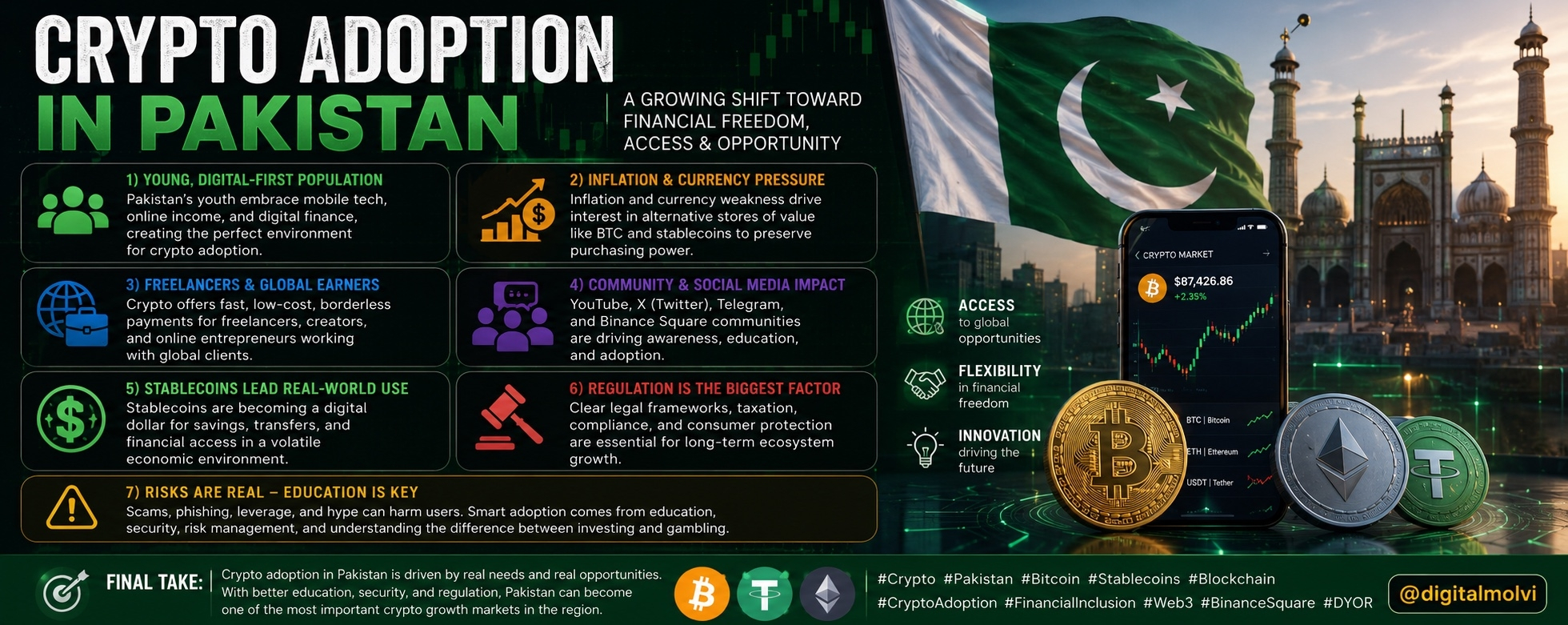
Crypto adoption in Pakistan is one of the most interesting stories in the digital asset space because it sits at the intersection of youth demographics, mobile connectivity, inflation pressure, global freelancing, and the search for alternative financial tools. While the regulatory environment has remained uncertain for years, public interest in crypto has continued to grow. That alone tells us something important: demand for digital assets often grows fastest where people are looking for flexibility, access, and financial alternatives.
Pakistan is not adopting crypto for just one reason. It is happening because several economic and social forces are pushing in the same direction.
1) A Young, Digital-First Population
Pakistan has a large young population, and younger users are naturally more open to digital finance, online income, and new technology. This matters because crypto adoption usually starts where people are already comfortable with:
mobile apps
digital wallets
online communities
remote work
internet-based income
For many young Pakistanis, crypto is not just an investment trend. It is part of a broader shift toward digital participation in the global economy.
2) Inflation and Currency Pressure Increase Interest
In countries where inflation and currency weakness are major concerns, people often look for alternative stores of value. In Pakistan, this has helped drive interest in assets outside the traditional local currency system.
That does not mean crypto is “safe” or stable—far from it. Bitcoin and altcoins are volatile. But when people lose confidence in purchasing power, they naturally start exploring:
USD-linked stablecoins
Bitcoin as a long-term hedge
digital assets as a way to diversify savings
In this environment, crypto becomes attractive not only because of upside, but because it offers an alternative financial rail.
3) Freelancers and Global Earners Play a Big Role
Pakistan has a large and growing freelance economy. Many freelancers work with international clients and face challenges related to:
cross-border payments
delays
high transfer costs
limited payment options
Crypto can look appealing here because it offers faster, borderless settlement. For digital workers, creators, and online entrepreneurs, crypto is often seen less as speculation and more as a practical payment tool.
This is one of the strongest real-world use cases for adoption in emerging markets.
4) Social Media and Community Education Drive Awareness
Crypto adoption does not spread only through institutions. It spreads through communities.
In Pakistan, awareness has grown through:
YouTube educators
X/Twitter communities
Telegram groups
Binance Square creators
local crypto influencers and educators
This creates both opportunity and risk. On one hand, education helps people understand wallets, Bitcoin, stablecoins, and blockchain. On the other hand, hype can also spread quickly, especially around meme coins, fake projects, and unrealistic profit promises.
That is why education quality matters just as much as adoption speed.
5) Stablecoins May Be More Important Than Speculation
When people talk about crypto adoption, they often focus only on Bitcoin or altcoin trading. But in many emerging markets, stablecoins may actually be the more important adoption layer.
Why? Because stablecoins can serve as:
a digital dollar alternative
a tool for preserving value
a medium for cross-border transfers
a bridge between local and global digital finance
In Pakistan, where currency pressure and payment friction matter, stablecoin usage may become one of the most practical forms of crypto adoption.
6) Regulation Remains the Biggest Uncertainty
No discussion of crypto adoption in Pakistan is complete without mentioning regulation. This is the biggest challenge.
Adoption can grow at the user level, but long-term ecosystem development needs clearer rules around:
legality
taxation
exchange access
compliance
consumer protection
Without regulatory clarity, adoption often stays informal. People may still use crypto, but businesses, builders, and institutions remain cautious. That slows down serious ecosystem growth.
The future of crypto in Pakistan will depend not only on user demand, but also on whether policymakers create a framework that balances innovation with risk control.
7) Risks Are Real and Cannot Be Ignored
Crypto adoption is not automatically positive if users enter without education. In Pakistan, as in many fast-growing markets, the biggest risks include:
scams and Ponzi schemes
phishing and wallet theft
fake trading signals
overuse of leverage
meme coin speculation without risk control
This is why the next phase of adoption must be smarter, not just bigger. Real adoption means people understand:
self-custody basics
exchange security
position sizing
volatility
the difference between investing and gambling
Without that foundation, adoption can become a trap instead of an opportunity.
Final Take
Crypto adoption in Pakistan is being driven by a powerful mix of demographics, digital behavior, inflation pressure, freelancing, and demand for alternative financial tools. The interest is real, and the use cases are growing—especially around digital savings, global payments, and financial access.
But the long-term success of crypto adoption in Pakistan will depend on three things: better education, stronger security awareness, and clearer regulation. If those pieces improve, Pakistan could become one of the most important crypto growth markets in the region.
Crypto adoption is not just about trading. In markets like Pakistan, it is increasingly about access, flexibility, and financial participation in a digital world.


