
Crypto was born from a powerful idea: people should be able to move, store, and control value without relying entirely on traditional financial institutions. That idea is one of the main reasons crypto became so attractive in the first place. It offers an alternative to the banking system—one that is open, borderless, programmable, and available 24/7.
But can crypto actually replace banks?
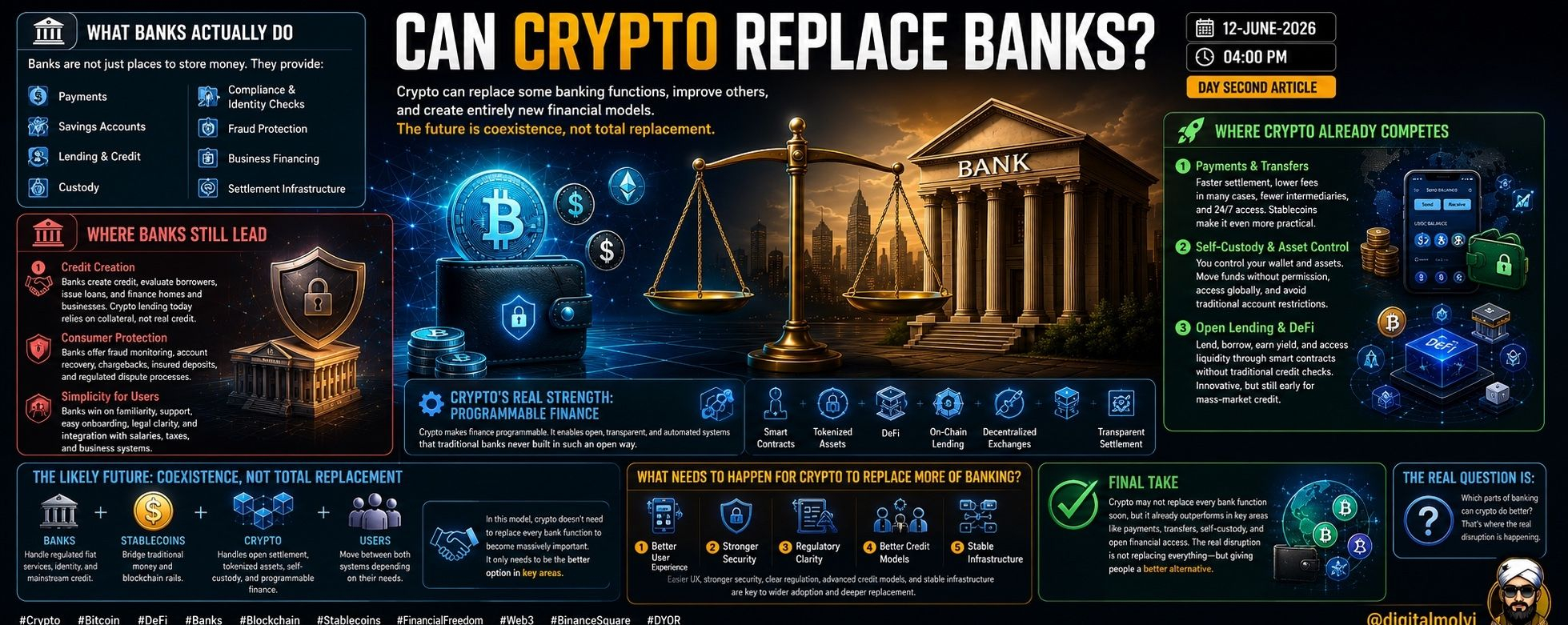
The short answer is: not fully, at least not anytime soon. Crypto can replace some banking functions, improve others, and create entirely new financial models. But banks still provide services, legal structures, and trust frameworks that crypto alone has not fully replicated at scale.
The more realistic future is not “crypto destroys banks.” It is that crypto forces finance to evolve.
What Banks Actually Do
To answer this question properly, we first need to understand what banks do.
Banks are not just places to store money. They provide:
payments
savings accounts
lending and credit
custody
compliance and identity checks
fraud protection
business financing
settlement infrastructure
So when people ask whether crypto can replace banks, the real question is whether crypto can replace all of these functions in a reliable, scalable, and user-friendly way.
Right now, the answer is mixed.
Where Crypto Already Competes with Banks
1) Payments and Transfers
This is one of crypto’s strongest areas.
Crypto allows users to send value globally without waiting for bank hours, intermediaries, or slow settlement systems. In many cases, stablecoins make this even more practical because they reduce volatility compared to assets like BTC or ETH.
For cross-border transfers, crypto can offer:
faster settlement
lower fees in some cases
fewer intermediaries
24/7 access
This is especially useful in regions where banking access is limited or international transfers are expensive and slow.
2) Self-Custody and Asset Control
Banks hold your money for you. Crypto allows you to hold your own assets directly through self-custody.
That is a major shift.
With crypto, users can:
control their own wallet
move funds without permission
access assets globally
avoid some traditional account restrictions
This is one of crypto’s most revolutionary features. But it also comes with responsibility. If you lose your keys, there is no bank help desk to reverse the mistake.
3) Open Lending and DeFi
DeFi has shown that lending, borrowing, and yield generation can happen through smart contracts instead of banks.
Users can:
lend assets
borrow against collateral
earn yield
access liquidity without traditional credit checks
This is a major innovation. But it is still far from replacing bank lending at a mass-market level because DeFi usually requires overcollateralization, which is very different from how normal consumer and business credit works.
Where Banks Still Have a Major Advantage
1) Credit Creation
This is one of the biggest reasons banks are hard to replace.
Banks do not just store money—they create credit. They evaluate borrowers, issue loans, finance homes and businesses, and support economic activity through credit systems.
Crypto has not solved this at scale in a way that matches traditional banking. Most crypto lending today depends on collateral already being posted. That means it works better for capital-rich users than for average people who need unsecured or reputation-based credit.
2) Consumer Protection
Banks offer protections that many crypto systems do not:
fraud monitoring
account recovery
chargebacks in some cases
regulated dispute processes
insured deposits in some jurisdictions
Crypto gives freedom, but freedom without safety can be dangerous for mainstream users. Scams, wallet theft, phishing, and irreversible transactions remain major barriers.
3) Simplicity for the Average User
Most people do not want to manage seed phrases, gas fees, wallet security, and network bridges. They want finance to feel simple and safe.
Banks still win on:
familiarity
customer support
easier onboarding
legal clarity
integration with salaries, taxes, and business systems
Crypto UX has improved, but it is still not easy enough for mass replacement of banking.
Crypto’s Real Strength: Programmable Finance
What makes crypto different is not just that it moves money. It makes money programmable.
With blockchain-based finance, users can interact with:
smart contracts
automated market makers
tokenized assets
on-chain lending
decentralized exchanges
transparent settlement systems
This creates financial tools that banks never offered in the same open way. Crypto is not just trying to copy banks—it is building a new financial layer with different rules.
That is why the future may be less about replacement and more about parallel systems.
The Likely Future: Coexistence, Not Total Replacement
A more realistic outcome is that crypto and banks coexist, compete, and eventually integrate.
Possible future model:
banks handle regulated fiat services, identity, and mainstream credit
crypto handles open settlement, tokenized assets, self-custody, and programmable finance
stablecoins bridge traditional money and blockchain rails
users move between both systems depending on their needs
In this model, crypto does not need to replace every bank function to become massively important. It only needs to become the better option in key areas.
And in some areas, it already is.
What Would Need to Happen for Crypto to Replace More of Banking?
For crypto to replace a larger share of banking functions, several things must improve:
1) Better User Experience
Wallets, security, and on-chain interactions must become much easier for normal users.
2) Stronger Security
The industry needs better protection against hacks, phishing, exploits, and user error.
3) Regulatory Clarity
Institutions and mainstream users need clear legal frameworks before crypto can scale into everyday finance.
4) Better Credit Models
Crypto needs more advanced reputation, identity, and undercollateralized lending systems if it wants to compete with traditional credit markets.
5) Stable Infrastructure
Scalable networks, reliable stablecoins, and trusted custody solutions are essential for broader adoption.
Final Take
Crypto is unlikely to fully replace banks in the near future, but it can absolutely replace or improve specific banking functions—especially in payments, transfers, self-custody, and open financial access. Banks still dominate in credit creation, consumer protection, legal integration, and ease of use.
So the better question may not be “Can crypto replace banks?” but rather:
Which parts of banking can crypto do better?
That is where the real disruption is happening.
Crypto’s biggest strength is not that it removes every institution. Its biggest strength is that it gives people an alternative financial system—one that is open, programmable, borderless, and increasingly difficult to ignore.


