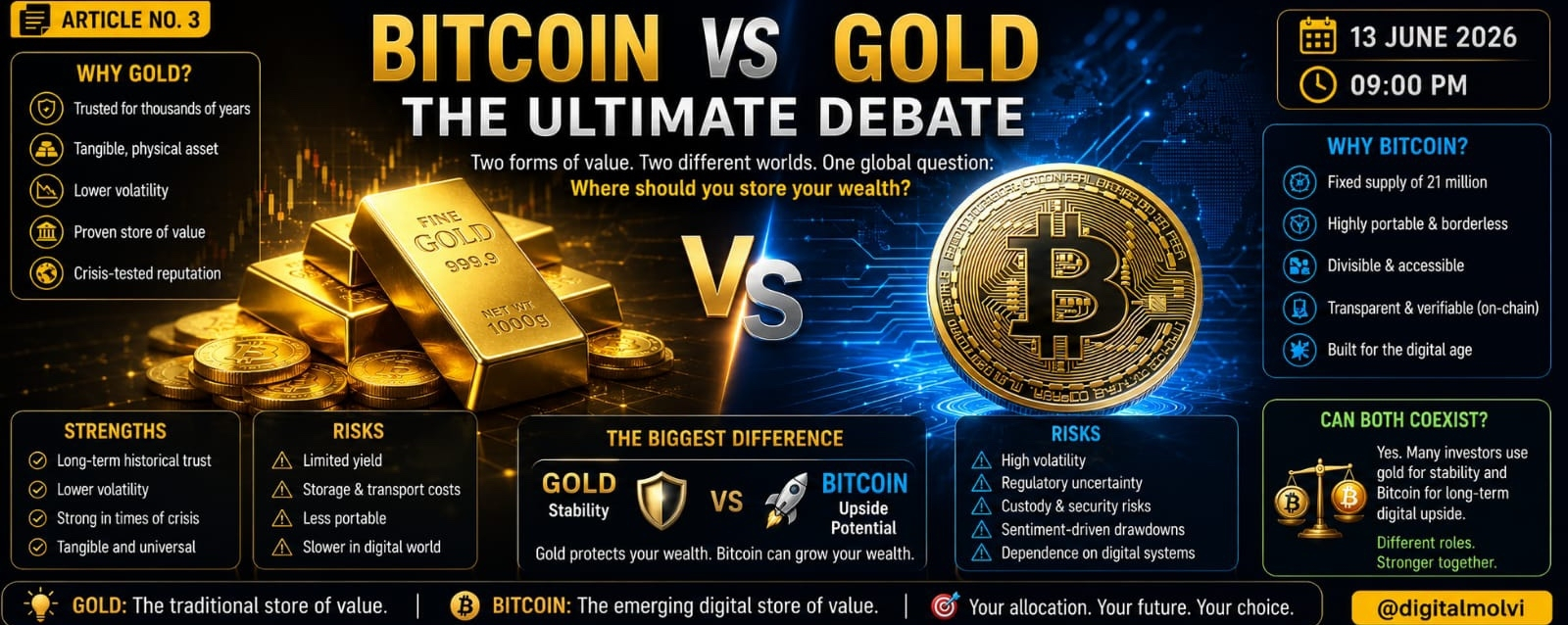
The Bitcoin vs Gold debate is one of the most important conversations in modern finance because it compares two very different forms of value storage. Gold has been trusted for thousands of years. Bitcoin is a much newer digital asset born from the internet era. One represents historical stability and physical scarcity. The other represents digital scarcity, portability, and a new financial model built for a connected world.
The debate is not really about choosing a winner in every situation. It is about understanding what each asset does well, where each one is weak, and why investors continue comparing them.
At the center of the debate is one simple question:
If people want to protect wealth, should they trust gold or Bitcoin?
The answer depends on what kind of protection they want.
Why Gold Has Been Trusted for So Long
Gold has served as a store of value for centuries because it has several qualities that made it useful across civilizations:
it is scarce
it is durable
it is widely recognized
it cannot be printed like fiat currency
it has a long history of preserving value over time
Gold’s biggest strength is trust built over generations. It has survived wars, inflationary periods, currency collapses, and political change. That historical credibility matters because investors often run toward assets with deep-rooted legitimacy during uncertain times.
Gold is also less volatile than Bitcoin, which makes it more attractive for conservative capital preservation.
Why Bitcoin Entered the Debate
Bitcoin entered the debate because it introduced something new: digital scarcity.
Bitcoin has a fixed supply cap of 21 million coins. That makes it fundamentally different from fiat currencies, which can be expanded by central banks. Supporters argue that this fixed supply gives Bitcoin “hard money” characteristics similar to gold, but in a digital form.
Bitcoin also offers advantages that gold does not:
it is easier to transfer globally
it is divisible
it is verifiable on-chain
it can be stored digitally
it is accessible 24/7
it fits naturally into the internet economy
This is why many people call Bitcoin “digital gold.”
The idea is simple: if gold was the store of value for the physical age, Bitcoin could become the store of value for the digital age.
The Case for Gold
Gold supporters usually make a few strong arguments.
1) Long-Term Trust
Gold has already proven itself over centuries. Bitcoin is still young by comparison.
2) Lower Volatility
Gold does not usually experience the kind of violent price swings that Bitcoin does. That makes it easier for conservative investors to hold.
3) Crisis Reputation
In times of geopolitical stress, inflation fear, or financial instability, gold has a long-established reputation as a defensive asset.
4) Tangible Asset
Some investors simply prefer something physical. Gold exists outside digital systems, which can feel safer to people who distrust technology or cyber infrastructure.
For these reasons, gold remains a core hedge asset in many traditional portfolios.
The Case for Bitcoin
Bitcoin supporters also have a strong case.
1) Fixed Supply
Bitcoin’s supply cap is transparent and programmatic. That appeals to investors worried about currency debasement.
2) Portability
Moving large amounts of gold across borders is difficult. Bitcoin can be transferred globally much more easily.
3) Divisibility and Accessibility
Bitcoin can be divided into very small units and accessed by anyone with internet connectivity. That makes it more flexible in a digital economy.
4) Younger Growth Profile
Gold is already a mature asset. Bitcoin, being newer, is seen by many as having greater upside potential if adoption continues.
5) Alignment with Digital Finance
As the world becomes more digital, Bitcoin fits naturally into online financial systems, exchanges, wallets, and global settlement networks.
This is why many investors see Bitcoin not just as a hedge, but also as a growth-oriented store of value.
The Biggest Difference: Stability vs Upside
The core difference between Bitcoin and gold is this:
Gold is generally chosen for stability
Bitcoin is often chosen for upside and digital scarcity
Gold is less exciting, but also less explosive.
Bitcoin is more volatile, but potentially more asymmetric.
That means the two assets often attract different types of investors:
gold appeals more to conservative wealth preservation
Bitcoin appeals more to investors willing to accept volatility for higher long-term potential
This is why the debate continues. They solve similar problems, but in very different ways.
Risks of Gold
Gold is not perfect.
Its weaknesses include:
limited yield
storage and transport costs
less portability
slower integration into digital systems
lower upside compared with high-growth assets
Gold protects purchasing power over long periods, but it is not designed for fast-moving digital finance.
Risks of Bitcoin
Bitcoin also has clear risks:
high volatility
regulatory uncertainty
custody and security risks
sentiment-driven drawdowns
dependence on digital infrastructure
Bitcoin may be scarce, but scarcity alone does not remove risk. It can still experience deep corrections, especially during risk-off periods.
That is why Bitcoin is often better understood as a high-conviction, high-volatility asset rather than a perfect safe haven.
Can Both Exist in the Same Portfolio?
Yes—and that may be the most realistic answer.
Many investors do not need to choose only one. Gold and Bitcoin can serve different roles in the same portfolio:
gold for stability and traditional hedging
Bitcoin for digital scarcity and long-term upside
In that sense, the debate may be less about replacement and more about allocation.
Gold represents the old world of hard money.
Bitcoin represents the new world of digital hard money.
Both can matter.
Final Take
The Bitcoin vs Gold debate is really a debate between historical trust and digital innovation. Gold has centuries of credibility, lower volatility, and a strong reputation during uncertainty. Bitcoin offers fixed supply, portability, divisibility, and stronger upside potential in a digital-first world.
Gold is the traditional store of value.
Bitcoin is the emerging digital store of value.
Neither is perfect, and neither fully cancels the other out. The better choice depends on an investor’s goals, risk tolerance, and view of the future.
For conservative protection, gold still has the edge.
For digital scarcity and asymmetric growth, Bitcoin remains the stronger candidate.