
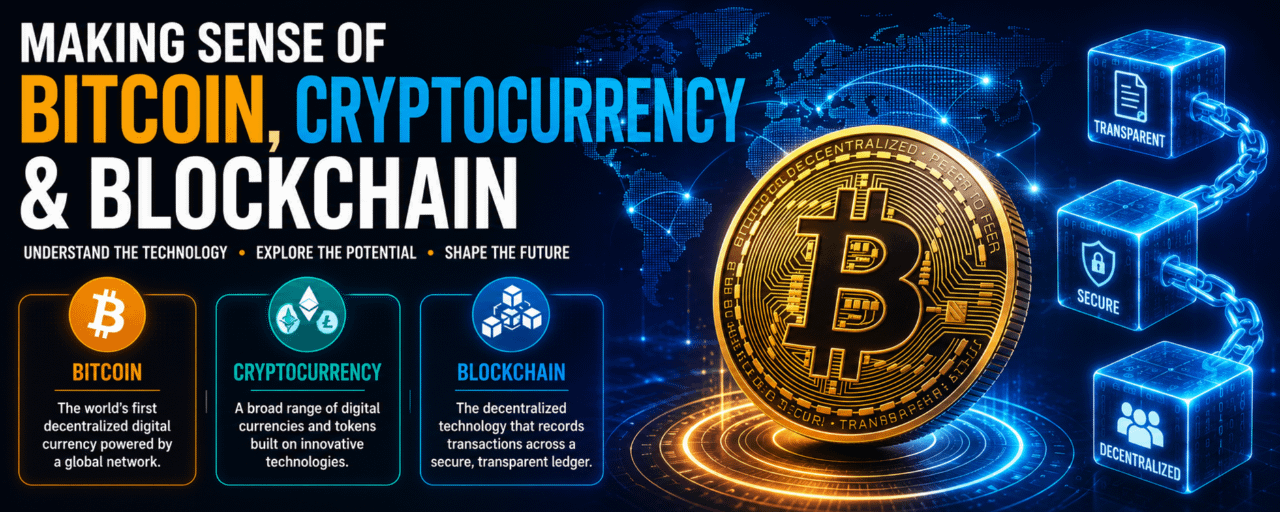
Making Sense of Bitcoin, Cryptocurrency and Blockchain.
Introduction
Over the past decade, terms like Bitcoin, cryptocurrency, and blockchain have become some of the most discussed topics in technology and finance. While many people have heard these words, understanding how they work and why they matter can still be challenging.
Some view cryptocurrencies as the future of money, while others see them as speculative investments. Meanwhile, blockchain technology is being explored for applications far beyond digital currencies, from supply chain management to healthcare and voting systems.
To understand this rapidly evolving digital revolution, it is important to first explore the relationship between Bitcoin, cryptocurrencies, and blockchain technology.
What Is Bitcoin?
Bitcoin is the world's first decentralized digital currency. It was introduced in 2009 by an anonymous individual or group using the name Satoshi Nakamoto.
Unlike traditional currencies such as the U.S. Dollar, Euro, or South African Rand, Bitcoin is not controlled by a government, central bank, or financial institution. Instead, it operates on a decentralized network of computers spread across the globe.
Bitcoin allows users to:
Send money directly to one another.
Store value digitally.
Make cross-border transactions.
Operate outside traditional banking systems.
The total supply of Bitcoin is capped at 21 million coins, making it a scarce digital asset that many investors compare to gold.
What Is Cryptocurrency?
Cryptocurrency is a broad term used to describe digital currencies that use cryptography to secure transactions and control the creation of new units.
Bitcoin is simply one cryptocurrency among thousands that exist today.
Popular cryptocurrencies include:
Bitcoin
Ethereum
Solana
Cardano
XRP
Each cryptocurrency has its own purpose, technology, and ecosystem.
Some are designed primarily as digital money, while others support decentralized applications, smart contracts, gaming platforms, artificial intelligence networks, or financial services.
What Is Blockchain?
Blockchain is the technology that makes cryptocurrencies possible.
A blockchain is essentially a digital ledger that records transactions in a secure, transparent, and tamper-resistant manner.
Instead of storing information on a single server, blockchain distributes data across thousands of computers called nodes.
Each block contains:
Transaction data.
A timestamp.
A cryptographic link to the previous block.
These blocks are connected in a chain, creating a permanent record of activity.
Because every participant in the network holds a copy of the ledger, altering historical data becomes extremely difficult.
How Bitcoin Uses Blockchain
Bitcoin relies on blockchain technology to record and verify every transaction.
When someone sends Bitcoin:
The transaction is broadcast to the network.
Computers verify the transaction.
The transaction is grouped with others into a block.
The block is added to the blockchain.
The transaction becomes permanently recorded.
This process eliminates the need for banks or payment processors to act as intermediaries.
The result is a financial system that can operate 24 hours a day, seven days a week, anywhere in the world.
Why Blockchain Matters Beyond Cryptocurrency
Although blockchain became famous because of Bitcoin, its applications extend far beyond digital money.
Industries exploring blockchain technology include:
Finance
Banks and financial institutions are investigating blockchain for faster payments, reduced settlement times, and lower transaction costs.
Supply Chain Management
Companies can use blockchain to track products from manufacturing to delivery, improving transparency and reducing fraud.
Healthcare
Medical records can be securely stored and shared while maintaining patient privacy.
Real Estate
Property ownership records can be digitized and verified through blockchain systems.
Voting Systems
Blockchain-based voting could potentially improve election transparency and reduce tampering risks.
The Advantages of Cryptocurrency
Cryptocurrencies offer several benefits compared to traditional financial systems.
Decentralization
No single authority controls the network.
Accessibility
Anyone with internet access can participate.
Transparency
Transactions are publicly recorded on blockchain networks.
Speed
International transfers can often be completed faster than traditional banking systems.
Security
Advanced cryptography helps protect user funds and network integrity.
The Risks and Challenges
Despite their potential, cryptocurrencies also face significant challenges.
Volatility
Prices can rise or fall dramatically within short periods.
Regulation
Governments worldwide continue developing rules for digital assets.
Security Threats
While blockchain itself is highly secure, exchanges and wallets can still be targeted by hackers.
Scalability
Some blockchain networks struggle to process large numbers of transactions efficiently.
Adoption
Mainstream acceptance remains a work in progress despite growing interest from businesses and institutions.
Bitcoin's Role in the Future
Bitcoin has evolved from an experimental digital currency into a globally recognized asset class. Institutional investors, corporations, and even governments have begun exploring its potential role in the financial system.
Supporters believe Bitcoin could serve as:
A store of value.
A hedge against inflation.
Digital gold.
A borderless payment network.
Critics argue that volatility and regulatory uncertainty remain obstacles to widespread adoption.
Regardless of differing opinions, Bitcoin has sparked one of the most significant technological and financial innovations of the 21st century.
Conclusion
Bitcoin, cryptocurrency, and blockchain are closely connected but distinct concepts. Bitcoin is a digital currency, cryptocurrency is the broader category of digital assets, and blockchain is the underlying technology that powers them.
Together, they are transforming how people think about money, ownership, trust, and digital transactions. While challenges remain, the continued development of blockchain technology suggests that its impact will extend far beyond finance.
As the digital economy continues to grow, understanding Bitcoin, cryptocurrency, and blockchain is becoming increasingly important for investors, businesses, students, and anyone interested in the future of technology.