
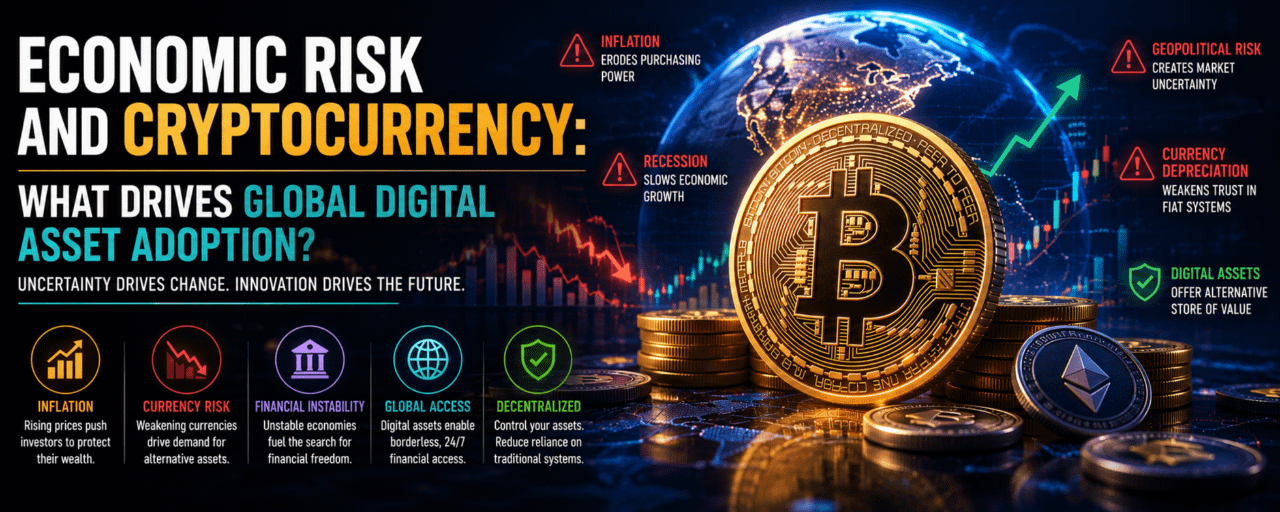
Economic Risk and Cryptocurrency: What Drives Global Digital Asset Adoption?
Introduction
The rise of cryptocurrency has transformed the global financial landscape, attracting investors, businesses, and governments alike. While technological innovation and financial opportunity have fueled much of this growth, another powerful factor continues to influence cryptocurrency adoption worldwide: economic risk.
Periods of economic uncertainty often push individuals and institutions to seek alternative ways to preserve wealth, transfer value, and access financial services. As a result, cryptocurrencies have increasingly become part of the conversation surrounding financial resilience and risk management.
Understanding the relationship between economic risk and cryptocurrency adoption provides valuable insight into why digital assets continue to gain traction across diverse regions and economies.
Understanding Economic Risk
Economic risk refers to the possibility that financial conditions, government policies, or market events may negatively affect wealth, income, or investment returns.
Common forms of economic risk include:
Inflation
Currency depreciation
Banking instability
Recession
Sovereign debt crises
Political uncertainty
Capital controls
High unemployment
When these risks intensify, individuals and businesses often search for alternative financial solutions to protect their assets and maintain economic stability.
Why Cryptocurrencies Attract Attention During Economic Uncertainty
Cryptocurrencies offer characteristics that distinguish them from traditional financial assets and banking systems.
These features include:
Decentralization
Most cryptocurrencies operate independently of central banks and governments. This decentralized structure appeals to individuals who have concerns about monetary policy or financial system stability.
Accessibility
Anyone with internet access can participate in cryptocurrency networks without requiring approval from traditional financial institutions.
Borderless Transactions
Digital assets can be transferred globally without many of the restrictions associated with conventional banking systems.
Transparency
Blockchain technology provides a public ledger that records transactions in a secure and verifiable manner.
Limited Supply
Certain cryptocurrencies, particularly Bitcoin, have fixed supply limits that some investors view as protection against inflation.
Inflation and Cryptocurrency Adoption
One of the strongest drivers of cryptocurrency adoption is inflation.
When inflation rises rapidly, the purchasing power of traditional currencies declines. Consumers may find that their savings buy less over time, creating a demand for alternative stores of value.
Many cryptocurrency supporters argue that digital assets such as Bitcoin can help preserve wealth because their supply cannot be expanded indefinitely.
As inflation concerns have increased globally in recent years, interest in cryptocurrencies has grown among both retail and institutional investors.
Currency Instability and Digital Assets
In countries experiencing significant currency depreciation, cryptocurrencies often become attractive alternatives.
When national currencies lose value due to economic mismanagement, political instability, or external shocks, citizens may seek digital assets to:
Protect savings.
Conduct international transactions.
Access global financial markets.
Reduce exposure to local currency volatility.
This trend has been observed in multiple regions where citizens face challenges related to exchange rate fluctuations and restricted access to foreign currencies.
Banking System Concerns
Trust in financial institutions plays an important role in economic behavior.
During banking crises or periods of financial instability, some individuals choose to diversify their holdings beyond traditional banks.
Cryptocurrencies offer users direct control over their digital assets through private wallets, reducing dependence on intermediaries.
While this self-custody model introduces new responsibilities and risks, it appeals to individuals seeking greater financial independence.
Institutional Adoption During Uncertain Times
Economic risk does not only influence individual investors.
Institutional investors increasingly consider cryptocurrencies as part of broader portfolio diversification strategies.
Large investment firms, hedge funds, and publicly traded companies have explored digital assets as potential:
Inflation hedges.
Alternative investments.
Portfolio diversifiers.
Long-term growth opportunities.
This growing institutional participation has contributed to cryptocurrency's evolution from a niche technology into a recognized asset class.
The Role of Technology and Financial Innovation
While economic risk encourages adoption, technological innovation remains equally important.
Several developments have accelerated cryptocurrency growth:
Blockchain Infrastructure
Improved blockchain networks provide greater security, efficiency, and scalability.
Mobile Accessibility
Smartphone adoption has made cryptocurrency platforms more accessible to global populations.
Decentralized Finance (DeFi)
DeFi platforms offer lending, borrowing, trading, and investment services without traditional intermediaries.
Stablecoins
Cryptocurrencies linked to traditional currencies provide an alternative for users seeking lower volatility.
Together, these innovations make digital assets more practical for everyday financial use.
Challenges That Limit Adoption
Despite growing interest, several obstacles continue to affect cryptocurrency adoption.
Regulatory Uncertainty
Governments worldwide are still developing frameworks for digital asset regulation.
Market Volatility
Cryptocurrency prices can fluctuate significantly, creating risk for investors and businesses.
Security Concerns
Scams, hacks, and poor security practices remain challenges within the industry.
Financial Literacy
Many potential users still lack sufficient understanding of blockchain technology and digital assets.
Addressing these issues will be essential for broader mainstream adoption.
Emerging Global Trends
Research suggests several trends will continue shaping cryptocurrency adoption:
Increased institutional participation.
Expansion of decentralized finance.
Growth of blockchain-based payment systems.
Development of central bank digital currencies (CBDCs).
Greater integration of artificial intelligence and blockchain technology.
Enhanced regulatory clarity in major markets.
These developments may influence how cryptocurrencies interact with traditional financial systems in the coming years.
The Future of Cryptocurrency in a Risk-Filled World
As global economies continue to face inflationary pressures, geopolitical uncertainty, and rapid technological change, cryptocurrencies are likely to remain an important topic of discussion.
While digital assets are not a perfect solution to economic risk, they offer alternative financial tools that appeal to individuals seeking diversification, accessibility, and greater control over their wealth.
The future of cryptocurrency adoption will depend on a combination of economic conditions, technological innovation, regulatory developments, and public trust.
Conclusion
Economic risk has become one of the most significant drivers of cryptocurrency adoption worldwide. Inflation, currency instability, banking concerns, and broader financial uncertainty have encouraged individuals and institutions to explore digital assets as alternative financial instruments.
At the same time, advances in blockchain technology, decentralized finance, and digital infrastructure continue to expand the usefulness of cryptocurrencies beyond speculation.
As the global economy evolves, understanding the relationship between economic risk and cryptocurrency adoption will be essential for investors, policymakers, businesses, and anyone interested in the future of finance. The growing intersection between economic uncertainty and digital innovation suggests that cryptocurrencies will continue to play an increasingly important role in the modern financial ecosystem.
