
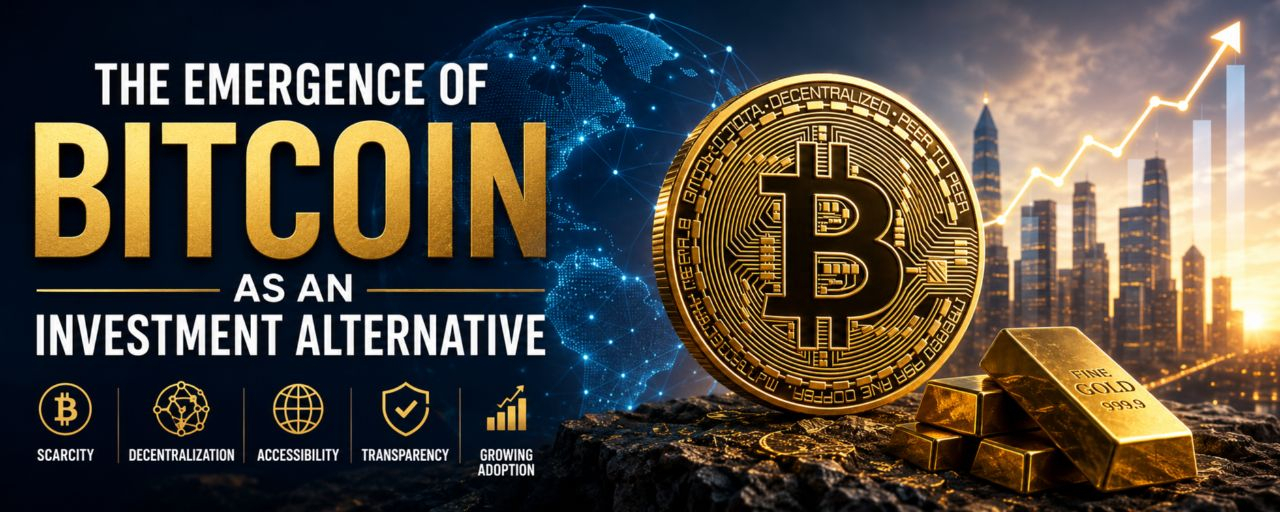
The Emergence of Bitcoin as an Investment Alternative
Introduction
Over the past decade, Bitcoin has evolved from a little-known digital experiment into one of the most discussed investment assets in the world. Initially dismissed by many financial experts as a speculative novelty, Bitcoin has gradually gained acceptance among retail investors, institutional funds, corporations, and even governments.
As traditional financial markets face challenges such as inflation, economic uncertainty, and changing monetary policies, Bitcoin has emerged as an alternative investment option that offers a unique combination of scarcity, accessibility, and technological innovation.
Today, Bitcoin is no longer viewed solely as a digital currency—it has become an asset class that is reshaping how investors think about wealth preservation and portfolio diversification.
The Birth of Bitcoin
Bitcoin was introduced in 2009 by the pseudonymous creator Satoshi Nakamoto. The cryptocurrency was designed as a decentralized peer-to-peer payment system that could operate without the need for banks or government control.
Built on blockchain technology, Bitcoin enables users to transfer value securely across the globe while maintaining transparency and security through a distributed network of computers.
What began as an experiment among technology enthusiasts soon attracted attention from investors seeking alternatives to traditional financial systems.
Why Investors Turned to Bitcoin
Several factors contributed to Bitcoin's emergence as an investment alternative.
Scarcity
Unlike traditional currencies that can be printed by central banks, Bitcoin has a maximum supply of 21 million coins.
This limited supply has led many investors to view Bitcoin as a scarce asset similar to gold.
Decentralization
Bitcoin operates independently of governments and financial institutions.
This decentralized structure appeals to investors who seek protection from political and monetary uncertainties.
Accessibility
Anyone with internet access can purchase, store, and transfer Bitcoin.
This accessibility has expanded investment opportunities to millions of people worldwide.
Transparency
Every Bitcoin transaction is recorded on a public blockchain, creating a transparent and verifiable financial system.
Bitcoin as Digital Gold
One of the most common comparisons made by investors is between Bitcoin and gold.
Gold has historically served as a store of value during periods of economic instability. Similarly, Bitcoin's limited supply and independence from traditional financial systems have led many supporters to describe it as "digital gold."
Both assets share several characteristics:
Scarcity
Durability
Global recognition
Resistance to inflationary policies
Long-term value preservation potential
While gold has thousands of years of history behind it, Bitcoin has quickly gained recognition as a modern alternative for wealth storage.
Institutional Adoption Changes Everything
A major turning point in Bitcoin's investment journey came when institutional investors began entering the market.
Large investment firms, hedge funds, pension funds, and publicly traded companies started allocating portions of their portfolios to Bitcoin.
Institutional adoption brought several benefits:
Increased credibility.
Greater market liquidity.
Enhanced infrastructure.
Improved regulatory engagement.
Broader public awareness.
As institutions entered the market, Bitcoin's reputation shifted from a speculative asset to a legitimate investment consideration.
Inflation and Economic Uncertainty
Global economic conditions have played a significant role in Bitcoin's growth.
Periods of rising inflation and currency depreciation often lead investors to seek alternative stores of value.
Many Bitcoin supporters believe the cryptocurrency can serve as a hedge against inflation because its supply cannot be expanded beyond its fixed limit.
Although debates continue regarding Bitcoin's effectiveness as an inflation hedge, economic uncertainty has undoubtedly increased investor interest in digital assets.
Portfolio Diversification
Modern investors increasingly seek diversification to reduce risk.
Bitcoin offers exposure to an asset class that behaves differently from traditional investments such as:
Stocks
Bonds
Real estate
Commodities
By adding Bitcoin to diversified portfolios, some investors aim to improve risk-adjusted returns while gaining exposure to emerging technologies.
The Role of Technology
Bitcoin's appeal extends beyond financial characteristics.
The underlying blockchain technology has demonstrated the potential to transform industries through decentralized systems, smart contracts, and secure digital transactions.
Investors often view Bitcoin as both:
A financial asset.
A bet on the future of blockchain technology.
This dual appeal has contributed significantly to its growth.
Challenges and Risks
Despite its popularity, Bitcoin remains a high-risk investment.
Volatility
Bitcoin prices can experience significant fluctuations within short periods.
Regulatory Uncertainty
Governments worldwide continue developing frameworks for digital asset regulation.
Security Concerns
Although the Bitcoin network itself is highly secure, exchanges and wallets remain potential targets for cybercriminals.
Market Sentiment
Investor sentiment, media coverage, and macroeconomic developments can strongly influence price movements.
Potential investors should carefully assess these risks before allocating capital.
The Future of Bitcoin as an Investment
As adoption continues to grow, Bitcoin's role within global financial markets may expand further.
Several developments could shape its future:
Increased institutional participation.
Enhanced regulatory clarity.
Greater integration with financial services.
Broader public adoption.
Continued technological innovation.
While uncertainty remains, Bitcoin has already established itself as one of the most influential financial innovations of the modern era.
Conclusion
The emergence of Bitcoin as an investment alternative represents a significant shift in the way people think about money, wealth preservation, and financial independence. What began as a decentralized digital currency has evolved into a globally recognized asset that attracts investors from all walks of life.
Driven by scarcity, technological innovation, and growing institutional acceptance, Bitcoin has become a compelling option for those seeking diversification and exposure to the digital economy.
Although risks remain, Bitcoin's journey from a niche experiment to a mainstream investment asset highlights its growing importance in the future of global finance. Whether viewed as digital gold, a speculative asset, or a technological breakthrough, Bitcoin has firmly secured its place in the modern investment landscape.