
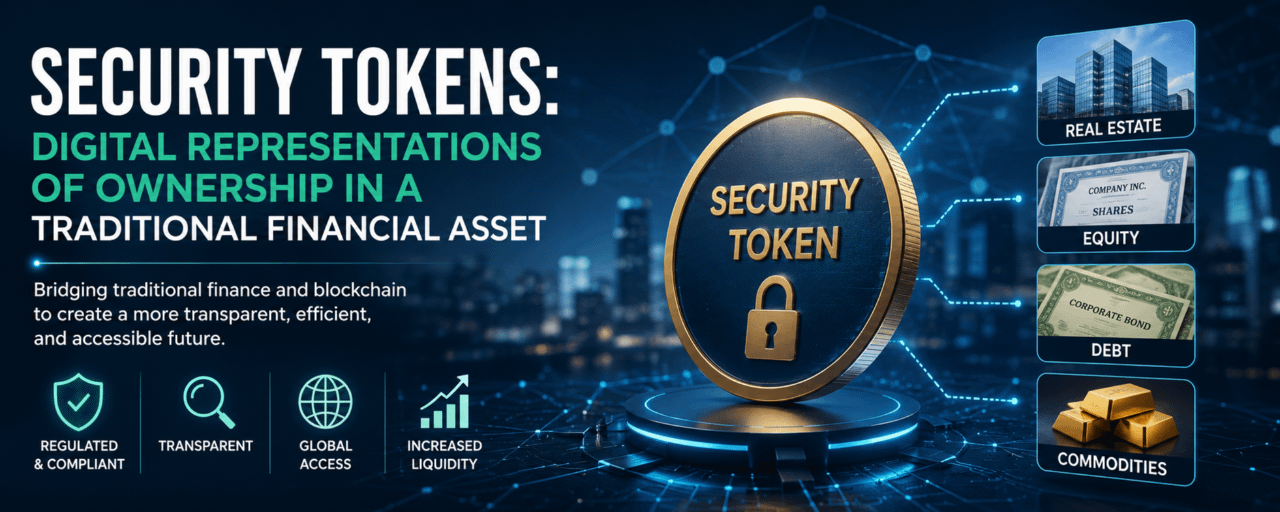
Security Tokens: Digital Representations of Ownership in Traditional Financial Assets
Introduction
As blockchain technology continues to transform the financial world, security tokens have emerged as one of the most promising innovations in digital finance. Unlike cryptocurrencies such as Bitcoin, which primarily function as digital currencies, security tokens represent ownership in real-world financial assets such as stocks, bonds, real estate, investment funds, and other regulated securities.
By combining traditional investments with blockchain technology, security tokens offer a modern, efficient, and transparent way to manage ownership and transfer value.
What Are Security Tokens?
A security token is a digital asset issued on a blockchain that represents ownership rights in an underlying financial asset. These tokens are subject to securities laws and regulations, similar to traditional investment products.
For example, a company can issue security tokens that represent shares in the business. Investors who purchase these tokens gain rights similar to traditional shareholders, including ownership interests, dividends, voting rights, or profit-sharing arrangements.
Because security tokens are backed by real assets, they differ significantly from utility tokens, which are designed primarily to provide access to a product or service.
How Security Tokens Work
Security tokens are created through a process known as Security Token Offering (STO). During an STO, investors purchase blockchain-based tokens that represent ownership in a regulated asset.
The blockchain records:
Ownership information
Transaction history
Compliance requirements
Transfer restrictions
Investor eligibility
This creates a secure and transparent record that can be verified at any time.
Types of Security Tokens
Equity Tokens
Equity tokens represent ownership shares in a company. Similar to traditional stocks, they may provide voting rights, dividend payments, and participation in company growth.
Debt Tokens
Debt tokens represent loans or bonds. Investors receive interest payments and repayment according to predetermined terms.
Asset-Backed Tokens
These tokens are backed by tangible assets such as:
Real estate
Precious metals
Artwork
Commodities
Investors gain exposure to valuable assets without needing direct physical ownership.
Revenue-Sharing Tokens
Revenue-sharing tokens allow investors to receive a portion of profits generated by a project, company, or asset.
Benefits of Security Tokens
Increased Accessibility
Security tokens can make investing more accessible by allowing fractional ownership. Instead of purchasing an entire property or expensive asset, investors can buy smaller tokenized portions.
Greater Liquidity
Traditional assets such as real estate are often difficult to buy and sell quickly. Tokenization allows these assets to be traded more efficiently through approved digital marketplaces.
Enhanced Transparency
Blockchain technology provides a transparent and tamper-resistant record of ownership and transactions, reducing fraud and improving trust.
Lower Costs
By automating processes and reducing the need for intermediaries, security tokens can lower administrative and transaction costs.
Faster Settlement
Traditional financial transactions may take days to settle. Blockchain-based transactions can often be completed much more quickly.
Challenges and Risks
Despite their advantages, security tokens face several challenges.
Regulatory Compliance
Because security tokens represent regulated financial assets, issuers must comply with complex securities laws that vary across countries.
Limited Market Adoption
While the industry is growing, security token markets remain relatively small compared to traditional stock exchanges and cryptocurrency markets.
Technical Risks
As with any blockchain-based asset, security tokens may face cybersecurity threats, platform vulnerabilities, or operational failures.
Investor Education
Many investors are still unfamiliar with blockchain technology and security token investments, creating barriers to wider adoption.
Security Tokens vs. Cryptocurrencies
Although both exist on blockchain networks, security tokens and cryptocurrencies serve different purposes.
Security Tokens Cryptocurrencies Represent ownership in real assets Function mainly as digital currencies Regulated by securities laws Often subject to different regulations May provide dividends or voting rights Generally do not provide ownership rights Backed by underlying assets Value often determined by market demand
The Future of Security Tokens
Many financial experts believe security tokens could play a major role in the future of capital markets. As regulations become clearer and blockchain infrastructure improves, more businesses, investment firms, and financial institutions are exploring tokenized assets.
Industries such as real estate, venture capital, private equity, and global finance may benefit significantly from the efficiency, transparency, and accessibility offered by security token technology.
Conclusion
Security tokens represent a powerful bridge between traditional finance and blockchain innovation. By digitizing ownership of real-world assets, they offer investors new opportunities while improving efficiency, transparency, and accessibility in financial markets.
Although regulatory and technical challenges remain, security tokens have the potential to reshape how assets are owned, traded, and managed in the digital economy. As adoption grows, they may become an essential component of the next generation of global financial systems.$SPCXB