
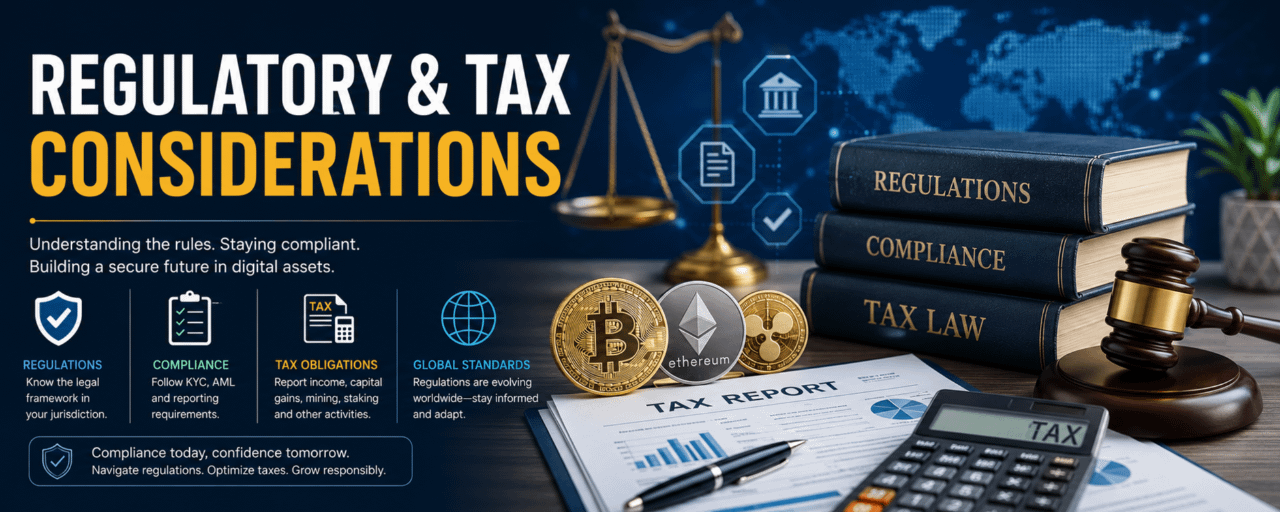
Regulatory & Tax Considerations in Cryptocurrency and Digital Assets
Introduction
As cryptocurrencies and blockchain-based assets continue to gain global adoption, governments and regulatory agencies are increasing their oversight of the digital asset industry. While cryptocurrencies offer innovation, financial freedom, and investment opportunities, they also introduce important regulatory and tax obligations that investors, businesses, and traders must understand.
Failure to comply with regulations or tax requirements can result in penalties, legal issues, and unexpected financial liabilities. Therefore, understanding the regulatory and tax landscape is essential for anyone involved in digital assets.
Why Regulation Matters
Regulation helps create a safer and more transparent environment for participants in the cryptocurrency market. Governments seek to balance innovation with consumer protection, financial stability, and the prevention of illegal activities such as fraud, money laundering, and terrorist financing.
Effective regulation can:
Protect investors from scams and fraudulent schemes.
Improve market transparency.
Encourage institutional adoption.
Reduce financial crime.
Promote long-term industry growth.
As the digital asset market matures, regulatory frameworks continue to evolve around the world.
Cryptocurrency Regulations Around the World
Different countries approach cryptocurrency regulation in different ways.
Some nations have embraced digital assets and established clear legal frameworks, while others have imposed restrictions or outright bans.
Regulatory authorities commonly focus on:
Cryptocurrency exchanges
Stablecoins
Security tokens
Initial coin offerings (ICOs)
Anti-money laundering (AML) compliance
Know Your Customer (KYC) requirements
Businesses operating in the cryptocurrency sector must often register with regulators and comply with reporting obligations.
Taxation of Cryptocurrency
In many jurisdictions, cryptocurrencies are considered taxable assets. This means that transactions involving digital assets may trigger tax obligations.
Tax authorities often require individuals and businesses to report:
Cryptocurrency purchases and sales
Trading profits and losses
Mining income
Staking rewards
Airdrops
Payments received in cryptocurrency
The specific rules vary by country, making it important to understand local tax regulations.
Capital Gains Tax
One of the most common tax considerations involves capital gains.
A capital gain occurs when a cryptocurrency is sold or exchanged for more than its original purchase price.
For example:
Buy Bitcoin for $10,000
Sell Bitcoin for $15,000
Taxable gain = $5,000
Depending on local laws, investors may be required to pay capital gains tax on the profit.
Similarly, losses may sometimes be used to offset gains and reduce tax liability.
Income Tax Considerations
Certain cryptocurrency activities may be treated as taxable income rather than capital gains.
Examples include:
Mining Rewards
Cryptocurrency earned through mining is often treated as income based on its fair market value when received.
Staking Rewards
Rewards earned from staking may also be taxable as income upon receipt.
Salary Payments
Employees paid in cryptocurrency generally must report the value of the payment as employment income.
Business Transactions
Companies accepting cryptocurrency as payment may need to recognize taxable revenue based on the asset's value at the time of the transaction.
Record-Keeping Requirements
Maintaining accurate records is essential for tax compliance.
Investors should keep records of:
Purchase dates
Sale dates
Transaction amounts
Wallet addresses
Exchange statements
Transaction fees
Fair market values
Good record-keeping helps simplify tax reporting and provides documentation if questions arise from tax authorities.
Compliance for Businesses
Businesses operating within the cryptocurrency industry face additional compliance requirements.
These may include:
Customer identity verification (KYC)
Anti-money laundering procedures
Transaction monitoring
Regulatory reporting
Financial audits
Data protection obligations
Compliance helps businesses build trust with customers, regulators, and financial institutions.
Emerging Regulatory Trends
Governments and regulators continue to develop new frameworks for digital assets.
Current areas of focus include:
Stablecoin regulation
Decentralized finance (DeFi)
Tokenized securities
Central Bank Digital Currencies (CBDCs)
Cross-border cryptocurrency transactions
Consumer protection standards
As regulations evolve, participants must stay informed about new legal requirements.
Best Practices for Investors
To reduce regulatory and tax risks, investors should:
Stay informed about local laws.
Use reputable exchanges and service providers.
Maintain accurate transaction records.
Report taxable activities honestly.
Seek professional tax advice when necessary.
Review regulatory updates regularly.
Taking a proactive approach can help avoid costly mistakes and ensure compliance.
Conclusion
Regulatory and tax considerations are becoming increasingly important as cryptocurrencies and digital assets enter the mainstream financial system. While regulations may vary between countries, the overall trend is toward greater transparency, accountability, and oversight.
Understanding tax obligations, maintaining proper records, and staying informed about regulatory developments can help investors and businesses navigate the digital asset landscape with confidence. As the industry continues to mature, compliance will remain a key factor in achieving sustainable growth and long-term success in the cryptocurrency ecosystem.$TSLAB