
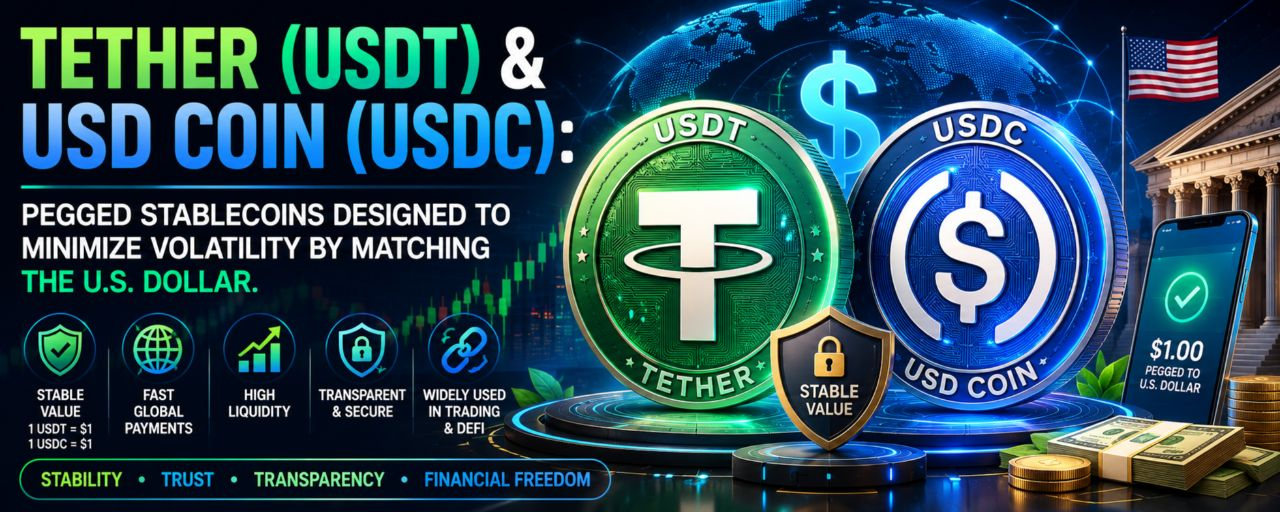
Tether (USDT) & USD Coin (USDC): Stablecoins Designed to Match the U.S. Dollar
Introduction
Cryptocurrencies are known for their price volatility. Assets such as Bitcoin and Ethereum can experience significant price swings within hours or even minutes. While this volatility creates opportunities for traders and investors, it can also make cryptocurrencies less practical for everyday transactions and financial planning.
To address this challenge, stablecoins were introduced. Among the most widely used stablecoins are Tether (USDT) and USD Coin (USDC), two digital assets designed to maintain a stable value by being pegged to the U.S. dollar.
These stablecoins have become essential components of the cryptocurrency ecosystem, providing stability, liquidity, and a bridge between traditional finance and digital assets.
What Are Stablecoins?
Stablecoins are cryptocurrencies designed to maintain a relatively stable price by linking their value to another asset, such as:
The U.S. dollar
Gold
Government bonds
Other fiat currencies
USDT and USDC are dollar-backed stablecoins, meaning each token aims to maintain a value of approximately $1.
Their primary purpose is to provide the benefits of blockchain technology while minimizing the volatility commonly associated with cryptocurrencies.
Tether (USDT)
Tether (USDT) is the world's largest and most widely traded stablecoin.
Launched in 2014, USDT was one of the first stablecoins introduced to the cryptocurrency market. It is designed to maintain a one-to-one value with the U.S. dollar.
Key Features of USDT
High liquidity across global exchanges
Available on multiple blockchain networks
Fast international transfers
Widely accepted in crypto trading
USDT is commonly used by traders as a temporary store of value when moving between cryptocurrencies during periods of market uncertainty.
USD Coin (USDC)
USD Coin (USDC) is another leading dollar-backed stablecoin that has gained significant popularity among investors, institutions, and businesses.
USDC was launched in 2018 and focuses heavily on transparency, regulatory compliance, and reserve reporting.
Key Features of USDC
Dollar-pegged stability
Strong emphasis on transparency
Widely used in DeFi applications
Supported by major exchanges and financial institutions
USDC has become a preferred choice for many businesses and institutional investors seeking a stable digital dollar.
How Stablecoins Maintain Their Value
Stablecoins such as USDT and USDC seek to maintain their peg by holding reserve assets that support the value of the issued tokens.
When users purchase stablecoins, the issuing company maintains reserves intended to support the circulating supply.
This system helps ensure that:
1 USDT ≈ $1
1 USDC ≈ $1
Although small fluctuations can occur due to market conditions, stablecoins generally remain close to their target value.
Why Stablecoins Are Important
1. Reduced Volatility
Stablecoins provide a safer place for traders to store value during periods of market turbulence.
2. Faster Global Payments
Blockchain-based stablecoins enable near-instant international transfers without relying on traditional banking systems.
3. Decentralized Finance (DeFi)
Many DeFi platforms use stablecoins for:
Lending
Borrowing
Yield farming
Liquidity provision
4. Trading Efficiency
Stablecoins allow traders to move between positions quickly without converting funds back into traditional currencies.
5. Digital Dollar Access
People in countries with unstable currencies can access a digital asset linked to the U.S. dollar using only a smartphone and internet connection.
USDT vs USDC
Feature USDT USDC Launch Year 2014 2018 Market Presence Largest stablecoin One of the largest stablecoins Liquidity Extremely high Very high Transparency Focus Moderate Strong DeFi Usage Extensive Extensive Institutional Adoption High Very High
Both stablecoins play critical roles within the cryptocurrency ecosystem and are widely accepted across exchanges and blockchain platforms.
Risks of Stablecoins
While stablecoins offer greater stability than traditional cryptocurrencies, they are not completely risk-free.
Potential risks include:
Reserve Risk
Users rely on issuers to maintain sufficient reserves to support the tokens in circulation.
Regulatory Risk
Governments and financial regulators continue to develop frameworks that could affect stablecoin operations.
Counterparty Risk
Stablecoin holders depend on the issuer's ability to manage reserves and maintain redemption mechanisms.
Market Confidence
The stability of a stablecoin is closely tied to public confidence in its reserves and operational practices.
The Future of Stablecoins
Stablecoins are increasingly being integrated into global financial systems.
Potential future applications include:
International remittances
Digital commerce
Corporate treasury management
Cross-border settlements
Central bank digital currency infrastructure
As blockchain adoption grows, stablecoins are expected to play a vital role in connecting traditional finance with decentralized technologies.
Conclusion
Tether (USDT) and USD Coin (USDC) have become foundational components of the cryptocurrency ecosystem by providing a stable digital representation of the U.S. dollar. Their ability to minimize volatility while enabling fast, borderless transactions has made them indispensable for traders, investors, businesses, and DeFi platforms.
As digital finance continues to evolve, stablecoins are likely to remain among the most important tools for facilitating efficient and reliable value transfer across the global economy.