
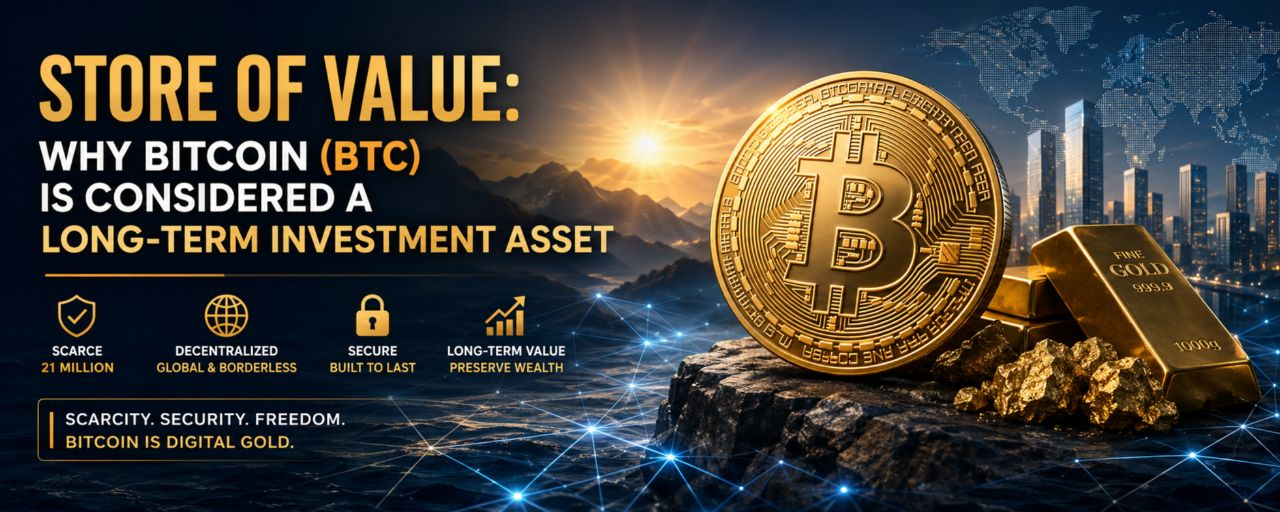
Store of Value: Why Bitcoin (BTC) Is Considered a Long-Term Investment Asset
Introduction
Throughout history, people have sought assets capable of preserving wealth over time. From gold and silver to real estate and government bonds, investors have traditionally relied on certain assets to protect purchasing power and safeguard wealth against inflation and economic uncertainty.
In the digital age, Bitcoin (BTC) has emerged as a new form of store of value. Often referred to as "digital gold," Bitcoin is increasingly viewed as a long-term investment asset rather than simply a means of everyday payment.
As adoption grows among individuals, corporations, and institutional investors, Bitcoin's role as a store of value continues to gain recognition within the global financial system.
What Is a Store of Value?
A store of value is an asset that maintains its worth over time and can be saved, retrieved, and exchanged in the future without significant loss of purchasing power.
Characteristics of a strong store of value include:
Durability
Scarcity
Portability
Divisibility
Security
Wide acceptance
Examples of traditional stores of value include:
Gold
Silver
Real estate
Fine art
Government securities
Bitcoin has increasingly been added to this list due to its unique digital properties.
Why Bitcoin Is Considered a Store of Value
Limited Supply
One of Bitcoin's most important features is its fixed supply.
Only 21 million bitcoins will ever exist. This scarcity is built into Bitcoin's code and cannot be changed without broad network consensus.
Unlike traditional currencies, which governments can print in unlimited quantities, Bitcoin's limited supply helps protect it from inflation caused by excessive money creation.
Decentralization
Bitcoin operates on a decentralized blockchain network.
No government, bank, corporation, or individual controls Bitcoin. Instead, thousands of computers worldwide maintain and verify the network.
This decentralization reduces the risk of political interference and centralized manipulation.
Security
Bitcoin is protected by one of the most secure blockchain networks in existence.
Its cryptographic design and global mining infrastructure make it extremely difficult to alter transaction records or compromise the network.
This security contributes to investor confidence and long-term value preservation.
Portability
Unlike physical assets such as gold, Bitcoin can be transferred globally within minutes.
Investors can move large amounts of value across borders without relying on traditional financial institutions.
Divisibility
Bitcoin is highly divisible.
One bitcoin can be divided into 100 million smaller units known as satoshis, making it practical for transactions of virtually any size.
Bitcoin vs Traditional Cash
Traditional currencies are designed primarily as mediums of exchange.
Governments and central banks often increase money supply to support economic activity, which can contribute to inflation over time.
Bitcoin differs because:
Feature Bitcoin Traditional Cash Supply Limit Fixed at 21 million Can be expanded Decentralized Yes No Inflation Resistance High Variable Global Accessibility High Depends on banking system Digital Native Yes Mostly No
These differences have led many investors to view Bitcoin as a long-term savings asset rather than everyday spending money.
Institutional Adoption
Over the past decade, Bitcoin has gained increasing acceptance among:
Investment funds
Public companies
Asset managers
Family offices
Retail investors
Many institutions view Bitcoin as a potential hedge against inflation and currency depreciation.
As adoption expands, Bitcoin's reputation as a store of value continues to strengthen.
Advantages of Bitcoin as a Store of Value
Protection Against Inflation
Bitcoin's fixed supply may help protect purchasing power during periods of monetary expansion.
Global Accessibility
Anyone with internet access can own and transfer Bitcoin regardless of geographic location.
Transparency
All Bitcoin transactions are recorded on a public blockchain, providing unprecedented transparency.
Independence from Traditional Banking
Bitcoin ownership does not require permission from banks or financial institutions.
Long-Term Growth Potential
Many investors view Bitcoin as a long-term asset with significant future growth potential as adoption increases.
Risks and Considerations
While Bitcoin has many attractive characteristics, it is not without risks.
Price Volatility
Bitcoin remains more volatile than traditional stores of value such as gold or government bonds.
Regulatory Uncertainty
Government regulations regarding cryptocurrency continue to evolve around the world.
Technology Risks
Although highly secure, users must properly safeguard private keys and digital wallets.
Market Sentiment
Bitcoin prices can be influenced by investor sentiment, macroeconomic events, and market speculation.
The Digital Gold Narrative
Bitcoin is often compared to gold because both assets share several important characteristics:
Scarcity
Durability
Independence from government control
Global recognition
Long-term wealth preservation potential
For this reason, many investors refer to Bitcoin as "digital gold."
While gold has served as a store of value for thousands of years, Bitcoin offers a modern, digital alternative designed for the internet age.
Conclusion
Bitcoin has evolved from a niche digital experiment into one of the most recognized financial assets in the world. Its limited supply, decentralized structure, security, portability, and growing adoption have contributed to its reputation as a store of value.
Although it remains a relatively young asset and carries risks, many investors view Bitcoin as a powerful tool for preserving wealth over the long term. As the global financial landscape continues to evolve, Bitcoin's role as a digital store of value may become increasingly important for future generations of investors.$
