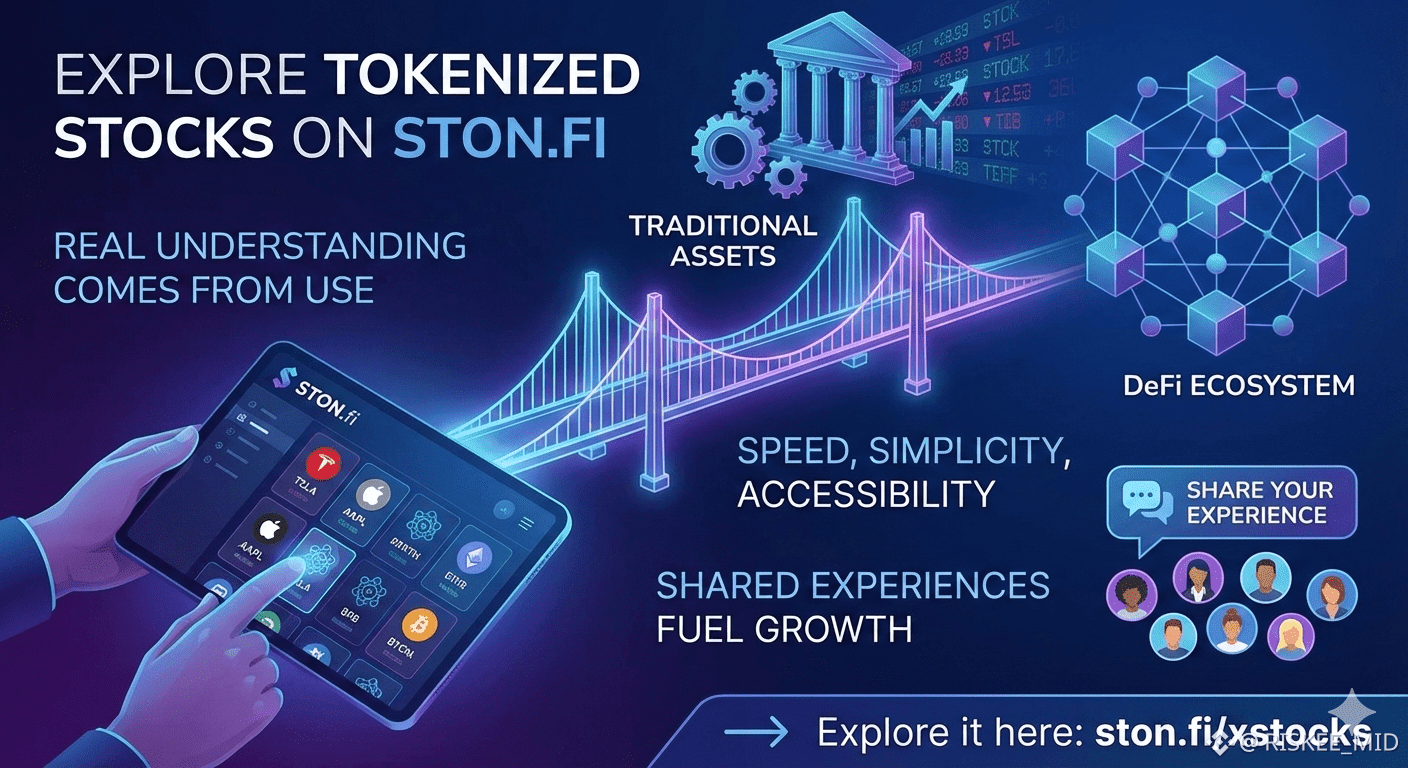
Try it, don’t just watch: how tokenized stocks fit into DeFi — and how to explore them yourself
The fastest way to understand how traditional assets are being folded into DeFi isn’t a lecture or a thread — it’s a session at the keyboard. Theory helps, but real understanding comes from using the product: from clicking through the UI, feeling how fast actions complete, noticing where the experience is smooth and where it’s clunky.
Below is a practical, user-focused guide to exploring tokenized stocks (using STON.fi’s xStocks as an example). It will help you learn by doing, notice the small details that matter, and share useful feedback that actually helps the ecosystem improve.
Why hands-on matters
Reading about tokenized stocks explains what they are. Trying them shows how they feel. Small things matter: how fast a trade executes, how clear the fee descriptions are, whether a deposit flow asks for more identity information than you expected, or whether mobile UX is usable. Those details determine whether real people — not just theorists — will adopt the tech.
What are tokenized stocks (short primer)
Tokenized stocks are blockchain-backed tokens that represent exposure to traditional equities. They aim to combine the familiarity and value of stocks with DeFi’s composability and accessibility. There are many implementation choices (custody, regulatory wrapper, minting/redemption mechanics), and each design choice changes the user experience. The best way to learn how a specific implementation behaves is to interact with it directly.
A step-by-step guide to exploring xStocks on STON.fi (or any tokenized-stock product)
Start with reading the product’s short docs or FAQ.
Look for: how the token maps to the underlying asset, whether tokens are fully backed, redemption processes, fees, and KYC requirements.Create or connect a wallet (on a test amount first).
Use a small amount of funds you’re willing to experiment with. Preferably use a new wallet or one with limited funds to reduce risk while learning.Observe the onboarding flow.
Was KYC required? If so, how intrusive was it and how long did it take?
Was the process transparent about why they needed the information?
Buy a tokenized stock (small trade).
How long did the trade take from “confirm” to completion?
Were there any unexpected approval steps (token approvals, bridge confirmations, gas prompts)?
Was pricing transparent (mid-price vs execution price, slippage, fees)?
Use the token in a DeFi context (if supported).
Try lending, staking, or adding the token to a farm or LP, so you can see composability in action.Attempt a redemption or on-ramp back to the underlying (if available).
Is redeeming simple? Any minimums?
How long does settlement take?
Are there off-chain steps (custodial transfers, fiat rails)?
Test cross-device experience.
Try the same flows on mobile and desktop. Does anything break or feel awkward?Note edge cases and error handling.
What happens if a transaction fails?
Are error messages helpful or cryptic?
Can you find transaction history and receipts easily?
Compare expectations vs reality.
Ask: did it feel as simple as a typical DeFi swap? More complicated? Less transparent?
What to pay attention to (the checklist)
Speed: time from action to finality.
Simplicity: number of clicks/approvals needed.
Transparency: clear fee breakdown, price source, collateral/backing info.
Accessibility: is it usable with a basic wallet? mobile-friendly?
Composability: can the token be used across lending, bridges, DEXes?
Custody & Trust: how is the underlying asset held and audited?
Redemption mechanics: easy exit to underlying asset or cash?
Support & Documentation: are guides and support channels helpful?
Security signals: audits, multisig, insurance information, and clear contracts.
If something confuses you — say it, precisely
When you report a confusing experience, short and concrete observations are the most useful:
“The buy flow asked for three approvals before I could trade; the second approval didn’t explain why it was needed.”
“I placed a redemption and saw ‘pending’ for 48 hours with no status updates.”
“On mobile, the order confirmation button was hidden behind a keyboard.”
Concrete specifics help developers reproduce issues and prioritize fixes — which directly improves the product for everyone.
If something works well — highlight it
Positive feedback is just as valuable. Call out things like:
“Instant finality for trades under €100 — felt like a normal crypto swap.”
“Fee breakdown was clear and showed both platform fee and gas estimate.”
“Redemption completed in under 24 hours with clear email notifications.”
These wins show what to keep and scale.
How to share your experience (quick template)
Use this short format when posting on community channels or sending feedback:
Platform & date: “STON.fi — Jan 2026”
Action: “Bought 0.1 xStock (ticker X) using MetaMask.”
Observations: 3 bullets (speed, fees, issues)
Outcome: “Trade succeeded, redemption pending” or “Trade reverted — error message: X”
Suggestion: “Show clearer text for approval step” or “Add estimated settlement time.”
Short, factual reports are the easiest to act on.
Safety and responsibility
Tokenized assets can behave like both traditional and crypto products. Always:
Start small.
Understand whether tokens are synthetic, fully-backed, or represent wrapped shares.
Check KYC and tax implications before scaling up.
Don’t share private keys or sensitive documents in public.
Final thought — the ecosystem needs active users
DeFi grows when people don’t just watch from the sidelines, but take part — thoughtfully, responsibly, and curiously. Trying tokenized stocks on platforms like STON.fi (ston.fi/xstocks) and sharing clear, actionable feedback accelerates progress. Your firsthand reports help developers fix real pain points, help newcomers move with confidence, and help the whole space move from theoretical promise to practical utility.
Go try it. Notice the details. Then tell others what you found — that’s how real progress happens.