
We stand at an inflection point in blockchain's evolution. The monolithic chain paradigm is giving way to a modular, specialized future—a "world of app-chains, rollups, and sovereign L2s." But this dazzling future harbors a dark forest of fragmentation. How do these thousands of chains communicate, share liquidity, and, most importantly, trust each other's data? The answer will define the next era, and it points directly to the importance of robust Data Availability (DA) layers like the one @Walrus 🦭/acc is building. $WAL, therefore, is more than a token; it's a stake in the dream of seamless interoperability.
The current interoperability landscape is a patchwork of bridges—often fragile, centralized, and prone to catastrophic hacks. The root cause? These bridges are often forced to act as trusted oracles, making subjective judgments about the state of a foreign chain. What if, instead of trusting a third-party bridge, we could have cryptographic certainty about the data on another chain?
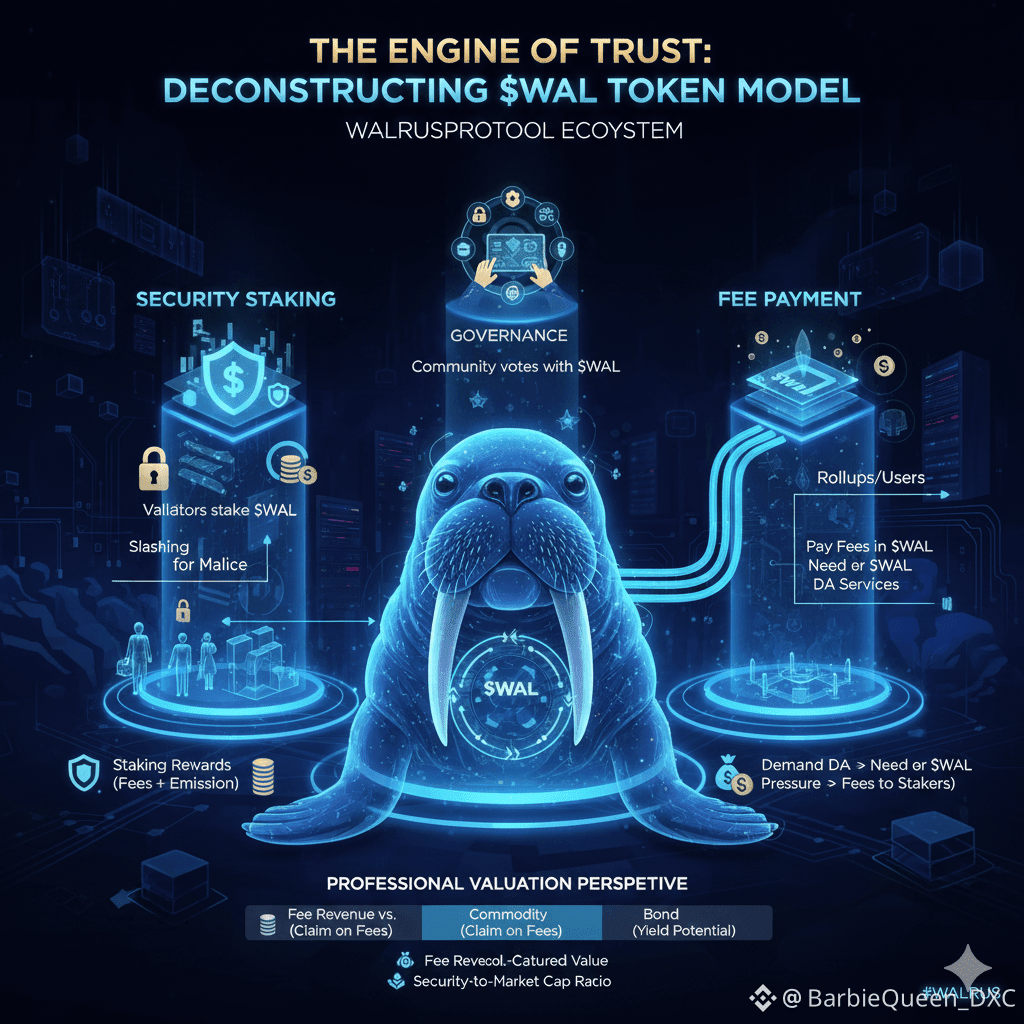
This is where a secure, neutral DA layer becomes revolutionary. Imagine @walrusprotocol not just as a passive data repository, but as the canonical source of truth for a vast array of rollups. If Rollup A and Rollup B both post their complete transaction histories to Walrus, they create a verifiable, shared data layer.
Now, a cross-chain message from Rollup A to Rollup B doesn't need a trusted bridge. Instead, it needs a light client on Rollup B that can efficiently verify, using the data already available on Walrus, that the transaction on Rollup A indeed happened and was finalized. This shifts the security assumption from "trust the bridge validator set" to "trust the security of the Walrus DA layer"—a layer specifically designed and cryptoeconomically secured (via $WAL staking) for this singular, critical purpose.
This vision positions @walrusprotocol as a foundational settlement and communication layer. It becomes the "common ground" where chains meet, the notary public of the decentralized world. The $WAL token's role expands in this scenario. It's not just for paying fees to post data; it becomes the bond securing the very system that allows for trustless cross-chain composability.
Think of the internet's evolution. Before TCP/IP, we had isolated, incompatible networks (AOL, CompuServe). TCP/IP provided the universal, foundational protocol that allowed them to interconnect, unleashing unimaginable innovation. Today's blockchains are like those pre-internet walled gardens. Execution layers (L2s, app-chains) are the exciting "websites" and "apps." But we are missing the universal TCP/IP layer for data and settlement.
@Walrus 🦭/acc is competing to be exactly that. Its long-term value isn't just in being the cheapest DA, but in being the most credibly neutral and secure one—the one that attracts the most high-value chains because its cryptoeconomic security, backed by $WAL, is beyond reproach. In this endgame, the Walrus ecosystem becomes a network of networks. Developers building a new rollup will choose its DA layer as a strategic, long-term decision, much like choosing a cloud provider today.
For investors and builders, the implication is stark: the greatest value in the modular stack may not accrue to the flashiest social app-chain, but to the foundational protocol upon which all app-chains depend for security and connectivity. By providing the bedrock layer of verified data, @walrusprotocol enables the entire edifice of a composable, interconnected blockchain universe to be built. Betting on $WAL, then, is a bet on that unified future—a future where blockchains don't just exist in parallel, but can truly, trustlessly interoperate. That is the interoperability endgame, and Walrus is positioning itself at the very center of the board. #walrus @Walrus 🦭/acc $WAL

