


Decentralized storage networks only work when the people running them have a reason to behave correctly not just once, but continuously. It is not enough for a node to be honest on the day it joins. It must remain honest for months and years while holding data that may be far more valuable than the rewards it earns. This creates a fundamental design problem. How do you make honesty more profitable than cheating over long periods of time, especially when participants can leave and reenter the system?
Walrus answers this question through a carefully structured system of reward cycles tied to cryptographic verification and economic collateral. Rather than paying nodes simply for being present, Walrus pays them for continuously proving that they are doing the job they committed to do. The timing and structure of these rewards is just as important as the amount. They are designed to make short-term cheating irrational and long-term reliability the only stable strategy.
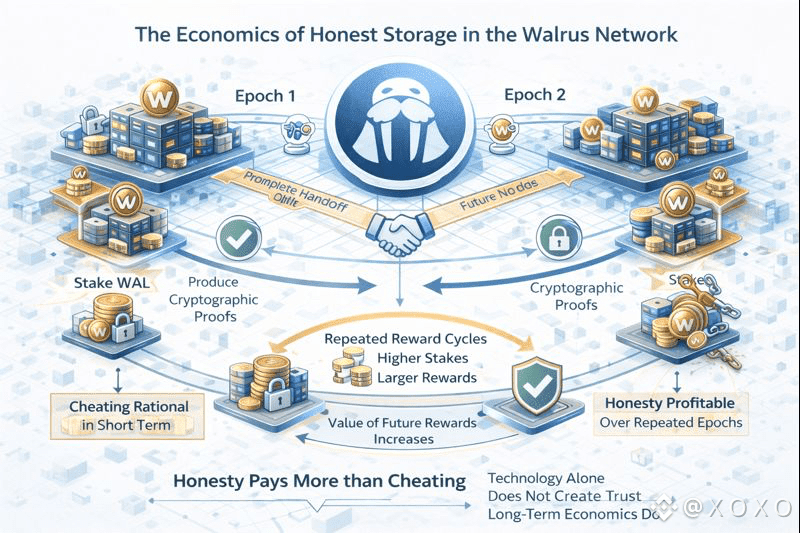
At the center of this system is the concept of epochs. Time in Walrus is divided into discrete periods. During each epoch, storage committees are responsible for specific datasets. Nodes stake WAL to participate, and they earn rewards only if they meet all of their obligations during the epoch. This creates a repeated game rather than a one-off transaction. Every epoch is a new opportunity to earn, but also a new opportunity to fail.
This repeated structure changes behavior. A node that cheats today does not just risk losing one reward. It risks losing its stake and being excluded from future epochs. Because participation is ongoing, the present value of future rewards becomes much larger than any short-term gain from misbehavior. The network is designed so that walking away with stolen or deleted data is far less profitable than continuing to earn rewards honestly.
Reward cycles also interact with proof systems. Nodes are required to produce regular cryptographic proofs that they still possess the data they are responsible for. These proofs are not optional. They are prerequisites for receiving payment. A node that misses proofs is treated as failing to perform and is penalized.
This ensures that rewards are not based on trust or reputation. They are based on verifiable work. Storage becomes measurable. Honesty becomes provable.
The fact that committees rotate adds another layer. A node does not just need to be honest while it holds data. It must also hand that data over correctly when its committee assignment ends. The reward cycle covers the entire custody period, including the exit. A node that attempts to leave early or sabotage the handoff loses rewards and stake.
This closes an important loophole. In many systems, the greatest temptation to cheat comes at the end of a contract, when future reputation no longer matters. Walrus prevents this by making the final act of handoff part of the same economic game.
Over time, this creates a strong alignment between network health and node profit. Nodes that provide reliable storage, serve data quickly, and complete handoffs cleanly are continuously rewarded. Nodes that try to exploit the system are economically eliminated.
This is especially important in a permissionless environment. Anyone can run a node. There is no central authority to screen operators. The protocol must assume that some participants will try to cheat. Reward cycles turn that adversarial reality into a stable equilibrium. Cheaters lose money. Honest operators earn it.
There is also a scaling effect. As more data is stored on Walrus, more WAL is staked and more rewards are distributed. This increases the total value at risk for storage providers. The more important the network becomes, the more expensive it becomes to attack. Reward cycles therefore scale security with usage.
Another important aspect is predictability. Nodes know when rewards are distributed and what is required to earn them. This allows operators to make long-term investments in hardware and connectivity. They are not guessing. They are participating in a structured economic system.
This is one of the reasons Walrus is suitable for professional storage providers as well as smaller operators. The rules are clear. Performance is measurable. Payment is automatic.
What emerges from this design is not just a set of incentives, but a culture of reliability. Nodes that behave well accumulate stake and reputation over many epochs. Nodes that behave poorly are filtered out. Over time, the network selects for competence and honesty.
My take is that this is one of the most underappreciated aspects of decentralized infrastructure. Technology alone does not create trust. Repeated economic interaction does. Walrus uses reward cycles to turn storage into a long-term relationship between nodes and the network. That is what makes decentralized data custody viable at scale.