



BNB Smart Chain just pulled off something most blockchains only talk about. On January 14, 2026, at 02:30 UTC, the Fermi hard fork went live, cutting block times to 0.45 seconds. That makes BSC one of the fastest EVM-compatible chains in existence.
This upgrade is the final piece in a year-long transformation that compressed block times by 6.7x, from 3 seconds down to under half a second. The implications stretch across DeFi trading, on-chain gaming, and high-frequency applications that need settlement speeds approaching traditional finance infrastructure.
What is Fermi Upgrade
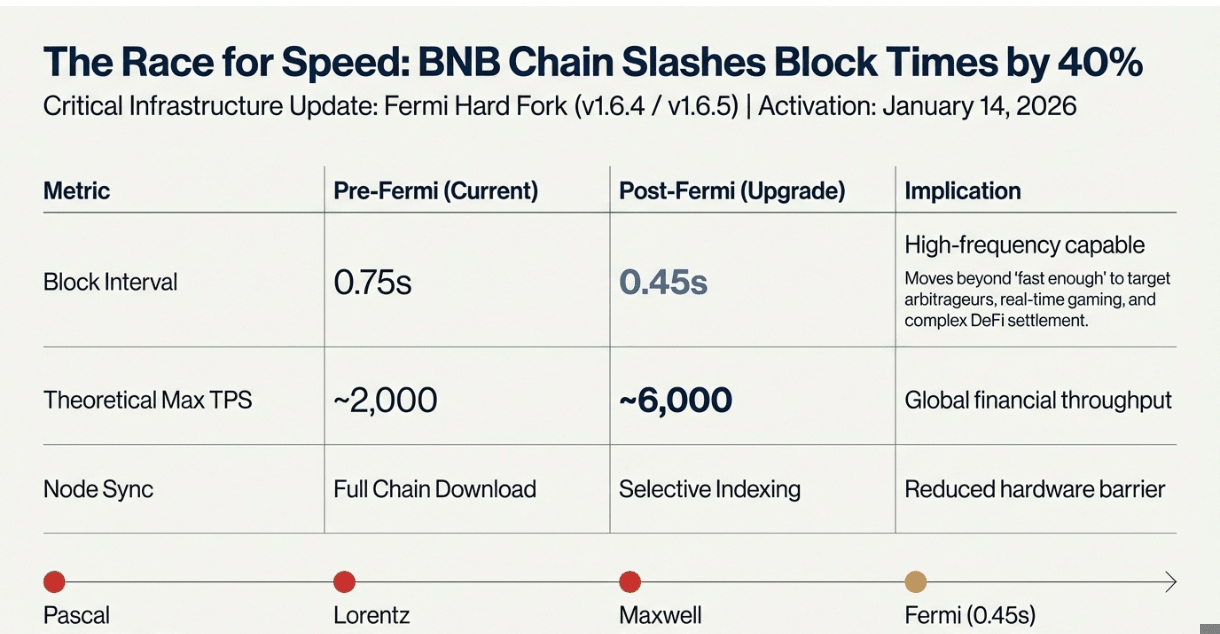
Fermi represents the fourth and most aggressive phase in BNB Chain's 2025-2026 performance roadmap. Following the Pascal, Lorentz, and Maxwell upgrades, Fermi specifically targets block production speed and network finality. The upgrade reduces the block interval from 0.75 seconds to 0.45 seconds while strengthening the fast finality mechanism that ensures transactions become irreversible.
The technical implementation required all validators and node operators to upgrade to client version v1.6.4 or later before activation. A synchronized maintenance release, v1.6.5, followed in December 2025 with additional features including optional transaction gas limit caps and improved synchronization capabilities.
What separates Fermi from typical network upgrades is the scope of change. The network now processes transactions with a finality time of roughly 1.125 seconds, meaning transactions reach irreversibility faster than most proof-of-stake competitors. BSC currently handles 133 million gas per second, with the roadmap targeting 1 gigagas per second as the ecosystem scales.
Technicals
Fermi implements five distinct BNB Evolution Proposals (BEPs) that work together to accelerate the network:
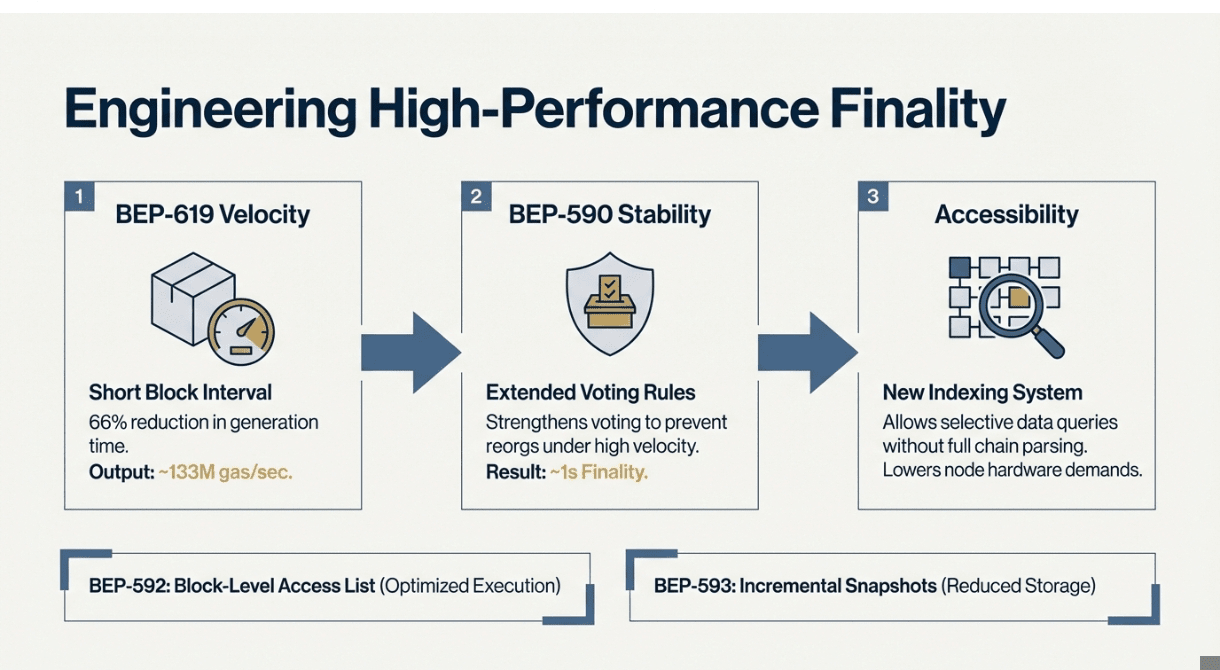
BEP-619: Short Block Interval Phase Three drives the core performance gain by reducing block production time from 750 milliseconds to 450 milliseconds. This 40% reduction in block time directly translates to faster transaction inclusion and confirmation.
BEP-590: Extended Voting Rules enhances fast finality stability to handle the increased throughput without compromising reliability under network congestion. The extended voting mechanism ensures validators can maintain consensus even as block production accelerates.
BEP-591: Non-Consensus Based Block-Level Access List (BAL) introduces experimental parallel execution capabilities based on deviations from EIP-7928. Local testing showed an 18.6% improvement in mega-gas per second with this feature enabled, though full network benefits require widespread adoption. The access list enables faster block imports via P2P propagation with a fallback to serial execution when needed.
BEP-592: Incremental Snapshot improves node startup and synchronization times. Instead of requiring full state regeneration, validators can now work with incremental snapshots. Snapshot regeneration takes approximately 5 hours on reference hardware starting from block 71,126,721.
BEP-593: EVM Super Instruction optimizes execution efficiency at the virtual machine level, reducing computational overhead for common operations.
The upgrade also removes the BSC protocol handshake and updates filtermap checkpoints for better synchronization across the network. Version 1.6.5 includes these enhancements while maintaining backward compatibility with the core Fermi changes.
From a network architecture perspective, Fermi pushes BSC close to global propagation limits. Block times below 450 milliseconds start hitting physical constraints around network latency and global consensus coordination. The roadmap complements this short block approach with multi-phase improvements in execution quality and predictable performance.
Key Features
Here are some of key features of Fermi Upgrade.
Sub-Second Block Times
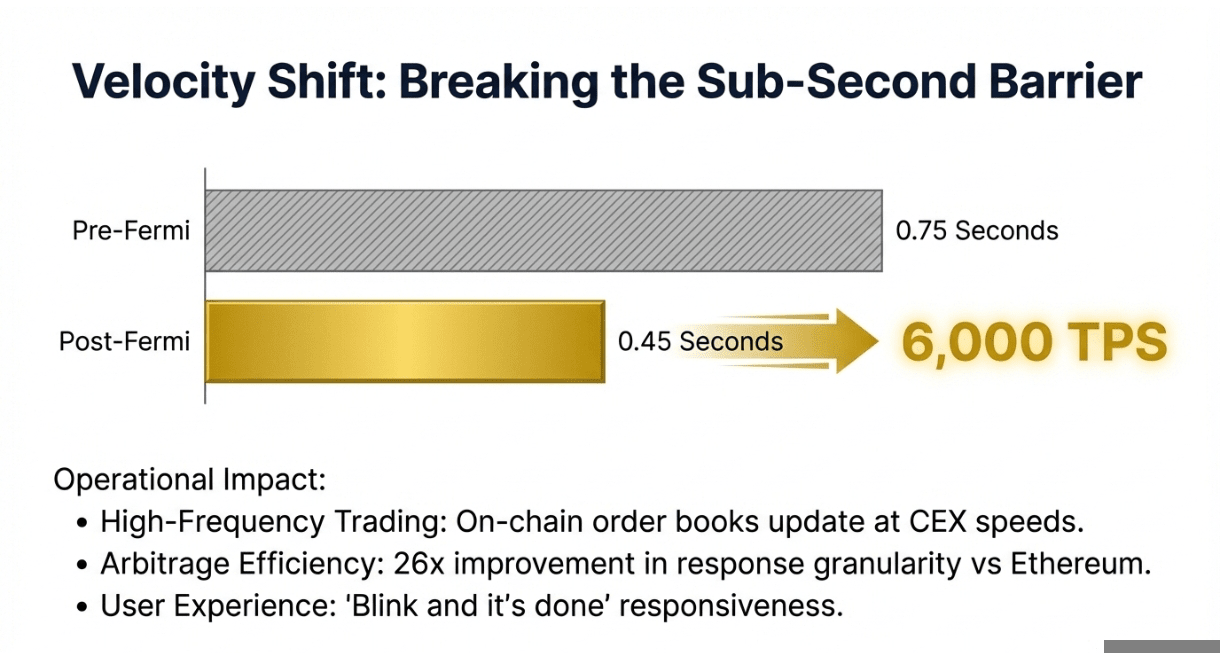
The headline feature is obvious: 450-millisecond blocks put BSC in elite company. For context, Ethereum produces blocks every 12 seconds, Avalanche C-Chain operates at 2 seconds, and Solana runs at 400 milliseconds. While Solana processes more raw transactions per second (1,000-5,000 TPS versus BSC's 378+ TPS), BSC achieves faster finality at roughly 1.125 seconds compared to Solana's 12-13 second finality time.
Enhanced Finality
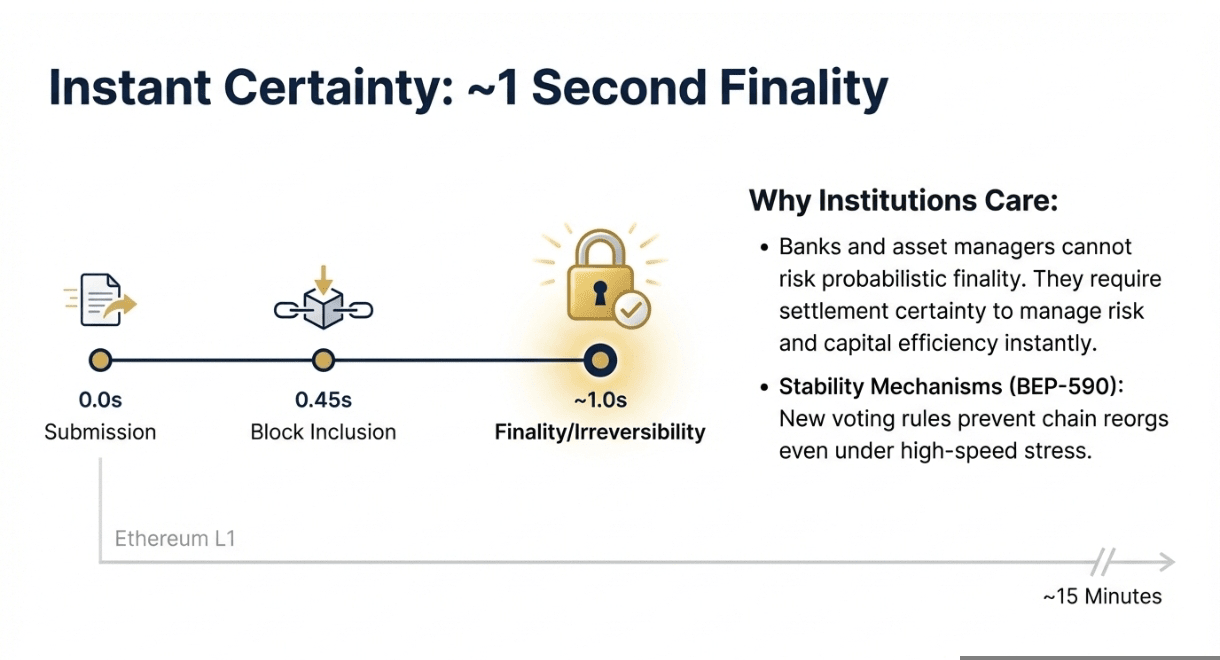
Fast finality means transactions become irreversible within seconds rather than minutes. Ethereum L1 requires 12-15 minutes for finality, creating significant risk windows for high-value transactions. Avalanche achieves 2-second finality at the cost of lower throughput. BSC now delivers sub-2-second finality while maintaining high transaction capacity and EVM compatibility.
Experimental Parallel Execution
The block-level access list feature in v1.6.5 enables parallel transaction processing when network operators activate the experimental flag. Testing shows 18.6% performance gains in gas throughput, positioning BSC for future scalability improvements as the feature matures.
Improved Node Infrastructure
Incremental snapshots reduce operational burden for validators and full nodes. Faster synchronization and reduced startup times make running BSC infrastructure more accessible and reliable.
Key Benefits
Here are some of the biggest and notable benefits of the upgrade.
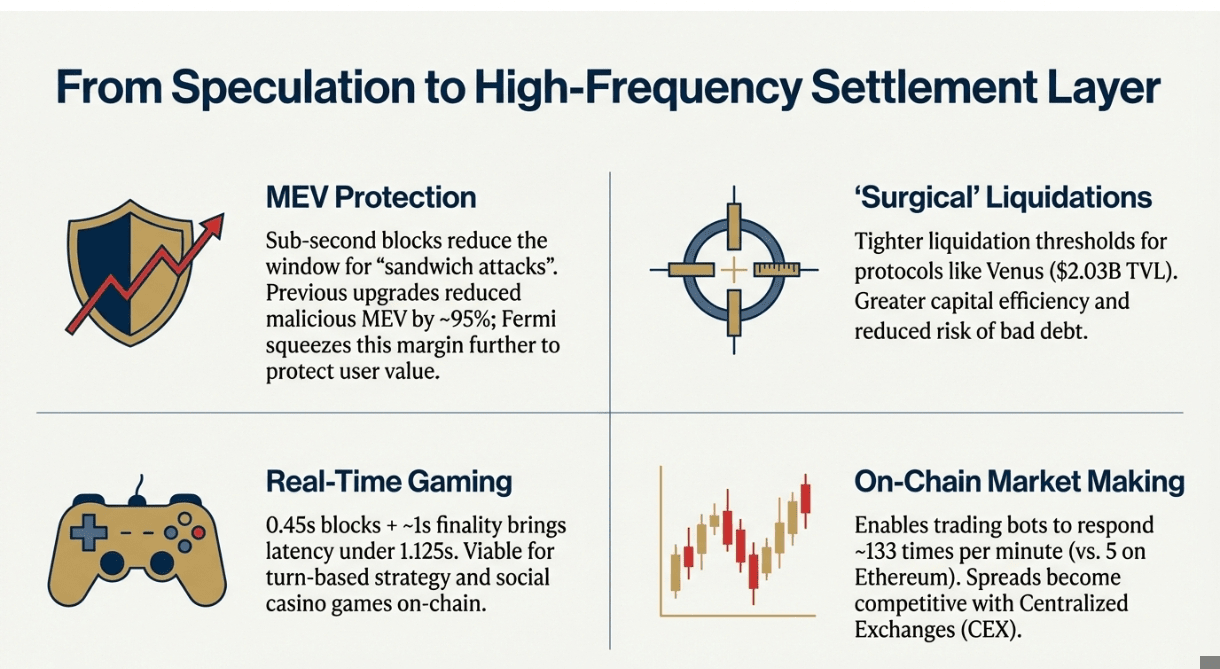
❍ DeFi Trading and MEV Protection
The combination of Lorentz, Maxwell, and Fermi upgrades reduced malicious MEV by 95%, with Fermi expected to compress that margin further. Sub-second block times make sandwich attacks exponentially harder to execute profitably. In a 3-second block environment, MEV bots have ample time to observe pending transactions, calculate profitable attacks, and submit competing transactions. At 450 milliseconds, that attack window shrinks dramatically.
For BSC's $7.21 billion in total value locked, this translates to less value leakage on swaps, limit orders, and liquidations. PancakeSwap, processing $1.56 billion in daily trading volume, benefits from reduced confirmation times and tighter spreads as arbitrage opportunities narrow.
❍ Lending Protocol Efficiency
Venus Protocol, with $2.03 billion in TVL, can implement tighter liquidation thresholds thanks to faster block times. When collateral values drop rapidly, the network needs to execute liquidations before positions become undercollateralized. Faster blocks enable more precise timing, allowing Venus users to earn up to 10.33% APY on stablecoin deposits with improved capital efficiency.
The relationship between block time and liquidation safety is direct: shorter blocks mean liquidators can respond faster to price movements, reducing protocol bad debt risk while enabling higher loan-to-value ratios for borrowers.
❍ On-Chain Gaming Viability
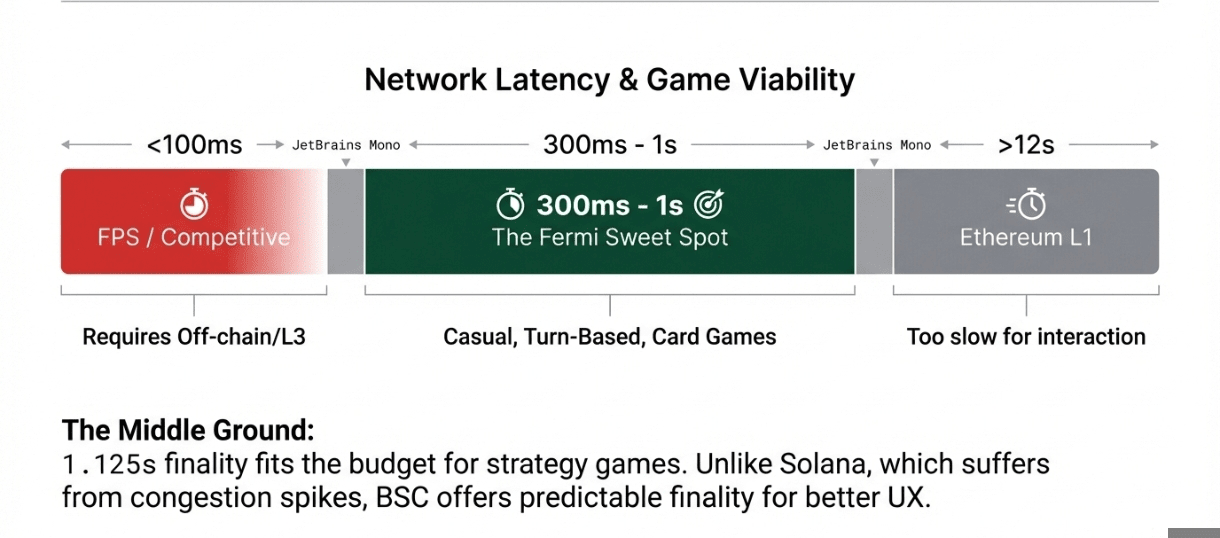
Fermi creates a new category of viable Layer 1 blockchain gaming. The 1.125-second finality fits within the latency budget for casual and turn-based games. Competitive games typically require under 100 milliseconds round-trip latency, while casual games tolerate up to 300 milliseconds before feeling unresponsive.
Ethereum's 12-second blocks make real-time gaming impossible on the base layer. Solana can handle gaming throughput but suffers from congestion-induced finality spikes during high activity. BSC now offers predictable sub-2-second finality that enables on-chain prediction markets with real-time settlement, card games, and strategy games where turn-based mechanics align with network speed.
While Fermi does not solve competitive gaming's need for ~10-millisecond response times (solutions like MagicBlock target that niche), it opens a substantial middle ground for games that benefit from blockchain's verifiability without requiring extreme low latency.
❍ High-Frequency Applications
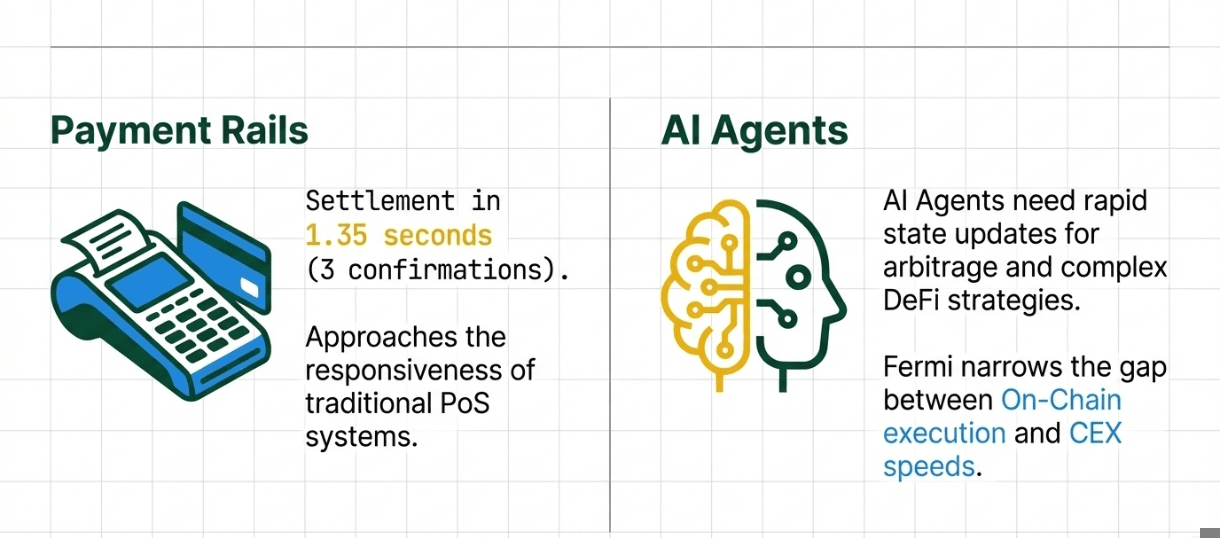
Payment systems, cross-chain bridges, and automated market makers all benefit from reduced confirmation times. A transaction that previously required 2.25 seconds for three block confirmations now completes in 1.35 seconds. For payment processors targeting point-of-sale or remittance use cases, this approaches the responsiveness of traditional payment rails.
The upgrade positions BSC competitively against centralized exchanges, which operate off-chain settlement systems measured in milliseconds. While BSC cannot match centralized speed, the gap has narrowed substantially. Applications requiring verifiable on-chain execution with near-exchange performance now have a viable platform.
❍ Ecosystem Stability
BEP-590's extended voting rules ensure the fast finality mechanism remains stable even as throughput increases and network activity spikes. Earlier upgrades demonstrated BSC's ability to maintain performance during high-load events. Fermi reinforces that reliability with enhanced consensus mechanisms designed for sustained high-frequency operation.
This stability matters for institutional adoption and developer confidence. Networks that slow down or become unreliable during peak usage create user experience problems and smart contract execution risks. BSC's approach prioritizes predictable performance even under stress.
❍ Reduced Latency for AI Agents
The integration of faster blocks with AI agent workflows creates opportunities for on-chain commerce and automated trading systems. AI agents executing strategies across DeFi protocols benefit from quicker state updates and reduced slippage in volatile markets. The roadmap targeting 20,000 TPS positions BSC as infrastructure for high-frequency AI-driven applications that need reliable, fast on-chain execution.
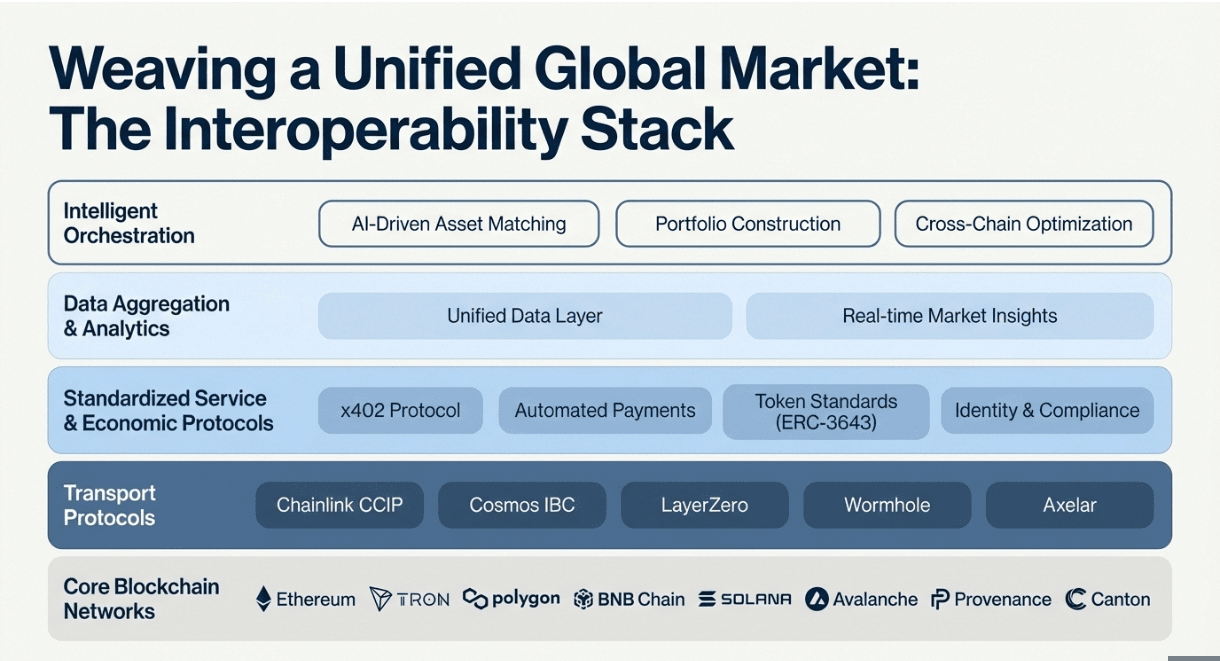
Fermi marks a technical turning point for BNB Smart Chain, transforming it from a fast EVM chain into one of the industry's highest-performance settlement layers. The 0.45-second block time and sub-2-second finality create new possibilities for DeFi, gaming, and high-frequency applications that were previously impractical on Layer 1 blockchains. With $7.21 billion in TVL and major protocols like PancakeSwap and Venus already operating at scale, the ecosystem has the foundation to capitalize on these performance gains.
The upgrade demonstrates that aggressive optimization of proof-of-stake consensus can push EVM-compatible chains to speeds that rival specialized high-performance networks while maintaining decentralization and composability.
