
From Open Profits to Closed Discipline: A Lesson Every Trader Learns the Hard Way
One of the most misunderstood moments in trading is not the entry. It’s not even the analysis. It’s the decision to close a position when you’re already in profit.
On the surface, it looks simple: price moved in your favor, unrealized P&L is green, and the trade is working. But psychologically, this is where most traders sabotage themselves. Greed whispers, fear argues back, and discipline quietly waits to see if you’ve actually trained it.
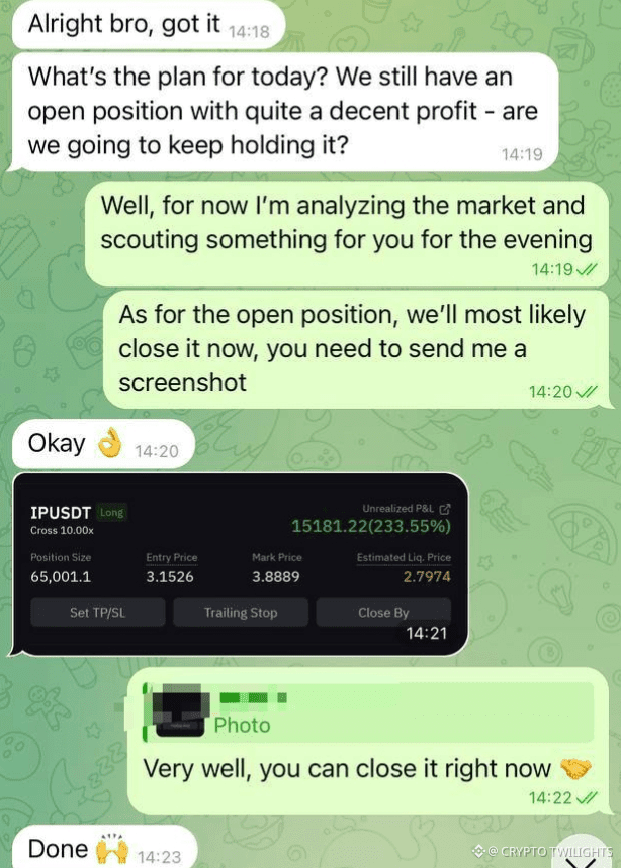
The conversation in the screenshot reflects a situation every trader eventually faces:
An open position with a very decent profit, and the big question — do we hold, or do we close?
This post isn’t about signals, indicators, or leverage. It’s about decision-making under pressure, and why closing a profitable trade at the right time is a skill more valuable than finding entries.
---
The Illusion of “More”
When a trade is deep in profit, the market creates an illusion. The chart hasn’t changed, but your mindset has.
You start thinking:
“What if it goes a little higher?”
“This move looks strong.”
“I’ll close it later.”
This is where many traders forget one truth:
Unrealized profit is not profit.
Until a position is closed, the market still owns it.
In the screenshot, the position shows a massive unrealized gain. Many traders would emotionally attach to that number. They start counting money they don’t yet have. This attachment is dangerous because it shifts focus from risk management to hope management.
Professional traders don’t ask, “How much more can I make?”
They ask, “What is the smartest decision from here?”
---
Why Analysis Doesn’t Stop After Entry
A common beginner mistake is thinking the job is done after entering a trade. In reality, entry is only the beginning.
Once in a position, the trader’s role changes:
From prediction → to management
From analysis → to execution
From excitement → to control
In the conversation, the response was clear:
> “For now, I’m analyzing the market and scouting something for the evening.”
This is important. It shows that even with an open winning trade, the market is still being reassessed. There is no emotional rush. No attachment to the position. Just continuous evaluation.
Markets evolve. Momentum weakens. Liquidity shifts. What made sense an hour ago may not make sense now.
Closing a trade isn’t an admission of fear.
It’s an acknowledgment that conditions change.
---
The Power of Confirmation, Not Assumption
Another key detail is asking for a screenshot before making the final call.
Why does this matter?
Because disciplined trading is built on verification, not assumptions.
Instead of guessing:
Position size
Entry accuracy
Current price behavior
Risk exposure
The trader asks for real data.
This habit protects you from:
Miscommunication
Overconfidence
Emotional decisions based on incomplete information
Professional trading is boring by design. It relies on confirmation, not excitement.
---
Why Closing in Profit Is a Skill
Many traders think the hardest part is surviving losses. In reality, handling profits is harder.
Losses trigger fear. Profits trigger greed.
And greed is more deceptive because it feels justified.
You start believing:
“I deserve more.”
“The market owes me.”
“This run isn’t over.”
But the market doesn’t reward beliefs. It rewards execution.
Closing a profitable trade at the right time requires:
Emotional neutrality
Respect for volatility
Acceptance that you’ll never catch the exact top
In the screenshot, the instruction was simple and firm:
> “You can close it right now.”
No debate. No hesitation. No drama.
That clarity comes from experience — usually built through painful lessons where profits turned into losses because someone waited “just a little longer.”
---
The Difference Between Traders and Gamblers
Gamblers let profits run because they’re chasing dopamine.
Traders let profits run only when the plan allows it.
If your plan says:
Partial close at resistance
Full close after momentum exhaustion
Exit when structure breaks
Then you follow it — even if price later moves higher without you.
Why?
Because consistency beats perfection.
You don’t need to catch every move.
You need to protect your capital and your mindset.
Closing a strong trade and watching price move further without you can hurt — but it hurts far less than watching a green position turn red because you refused to act.
---
Discipline Is Built in Moments Like These
Anyone can feel confident after a winning trade.
Few can stay disciplined during one.
The “Done” message at the end isn’t just about closing a position. It represents:
Trust in decision-making
Respect for the process
Emotional maturity
Trading isn’t about being right all the time.
It’s about making the right decision at the right moment, even when your emotions disagree.
---
A Reality Check Every Trader Needs
If you struggle with closing trades, ask yourself:
Am I following a plan, or chasing a feeling?
Do I fear missing out more than I respect risk?
Am I trading the market, or my emotions?
Markets don’t reward hope.
They reward preparation, patience, and execution.
---
Final Thought
The most important skill in trading is not analysis.
It’s not strategy.
It’s not leverage.
It’s discipline under pressure.
Closing a profitable trade when logic says so — not when emotions allow it — is what separates long-term survivors from short-term winners.
The market will always offer another opportunity.
Your capital, confidence, and discipline are harder to replace.
Protect them.
