

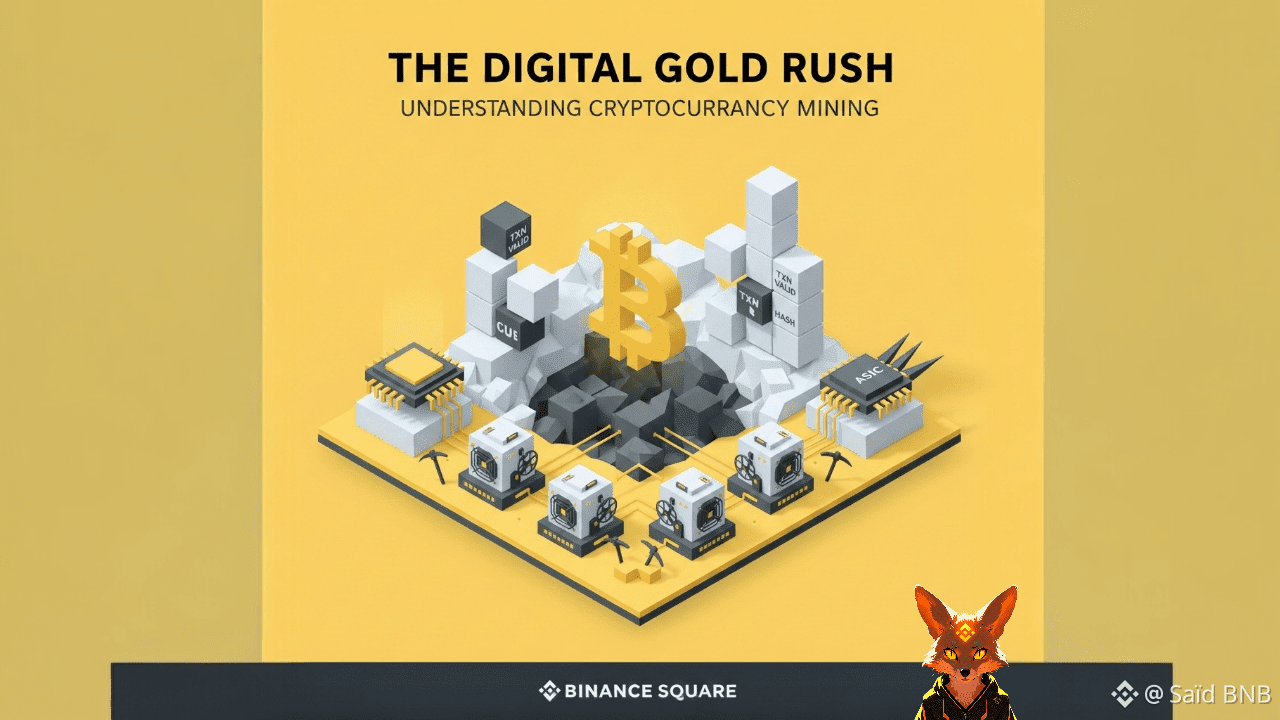
The Foundation of Decentralized Trust
At its core, cryptocurrency mining is the lifeblood of many decentralized networks, most notably Bitcoin.
While the term "mining" inevitably conjures images of pickaxes and physical extraction, the digital reality is far more sophisticated.
It is the process by which new units of cryptocurrency are entered into circulation, but more importantly, it is the mechanism that secures the entire network.
Unlike traditional banking systems where a central authority validates transactions and maintains the ledger, blockchain networks rely on a distributed global network of computers.
Mining is the method used to validate these transactions and add them to the public ledger, known as the blockchain.
This process ensures that every transaction is legitimate and prevents the "double-spending" problem, creating a trustless environment where strangers can exchange value without an intermediary.
Solving the Cryptographic Puzzle
The mechanics of mining revolve around a consensus mechanism known as Proof of Work (PoW).
In this system, miners compete against one another to solve complex mathematical equations using specialized computer hardware.
These equations are not difficult in a way that requires human intelligence, but they are computationally intensive, requiring significant processing power and energy. This "work" serves as proof that the miner has expended resources to secure the network.
The first miner to solve the puzzle gets the privilege of grouping a batch of pending transactions into a "block" and appending it to the blockchain.
This cryptographic puzzle is essential because it makes the network extremely difficult to attack; to alter the ledger, an attacker would need to control more than 51% of the network's total computing power, a feat that is astronomically expensive and logistically near-impossible for established networks like Bitcoin.
The Incentive Structure
The economic model of mining is designed to be a self-sustaining ecosystem driven by incentives.
When a miner successfully validates a block and adds it to the blockchain, they are rewarded in two ways: newly minted cryptocurrency (the block reward) and transaction fees paid by the users included in that block.
This block reward is the only way new coins are released into circulation, mimicking the extraction of gold from the earth at a predictable, controlled rate.
As the network grows and the price of the asset appreciates, the competition increases, driving miners to invest in more efficient hardware.
This creates a virtuous cycle where higher asset value leads to more miners, which in turn leads to higher network security, further solidifying the asset's value proposition as a store of wealth or medium of exchange.
The Evolution of Hardware
In the early days of cryptocurrency, mining was a hobbyist pursuit that could be done on a standard home computer’s Central Processing Unit (CPU). However, as the difficulty of the mathematical puzzles increased with the network's popularity, the hardware required to mine profitably evolved rapidly.
The industry shifted first to Graphics Processing Units (GPUs), which were better at handling the repetitive calculations required for hashing.
Eventually, this gave way to the current era of Application-Specific Integrated Circuits (ASICs)—highly specialized machines designed solely for the purpose of mining a specific cryptocurrency algorithm.
Today, mining is a professional industry dominated by large-scale data centers located in regions with access to abundant and often renewable energy sources.
This industrialization underscores the maturity of the sector, transforming what was once a niche experiment into a critical component of the global financial infrastructure.


