

 Institutional privacy only proves itself after something goes wrong.
Most privacy discussions begin with success scenarios: compliant trades, clean audits, orderly markets. Institutions don’t evaluate systems that way. They start from the opposite direction:
What is the worst plausible outcome and does privacy make it survivable or fatal?
That is the correct lens for evaluating Dusk Network.
Institutions don’t fear exposure they fear unmanaged exposure
Bad outcomes are inevitable:
a regulatory inquiry under time pressure,
a market event that forces rapid rebalancing,
a counterparty dispute,
an internal compliance investigation.
Privacy becomes valuable only if, during these moments:
information exposure is controlled,
proof is immediate,
blame is not diffused,
and no party gains unfair advantage.
Privacy that works only when nothing goes wrong is not privacy. It’s fragility.
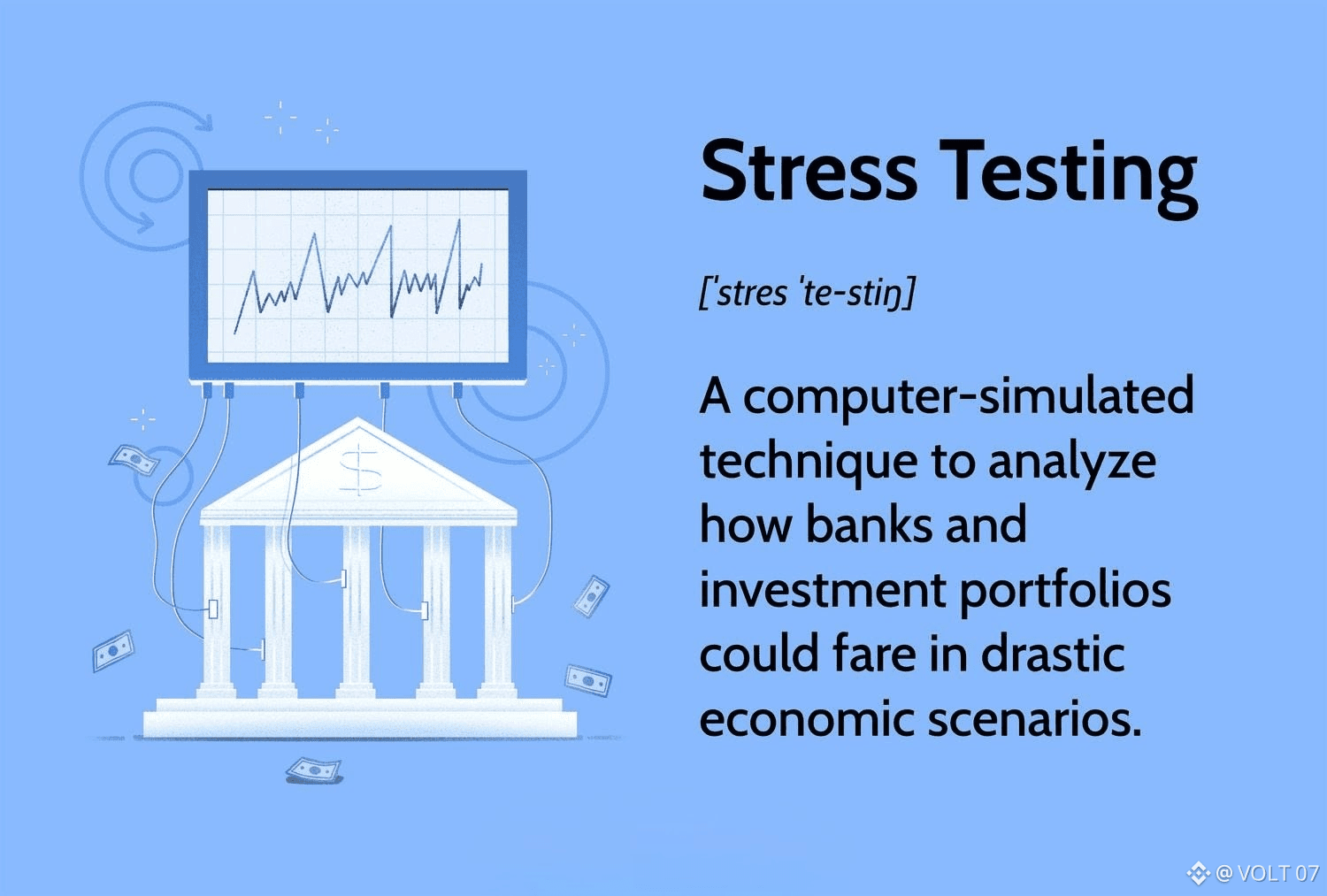
Stress-testing privacy means assuming scrutiny, not cooperation
In a bad-outcome scenario:
regulators are impatient,
counterparties are adversarial,
markets are reactive,
timelines are non-negotiable.
Institutions ask four questions immediately:
Can we prove correctness now?
Does anyone else gain information we didn’t intend to share?
Does the system degrade quietly or halt safely?
Is our exposure bounded or cumulative?
Dusk’s architecture is built around answering these questions under pressure.
Bad outcome #1: regulator demands proof during market stress
This is the most common institutional nightmare.
On many privacy systems:
proofs require coordination,
disclosure paths are unclear,
operators assemble explanations manually.
On Dusk:
compliance is embedded in execution,
proofs are native artifacts,
disclosure is deterministic and scoped.
Even under stress, the system does not hesitate.
Privacy does not delay proof.
Bad outcome #2: partial inference becomes possible
Assume some metadata correlates. Some observers learn more than intended.
The critical test is not whether leakage occurs, but what it enables.
On Dusk:
partial visibility does not enable front-running,
execution remains non-simulatable pre-finality,
validators gain no ordering advantage,
incentives do not flip toward extraction.
Leakage does not become leverage. That containment is intentional.
Bad outcome #3: counterparty dispute over execution fairness
Institutions don’t litigate intent they litigate outcomes.
Dusk provides:
cryptographic finality,
provable rule enforcement,
verifiable correctness without revealing strategy.
Disputes resolve on proof, not narrative.
Enforceability is not weakened by privacy.
Internal compliance investigation is the fourth unfavorable result.
Internal teams must respond to boards and regulators without disclosing their strategies to the public.
Dusk makes it possible to:
selective disclosure to parties with permission,
auditability without broadcasting
restricted data access with cryptographic assurances.
The institution remains in control of who sees what, even under scrutiny.
Why transparent chains fail this stress test immediately
On fully transparent chains, bad outcomes cascade:
strategies are visible in real time,
stress signals trigger MEV and exploitation,
exposure is permanent and reconstructible,
institutions lose control instantly.
There is no containment phase. Transparency compounds damage instead of limiting it.
Privacy becomes institutional-grade only if it fails safely
Institutions don’t expect perfection. They expect:
early detectability,
bounded exposure,
immediate proof,
no upside for adversaries.
Dusk’s privacy model is built around safe failure, not ideal conditions.
Why this perspective matters more than features
Features describe what a system can do.
Bad outcomes reveal what a system is.
A privacy system that:
survives scrutiny,
preserves fairness,
maintains provability,
and limits blast radius
is infrastructure.
Everything else is a demo.
I stopped evaluating privacy by what it hides
Because hiding is easy to claim.
I started evaluating privacy by:
What happens when institutions are under pressure and something has already gone wrong?
Under that lens, Dusk stands out not because it promises secrecy but because it makes bad outcomes survivable without sacrificing trust, compliance, or fairness.
