

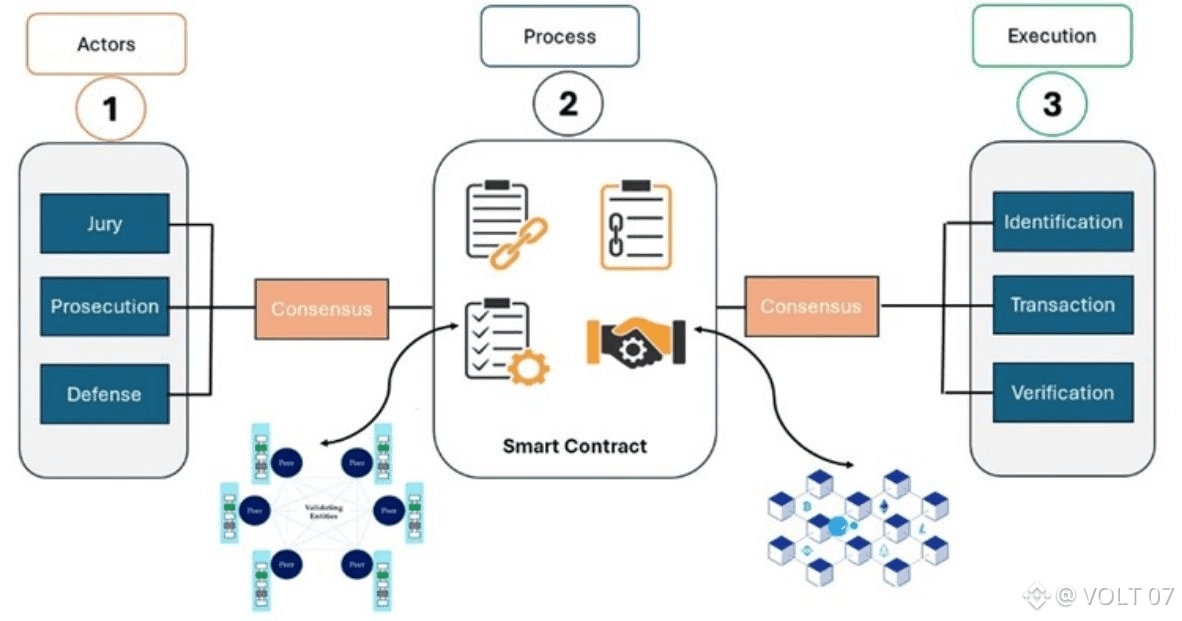
 Trust doesn’t collapse when proofs fail it collapses when proofs are disputed.
Most compliance architectures assume a clean world: proofs are generated, verified, and accepted. Reality is messier. In regulated environments, proofs are often contested, not rejected outright.
A regulator questions scope.
A counterparty challenges interpretation.
An auditor asks whether the proof actually proves enough.
That moment not the happy path determines whether a system is trusted.
This is the real stress test for Dusk Network.
Contested proofs are not a cryptographic problem
When compliance breaks down, it is rarely because:
the math is wrong,
the proof is invalid,
the system malfunctioned.
Instead, it fails because:
the proof answers the wrong question,
the scope is ambiguous,
disclosure boundaries are unclear,
responsibility is diffused.
In other words, the proof verifies something but not the thing the regulator cares about at that moment.
That gap is where trust erodes.
The first point of collapse: ambiguity of scope
When a proof is contested, the first question is always:
What exactly does this proof guarantee?
If the answer requires explanation, interpretation, or narrative, trust weakens immediately.
Systems collapse early when:
proofs are technically valid but semantically vague,
compliance rules are enforced off-chain,
context must be reconstructed manually.
At that point, cryptography no longer speaks for itself.
The second collapse: latency under challenge
A contested proof creates urgency.
If the system hesitates because:
additional proofs must be generated,
authorization paths are unclear,
operators must coordinate disclosure,
then the dispute escalates procedurally.
From a regulator’s perspective, delay equals uncertainty and uncertainty triggers expanded scrutiny, not patience.
The third collapse: asymmetry of confidence
In contested scenarios, trust collapses fastest when:
insiders are confident,
outsiders are not.
If the system’s operators say “this is fine” while regulators or counterparties remain unconvinced, the system is already losing credibility.
At that point, trust shifts away from cryptography and toward institutional discretion exactly what blockchains are meant to avoid.
Why many privacy systems fail at this stage
Privacy-first systems often assume:
proofs will be accepted at face value,
regulators will align with protocol definitions,
disputes will be rare and cooperative.
None of these assumptions hold under pressure.
When proofs are contested, systems that rely on:
layered explanations,
human arbitration,
ad hoc disclosure
appear fragile — even if the underlying cryptography is sound.
How Dusk prevents trust collapse during proof disputes
Dusk is designed so that proofs are not contextual artifacts they are execution outputs.
This means:
compliance conditions are enforced at runtime,
proofs are scoped to specific rules,
verification is binary and deterministic,
disclosure boundaries are pre-defined.
When a proof is challenged, the system does not reinterpret.
It re-verifies.
That distinction is critical.
Proofs that survive dispute share one property: finality
In Dusk’s model:
a valid proof conclusively answers a specific compliance question,
an invalid proof fails immediately and visibly,
there is no gray zone where discretion fills gaps.
Trust does not depend on who is explaining the proof only on whether it verifies.
This keeps disputes technical, not political.
What regulators actually trust under contestation
Regulators do not trust:
elegance,
complexity,
or theoretical guarantees.
They trust:
immediacy,
clarity of scope,
repeatable verification,
minimal reliance on explanation.
Dusk aligns with this by ensuring contested proofs do not widen into contested narratives.
Transparent chains collapse trust differently but faster
On fully transparent chains:
proofs are replaced by raw data,
disputes turn into interpretation battles,
context is unlimited but conclusions are unclear.
Here, trust collapses not because there is too little information but because there is too much, and none of it is authoritative.
Privacy-first, proof-based systems avoid this trap only if proofs are final, scoped, and dispute-resistant.
Where trust really collapses
Trust does not collapse when:
a proof fails,
a rule is violated,
enforcement triggers consequences.
Trust collapses when:
no one can agree on what the proof was supposed to prove in the first place.
Dusk’s architecture is designed to prevent that ambiguity from arising.
I stopped asking whether proofs are valid
Validity is table stakes.
I started asking:
When a proof is challenged, does the system resolve the dispute or does it create a bigger one?
If the answer is the latter, trust is already gone.
Dusk earns relevance by ensuring that compliance proofs remain authoritative even when they are contested not because everyone agrees, but because the system leaves no room for interpretation.
In regulated systems, trust collapses not when proofs fail, but when proofs stop being decisive.
