

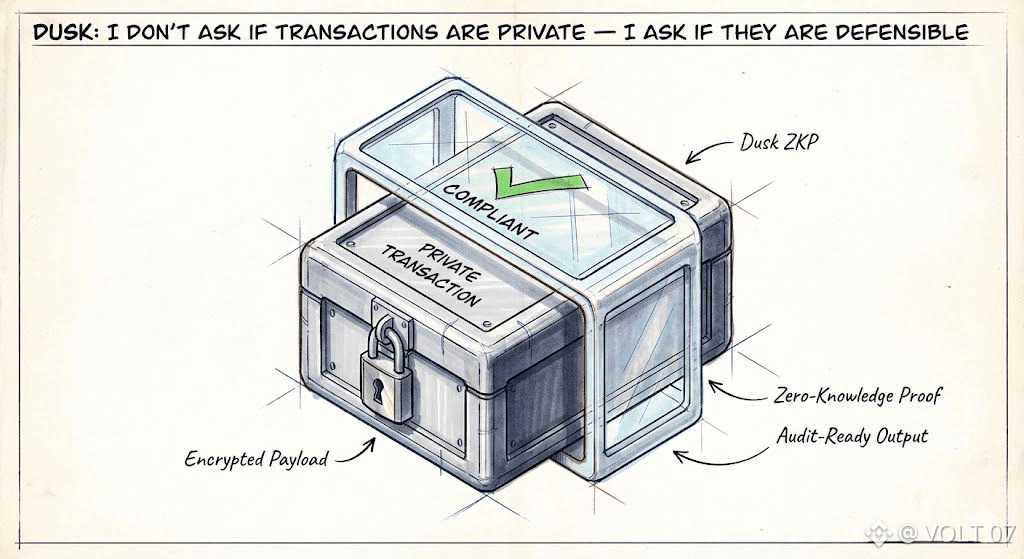
 Privacy is not the goal. Defensibility is.
Crypto often treats privacy as an ideological finish line: hide amounts, hide identities, hide flows. But in real financial systems, privacy is only valuable if it can survive scrutiny.
Institutions don’t ask whether transactions are private.
They ask whether transactions are defensible:
in an audit,
in a dispute,
under regulatory pressure,
when incentives are stressed.
That is the real context for evaluating Dusk Network.
Why “private” transactions can still be indefensible
A transaction can be confidential and still fail the real test if:
compliance cannot be proven immediately,
proof scope is ambiguous,
disclosure paths are improvised,
correctness depends on operator explanations.
At that point, privacy stops looking like protection and starts looking like obstruction.
Defensibility requires a different architecture: one where privacy never competes with proof.
Defensibility means selective disclosure that is not negotiable
In regulated markets, disclosure is layered:
regulators see more than the public,
auditors see more than competitors,
counterparties see only what is necessary.
This is not politics. It is market structure.
Dusk’s design aligns with this by enabling:
confidential execution,
proof-based correctness,
scoped disclosure to authorized parties,
deterministic verification under challenge.
A defensible transaction is not one that hides everything.
It is one that reveals the minimum necessary truth with maximum certainty.
The real threat is not exposure it is interpretation
Most trust collapses do not come from leaked data. They come from contested meaning:
Did this transfer violate restrictions?
Was the user eligible?
Was market integrity preserved?
Can we prove it without opening everything?
If answers depend on narrative, trust collapses.
Dusk prevents this by making compliance a runtime condition, not an after-the-fact argument.
How Dusk makes transactions defensible by construction
Dusk’s architecture is built so that:
smart contract execution can remain confidential,
correctness is proven cryptographically,
compliance conditions are enforced deterministically,
proofs are verifiable without revealing sensitive strategy.
This means a transaction can be defended on two levels:
It was valid (state transition correctness).
It was compliant (rule enforcement proof).
Both can be demonstrated without broadcasting intent.
Why defensibility matters more than privacy in institutional markets
Institutions can tolerate limited exposure.
They cannot tolerate ambiguous compliance.
In practice, defensibility protects institutions from:
regulatory escalation due to hesitation,
counterparty disputes over execution,
reputational damage from unverifiable claims,
operational fragility during audits.
A privacy system that cannot produce decisive proof is not privacy infrastructure. It is deferred risk.
Transparent chains are defensible in the wrong way
Public chains often appear “defensible” because:
everything is visible,
anyone can inspect data,
answers are immediate.
But this defensibility is expensive:
strategies leak permanently,
MEV becomes structural,
users subsidize insiders,
institutions avoid participation.
Transparency offers proof by exposure.
Dusk offers proof by verification.
That difference is what allows markets to scale without becoming a public surveillance arena.
Defensibility survives stress. Privacy alone does not.
Under real stress conditions:
regulators demand answers now,
counterparties contest outcomes,
markets react adversarially.
A defensible system must:
produce immediate proof,
keep disclosure bounded,
prevent extraction incentives,
preserve fairness even when assumptions weaken.
Dusk is designed for these conditions, not for ideal demos.
I stopped treating privacy as a feature.
Features can be turned off, bypassed, or misunderstood.
I started treating privacy as a liability unless it produces defensible outcomes under scrutiny.
That is why Dusk matters: it does not ask users to trust privacy claims. It structures privacy so that transactions remain provable, enforceable, and defensible when challenged.
A private transaction is useful; a defensible transaction is survivable.
