I’ll admit it: my initial reaction to Walrus Protocol was a shrug. Not because it looked bad, but because the category of "decentralized storage" has a long memory and a graveyard of broken promises. We’ve been told for years that the cloud is dead, only to see decentralized alternatives struggle with latency, cost, and complexity.
But the more I looked at Walrus, the more I realized its greatest strength isn't a flashy feature. It’s the absence of theatrics.
1. Survival Over Spectacle
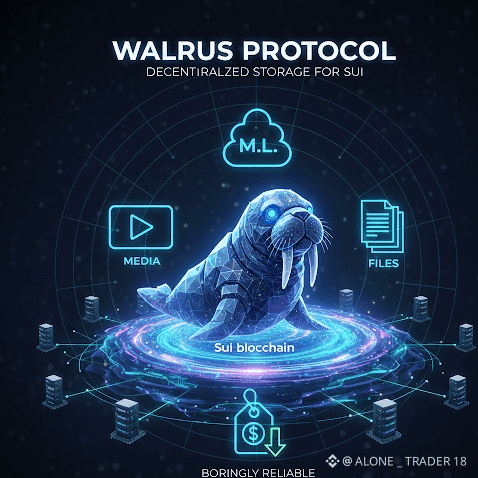
Walrus doesn’t try to reframe the internet. It simply asks: What does decentralized storage look like when it’s designed to be used, not just admired? Most protocols try to win attention. Walrus is trying to survive reality. Built on the Sui blockchain, it follows a disciplined philosophy: blockchains should coordinate and verify, not hoard raw data. By offloading "blobs" (large unstructured data) to a dedicated network of nodes while keeping the "map" (metadata) on-chain, Walrus treats the blockchain like a librarian rather than a warehouse.
2. The Power of "Good Enough"
At its core, Walrus uses erasure coding to split and distribute data. This isn’t a new concept, but Walrus treats it as a default rather than an afterthought. It acknowledges that nodes will fail, networks will congest, and demand will fluctuate.
Instead of chasing a theoretical, "perfect" decentralized utopia, it optimizes for consistently good. * Privacy isn’t a toggle: It’s assumed by the way data is fragmented.
Redundancy isn’t infinite: It’s calculated to be economically rational.
3. Modesty is a Rare Currency
Decentralized storage usually fails because it’s economically irrational at scale. When costs drift upward, incentives break. Walrus seems obsessed with efficiency. It isn't trying to store every byte of human history until the end of time; it’s trying to store valuable data reliably and at a predictable price.
In a space where "hyper-scalability" is the standard marketing buzzword, Walrus’s modesty is refreshing. It feels like a tool built by people who have watched other systems fail and decided to build something that simply works.
4. Infrastructure Doesn't Need Applause; It Needs Dependency
The protocols that end up mattering most are rarely the ones that dominate the headlines. They are the ones that become invisible. Walrus is positioning itself to be the quiet background engine for:
DeFi protocols managing sensitive, large-scale data.
Web3 Media platforms that need to serve video without a $10,000 AWS bill.
AI Developers who need censorship-resistant datasets.
These aren't glamorous users, but they are loyal ones. They don't want a revolution; they want a hard drive that doesn't go down.
The Verdict: Built to Outlast
Walrus doesn’t feel like it was built to win a single hype cycle. It feels like it was built to outlast one. By prioritizing availability and efficiency over universal "everything-storage," it makes a conscious trade-off that might just save it from overextension.
If decentralized storage is ever going to move from an ideological experiment to essential infrastructure, it will look a lot like this: quiet, specialized, and dependable. Walrus is willing to be boring now so it can be indispensable later.