

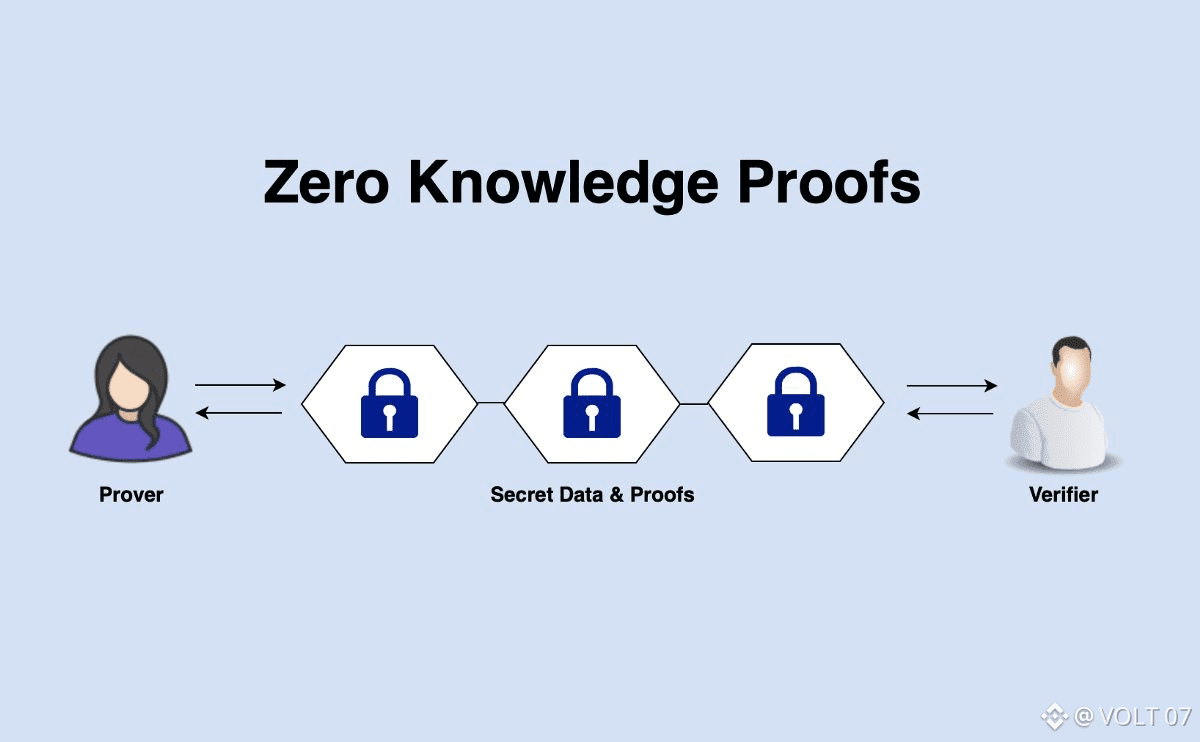
 Zero-knowledge proofs are often described like a magic trick, but on Dusk they behave like a legal instrument.
In most crypto conversations, ZK is reduced to one headline: “private transactions.” That framing is incomplete. Privacy is only the first layer of what ZK enables, and it’s not even the most valuable one for regulated markets. Dusk Network treats zero-knowledge proofs as a way to upgrade how financial systems enforce rules proving compliance, identity constraints, and asset logic without exposing sensitive information.
That difference turns ZK from a feature into infrastructure.
The real power of ZK isn’t hiding data it’s proving conditions.
Privacy-focused chains tend to optimize for concealment: hide the sender, receiver, and amount. Dusk’s architecture is built around something more practical: selective disclosure. The question isn’t “can we make this invisible?” but rather:
Can we prove this transfer is legal?
Can we prove the user is eligible?
Can we prove the asset rules were respected?
Can we prove the system is solvent without leaking strategies?
ZK proofs allow Dusk to answer “yes” to all of these, and that’s why its design fits tokenized securities, institutional DeFi, and real-world financial workflows far better than privacy-maximalist systems.
Think of Dusk’s ZK layer as a compliance engine disguised as cryptography.
Traditional finance is full of gated access: KYC, accreditation, jurisdiction filters, transfer restrictions, and disclosure requirements. Public blockchains struggle here because they can either be fully open (and non-compliant) or permissioned (and less composable).
Dusk attempts to bridge that gap with ZK-based verification. Instead of exposing personal information on-chain, a user can prove they satisfy requirements while keeping the underlying data private. The blockchain becomes capable of enforcing rules without turning every participant into a public dossier.
This is not just “privacy.” It is regulatory compatibility at protocol speed.
1) Private identity verification without on-chain identity exposure
One of the most underestimated ZK use cases is identity gating. In compliant finance, access is conditional. But in Web3, identity checks usually mean one of two bad options:
Put identity on-chain (privacy disaster), or
Keep identity off-chain (trust assumptions, centralization)
Dusk’s ZK approach enables a third path: prove identity attributes without revealing identity.
A user can prove statements like:
“I passed KYC with an approved provider.”
“I am not from a restricted jurisdiction.”
“I am eligible to hold this asset.”
without publishing their name, documents, or personal details to the public ledger.
This is how you scale compliant markets without sacrificing user dignity.
2) Enforcing transfer restrictions for tokenized securities
Tokenized securities are not like memecoins. They have rules. They may require:
whitelisted investors only
lockup periods
transfer limits
jurisdiction restrictions
investor caps per region
corporate actions compliance
Most chains cannot enforce these without centralized gatekeepers. Dusk can use ZK proofs to enforce restrictions while keeping holdings and counterparties confidential. That means the chain can run regulated assets without exposing sensitive ownership structures to the entire world.
If tokenization is going to grow beyond experiments, this is the kind of machinery it needs.
3) Confidential smart contract execution, not just private transfers
Transaction privacy is simple: hide who paid whom. Real finance is more complex: it involves state changes, conditional logic, and multi-step settlement flows.
Dusk’s design allows for confidential execution, meaning contracts can update state while keeping critical parts private. This enables:
confidential auctions
private OTC settlement
sealed-bid mechanisms
hidden collateral positions
private liquidity provisioning logic
Once smart contracts become confidential, markets become safer. Strategies stop leaking. Participants stop being hunted. And institutional users stop viewing public chains as operationally dangerous.
4) Proof-of-compliance instead of disclosure-as-compliance
Legacy finance often treats disclosure as the method of enforcement: “show everything so we can audit it.” Public blockchains push this to the extreme by default, but that model breaks under real-world constraints.
ZK allows Dusk to invert the model:
Instead of disclosing data → prove compliance.
Instead of exposing positions → prove solvency.
Instead of publishing identity → prove eligibility.
This is how financial privacy becomes compatible with enforcement. The blockchain can remain open and verifiable while the sensitive business logic stays protected.
It’s the difference between surveillance-based trust and proof-based trust.
5) Confidential asset issuance with verifiable legitimacy
Issuance is where real-world assets collide with crypto reality. If a company issues tokenized equity, it needs:
compliance guarantees
investor eligibility enforcement
cap table confidentiality
controlled distribution
regulated settlement
Dusk’s ZK layer can support issuance flows where the market can verify legitimacy without forcing issuers to expose sensitive shareholder structures publicly.
This is essential because institutional issuers do not want:
competitors tracking their capital formation
public wallet mapping of their investors
real-time visibility into treasury moves
ZK-based issuance is what makes tokenization viable at enterprise scale.
6) Private settlement that still supports auditability
Settlement is the moment where everything must be correct. In TradFi, settlement is private but auditable. In DeFi, settlement is public but often exploitable.
Dusk’s ZK-based privacy model aims to deliver:
private settlement
correct execution
provable finality
auditable trails when required
This is the real endgame: a chain that can run markets like a financial institution, without becoming a closed institution.
That balance is extremely difficult, and it is exactly where most blockchains fail.
7) ZK as a defense against market predation
There is a brutal truth about public chains: transparency is not neutral. It creates asymmetric advantages for:
MEV bots
liquidators
copy traders
adversarial market makers
wallet trackers
When everything is visible, sophisticated actors extract value from less sophisticated participants. ZK reduces this exploitation by limiting the information surface attackers can weaponize.
In this sense, ZK is not just privacy it is market fairness technology.
Dusk’s ZK usage represents a shift from “crypto privacy” to “financial confidentiality.”
Crypto privacy is often ideological. Financial confidentiality is operational. Institutions don’t demand privacy because they want to hide wrongdoing they demand it because markets break when strategies and positions are exposed in real time.
Dusk’s ZK layer is designed for this reality. It supports a world where:
assets can be regulated
identities can be verified
compliance can be enforced
strategies can remain confidential
markets can operate without surveillance
That’s why ZK on Dusk goes far beyond “private transactions.” It becomes the base layer for compliant capital markets.
The next financial revolution won’t come from hiding everything it will come from proving the right things while revealing almost nothing.
