


Stablecoins are no longer a niche innovation. They are rapidly becoming the default mechanism for moving value across borders, businesses, and digital economies. With trillions of dollars already flowing through stablecoins each year—surpassing even legacy payment giants—the question is no longer if stablecoins will reshape global finance, but what infrastructure will carry them.
That is where Plasma enters the picture.
Plasma is not trying to be another multipurpose blockchain competing for attention in an already crowded landscape. It is engineered with a singular mission: to serve as the global settlement layer for stablecoins. Every design choice, from consensus to user experience, reflects one belief—money movement deserves dedicated infrastructure.
Why the World Is Actively Searching for a New Payment Rail
The rise of stablecoins is driven by necessity, not speculation. The global financial system is struggling to meet modern demands.
Cross-border payments remain slow, expensive, and opaque. Settlement through legacy systems can take days, incur high fees, and rely on multiple intermediaries. For individuals, this means lost income. For businesses, it means locked capital and operational inefficiency.
Stablecoins remove these barriers by enabling instant, programmable, borderless value transfer. In 2024 alone, stablecoins processed over $32.8 trillion in volume—more than Visa. This surge reflects a structural shift in global finance.
Yet despite explosive adoption, the infrastructure beneath stablecoins has not kept pace.
The Infrastructure Mismatch Holding Stablecoins Back
Most stablecoins today ride on blockchains that were never designed for payments at scale.
Ethereum pioneered programmable money but struggles with congestion and volatile fees. Small payments become impractical during peak usage, undermining everyday adoption.
Tron offers lower-cost transfers but relies on a highly centralized validator model. While efficient, it lacks the neutrality and resilience required for global financial infrastructure.
Across nearly all chains, users face unnecessary friction. Sending USDT often requires holding a second asset purely to pay gas fees—an experience that feels foreign to anyone accustomed to traditional finance.
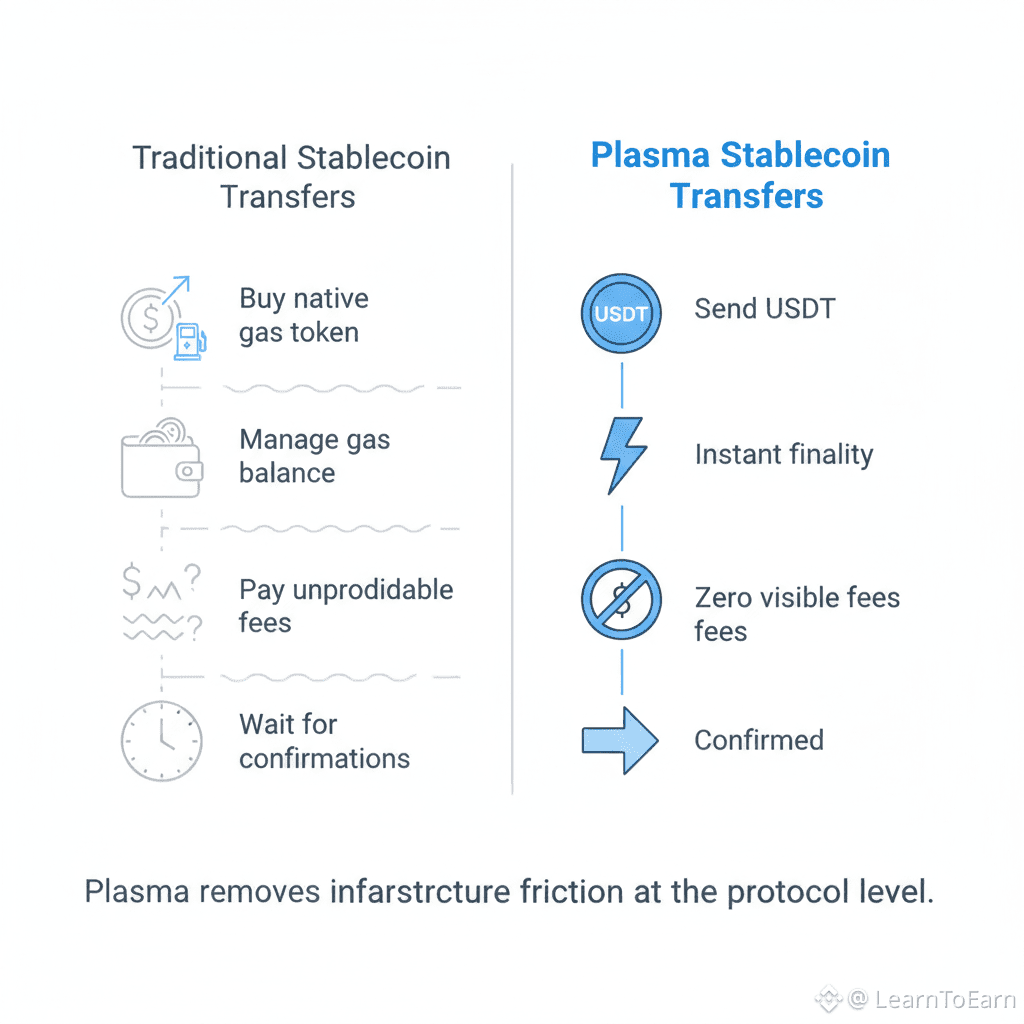
These are not user problems. They are infrastructure problems.
Plasma is built to solve them at the foundation.
Plasma’s Architecture: Built for Money, Not Noise
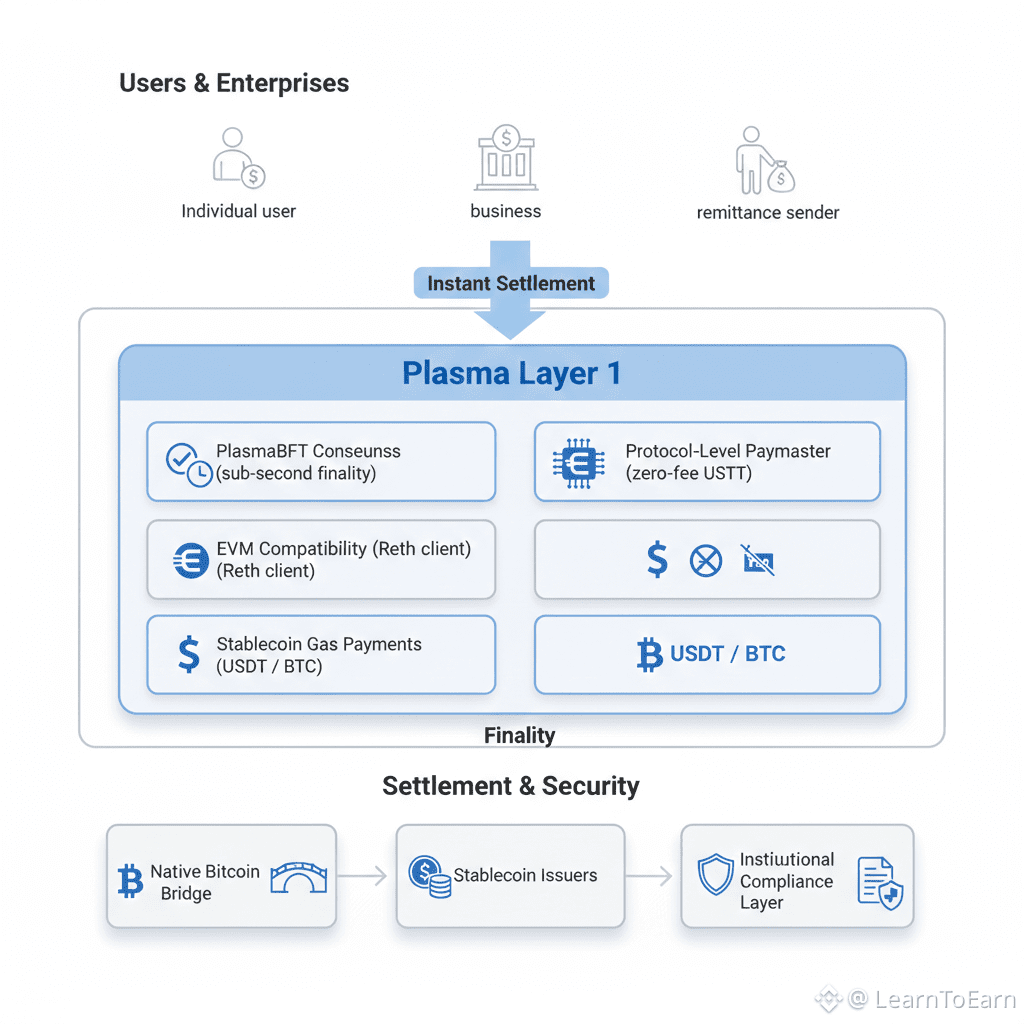
Plasma is a Layer 1 blockchain designed from the ground up for high-volume, low-latency stablecoin settlement. Instead of retrofitting payment features onto a general-purpose chain, Plasma removes unnecessary complexity and optimizes for what matters most: speed, cost predictability, and usability.
Ultra-Fast Finality with PlasmaBFT
At its core, Plasma runs on PlasmaBFT, a consensus mechanism derived from Fast HotStuff and optimized for pipelined execution.
This enables transactions to reach irreversible finality in under one second. For payments, this is transformative. There is no waiting, no uncertainty, and no reliance on probabilistic confirmations.
The network is designed to scale beyond 1,000 transactions per second, providing throughput comparable to global payment networks while retaining decentralized security guarantees.
This is consensus designed for commerce, not speculation.
Instant Developer Adoption Through Full EVM Compatibility
Plasma removes friction not just for users, but for builders.
By offering full EVM compatibility via the Reth client, Plasma allows developers to deploy Ethereum-based applications without modification. Wallets, tooling, and smart contracts work immediately.
This ensures Plasma does not need years to build an ecosystem. It inherits one from day one.
Protocol-Level Design That Eliminates User Friction
Where Plasma truly differentiates itself is at the protocol layer—solving adoption barriers that other chains leave to applications.
Zero-fee USDT transfers are made possible through a protocol-level paymaster that sponsors gas costs for standard stablecoin transactions. From the user’s perspective, sending USDT costs nothing.
Beyond that, Plasma allows gas fees to be paid directly in stablecoins like USDT or even Bitcoin. Users never need to acquire or manage the native token to participate in the economy.
This abstraction mirrors traditional financial apps. You pay in the asset you are using. Nothing else.
Plasma also integrates a native Bitcoin bridge, allowing BTC to enter the ecosystem as a programmable asset while maintaining trust-minimized security. This anchors the network to the most battle-tested monetary system in existence.
Privacy-conscious payments are also on the roadmap, with confidential transaction support designed to meet enterprise needs without sacrificing compliance.
Why Plasma Changes Stablecoin Use Cases at Scale
When friction disappears, use cases expand.
For cross-border payments and remittances, Plasma enables instant settlement at effectively zero cost. Migrant workers can send value home without losing income to intermediaries, and recipients gain immediate access to funds.
For enterprises, Plasma unlocks programmable settlement. Supplier payments, treasury operations, and trade finance can be automated with real-time execution and finality.
For emerging markets, Plasma provides direct access to digital dollars in regions where inflation, capital controls, or banking limitations restrict financial freedom. This alone represents tens of billions in economic demand.
Plasma also serves as the ideal settlement layer for tokenized assets—stocks, bonds, and commodities that require fast, neutral, and trusted settlement in stable value.
A Clear Leap Over Existing Payment Rails
Compared to traditional banking, Plasma is faster, cheaper, and always on.
Compared to general-purpose blockchains, it is predictable, user-friendly, and optimized for scale.
Where others compromise between flexibility and efficiency, Plasma chooses clarity of purpose.
Launching with Liquidity, Not Promises
Plasma avoided the typical cold-start problem by launching with deep liquidity and live interoperability.
Within weeks, it attracted billions in deposits and became one of the largest networks by stablecoin holdings. Major DeFi protocols deployed immediately, validating Plasma not just as a concept, but as functioning financial infrastructure.
This “launch liquid” approach ensured Plasma began life as a settlement layer—not a theoretical network waiting for adoption.
Positioned for Institutional and Regulatory Alignment
Global adoption requires more than technology. Plasma is building for institutions from day one.
Compliance tooling, transaction monitoring, and regulatory readiness are integrated into the ecosystem. As regulatory clarity improves across major jurisdictions, Plasma is positioned to meet institutional standards rather than adapt after the fact.
This makes it suitable not just for users and startups, but for enterprises, payment processors, and financial institutions seeking stablecoin-native rails.
The Rise of Dedicated Financial Infrastructure
General-purpose blockchains introduced programmable money, but they were never optimized for moving it at global scale.
Plasma represents the next phase of evolution—a blockchain that treats stablecoins not as applications, but as the reason the network exists.
By removing fees, abstracting gas complexity, guaranteeing instant settlement, and anchoring security in proven systems, Plasma transforms stablecoins from a crypto instrument into a global financial medium.
It is not building another lane on a congested road.
It is building the highway the world’s digital dollars will travel on.
USDT₀ on Plasma: The Birth of Truly Frictionless Digital Dollar Payments
USDT has already won the stablecoin race.
It moves trillions of dollars every year, underpins global crypto liquidity, and quietly acts as the digital dollar for millions of people and businesses worldwide. Yet despite its dominance, USDT has never reached its full potential as a payment rail. Not because of trust or adoption—but because the blockchains carrying it were never designed for money movement at scale.
Plasma changes that.
By embedding USDT directly into the protocol layer, Plasma doesn’t just make stablecoin payments cheaper or faster. It removes the invisible friction that has held digital dollars back from becoming everyday money. USDT₀ on Plasma represents a structural shift—from “stablecoins on blockchains” to “blockchains built for stablecoins.”
This is not an incremental upgrade. It is a redefinition of how digital dollars move.
Why Stablecoins Still Feel Hard to Use
On paper, stablecoins solve everything: instant settlement, global reach, and dollar stability. In practice, users still face unnecessary hurdles that prevent mass adoption.
The most common frictions are structural, not user errors.
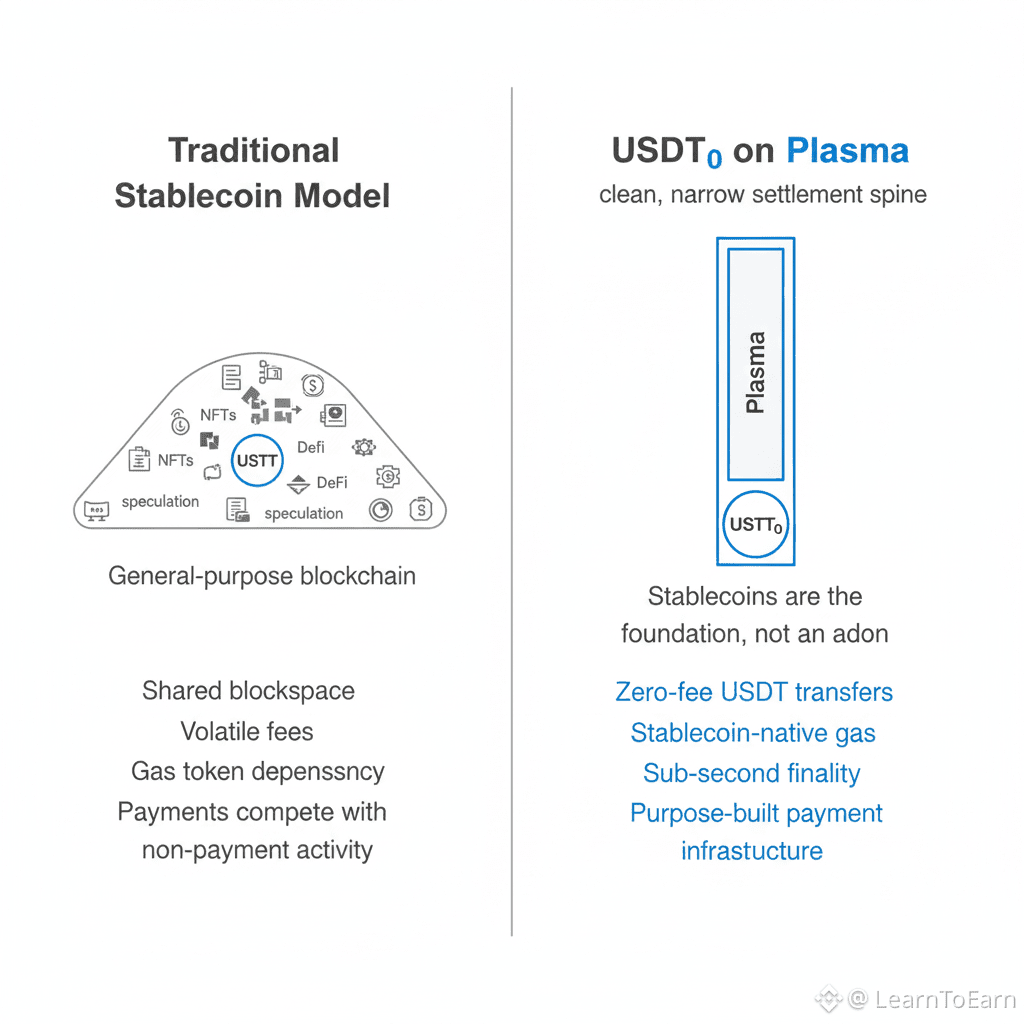
First, there is gas token dependency. On nearly every blockchain today, sending USDT requires holding a separate asset just to pay fees. This breaks the mental model of money. No one expects to buy oil futures to send a bank transfer—but that’s effectively what users must do on general-purpose chains.
Second, fees are unpredictable. When blockspace is shared with NFTs, DeFi liquidations, and speculation, payment costs become volatile. A transaction that costs cents today may cost dollars tomorrow, killing micro-payments and everyday use.
Third, most blockchains are architecturally misaligned with payments. They optimize for expressive computation, not throughput and finality. Payments don’t need complexity—they need speed, reliability, and consistency.
Plasma does not attempt to patch these issues. It removes them at the root.
USDT as a First-Class Citizen, Not a Guest
The defining difference between Plasma and other chains is philosophical as much as technical.
Plasma is not a blockchain that “supports USDT.” It is a blockchain designed around USDT.
This distinction unlocks capabilities that cannot be retrofitted onto general-purpose networks.
Zero-Fee USDT Transfers: Removing Cost from the User Experience
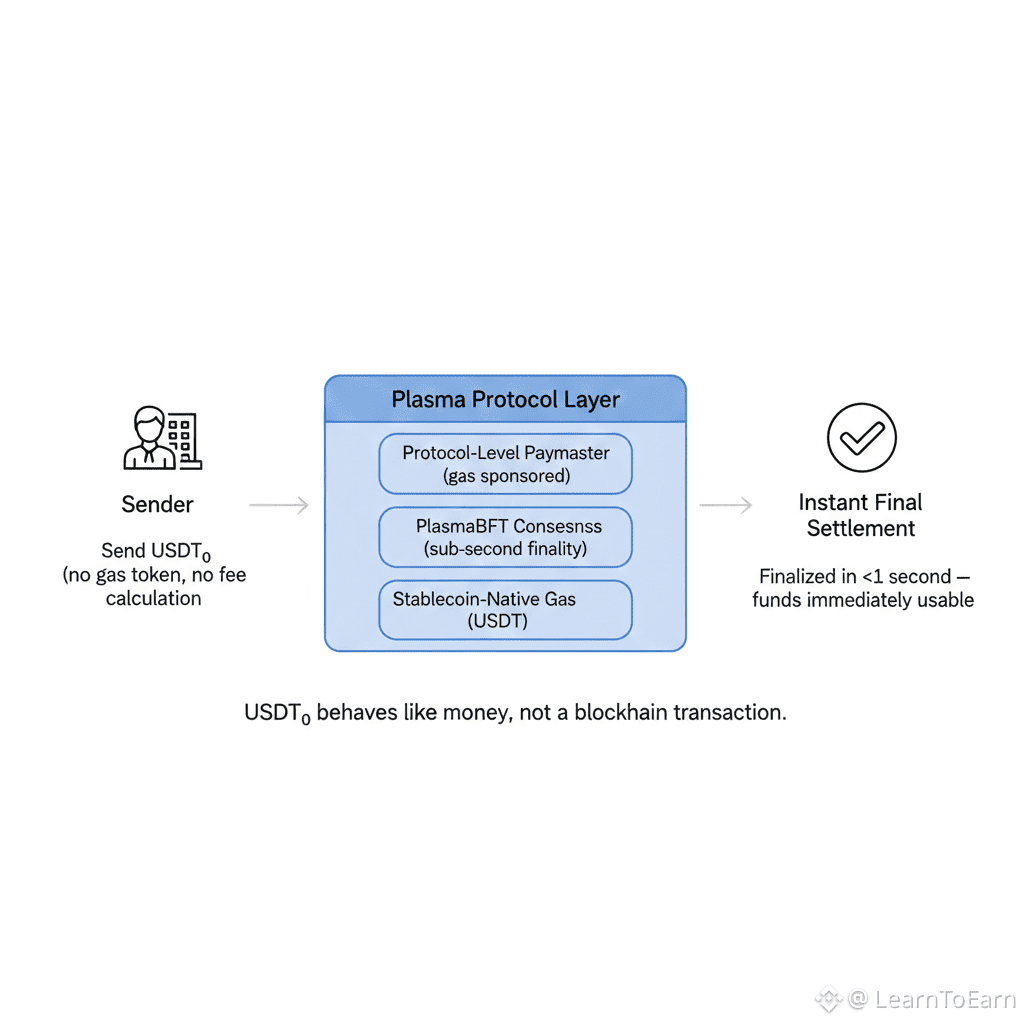
At the heart of USDT₀ is Plasma’s protocol-level gas sponsorship.
For standard USDT transfers, Plasma automatically covers the gas cost using a native paymaster mechanism. Users do not calculate fees. They do not hold extra tokens. They simply send digital dollars.
This transforms usability:
Micro-payments become viable
Remittances cost nothing to send
Payment UX mirrors Web2 finance
To maintain sustainability, Plasma enforces rate limits and lightweight identity constraints at the protocol edge, preventing abuse without reintroducing friction.
From the user’s perspective, cost disappears. From the system’s perspective, efficiency improves.
Stablecoin-Native Gas: Payments Without Token Management
Even beyond fee-less transfers, Plasma allows transaction fees to be paid in USDT itself.
This is more important than it sounds.
Gas abstraction means developers can build applications where users never touch the native token. No swapping. No onboarding confusion. No “insufficient gas” errors. Payments behave like payments, not crypto transactions.
This is the difference between infrastructure built for developers and infrastructure built for users.
A Payment-Optimized Performance Stack
Frictionless payments are impossible without fast and deterministic settlement. Plasma’s architecture is purpose-built to deliver exactly that.
PlasmaBFT consensus achieves sub-second finality by pipelining block production and confirmation. Payments settle fast enough for real-time use cases—point-of-sale systems, payroll, merchant checkouts—where even small delays matter.
The execution layer remains fully EVM-compatible, powered by Reth. Developers bring existing contracts, tooling, and workflows without modification, while benefiting from millisecond-level timestamp precision ideal for payment ordering and batching.
Plasma’s Bitcoin-native bridge adds a final layer of credibility. By anchoring state to Bitcoin and enabling BTC to flow into the ecosystem as pBTC, Plasma grounds its settlement layer in the most secure ledger ever created.
This combination—speed, compatibility, and neutral security—is rare, and intentional.
What USDT₀ Unlocks in the Real World
Removing friction doesn’t just improve existing use cases—it creates new ones.
Cross-Border Payments Without Trade-Offs
Stablecoins already outperform traditional wires. Plasma removes the remaining compromises.
With USDT₀:
Transfers finalize in under a second
Fees are effectively zero
Funds are usable immediately upon receipt
For remittance corridors, this is transformative. Workers no longer choose between speed and cost. They get both.
Programmable Enterprise Settlement
For businesses, Plasma turns USDT into a programmable treasury asset.
Payments can trigger automatically based on on-chain or off-chain events. Settlement occurs instantly. Accounting becomes real-time. Counterparty risk collapses.
This is not faster banking. It is a different settlement paradigm.
The Settlement Layer for Tokenized Markets
Tokenized assets—equities, bonds, commodities—require a neutral, fast, and trusted settlement asset.
USDT₀ on Plasma fits that role naturally.
Atomic exchange between tokenized assets and USDT₀ becomes seamless, enabling capital markets that settle instantly, globally, and without intermediaries.
Plasma doesn’t compete with financial markets. It modernizes their plumbing.
Why Plasma Is Different from Every Other Option
Traditional banking systems are slow, expensive, and opaque.
General-purpose blockchains are faster but unpredictable and complex.
Plasma occupies a new category entirely: purpose-built stablecoin infrastructure.
It offers:
Sub-second settlement
Zero-fee USDT transfers
24/7 global availability
Gas abstraction by default
This is not an optimization. It is a redefinition of expectations.
Liquidity, Access, and the Path to Scale
Payments only work if money can enter and exit the system easily.
Plasma launches with deep USDT liquidity, live exchange support, and full developer readiness. Users can move funds in and out seamlessly, while applications tap into existing DeFi infrastructure from day one.
This ensures Plasma is not just technically capable—but economically usable.
The Bigger Picture: From Stablecoins to Standards
USDT₀ on Plasma represents more than a feature release. It signals the emergence of a new financial standard.
As regulators clarify frameworks and institutions adopt stablecoins at scale, demand will shift toward infrastructure that feels familiar, predictable, and compliant.
Plasma is built for that future.
By treating stablecoins as first-class citizens—rather than guests competing for blockspace—Plasma transforms digital dollars from a crypto tool into a global payment medium.
In the evolution of money rails, this is the moment where stablecoins stop adapting to blockchains—and blockchains finally adapt to stablecoins.
The Specialized Superhighway: How Plasma Is Redefining Stablecoins as a Global Payment Rail
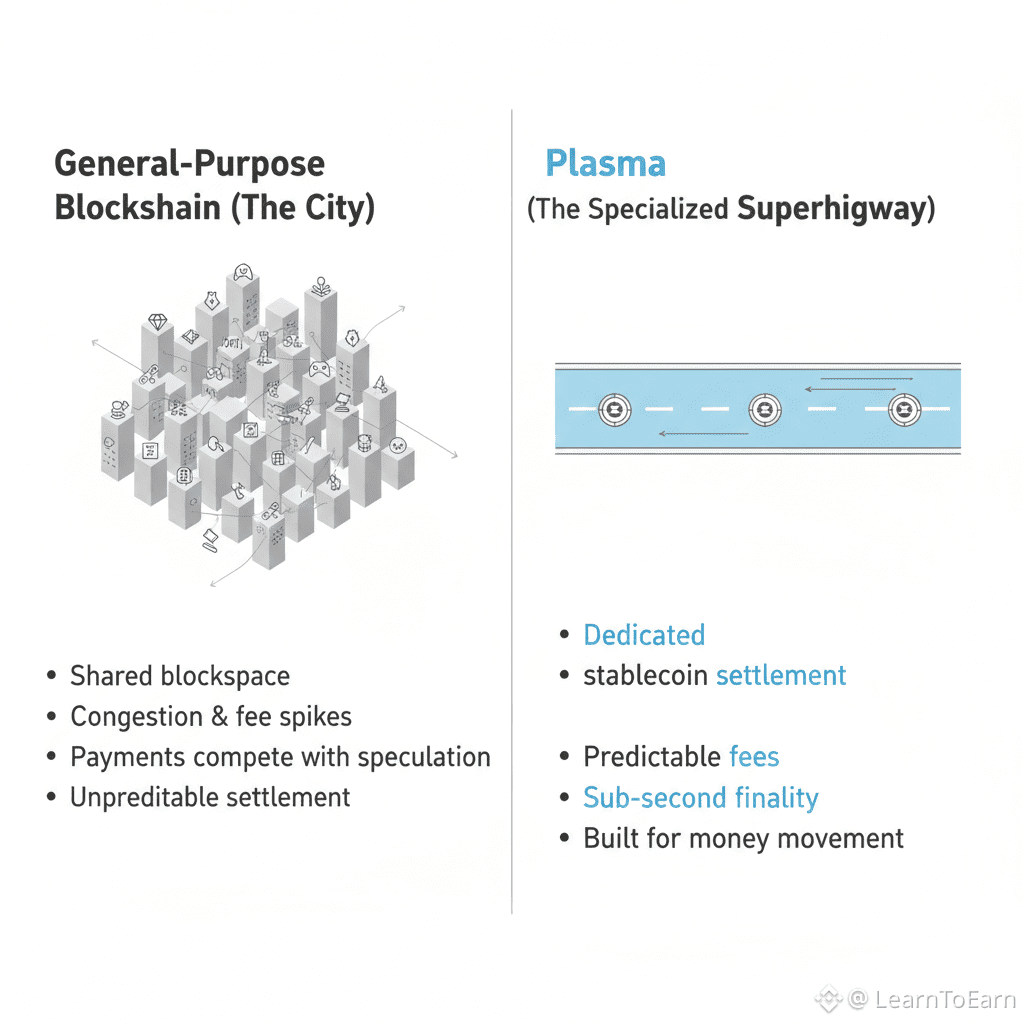
In crypto, most blockchains try to be cities. They host everything—NFT art galleries, memecoin casinos, DeFi banks, gaming arcades, and governance forums—all competing for the same blockspace. It’s impressive, but it’s also chaotic. Fees spike unpredictably, transaction times fluctuate, and something as simple as sending digital dollars can feel unnecessarily complex.
Plasma takes a completely different approach. Instead of building another crowded city, it builds a superhighway.
A highway doesn’t need shops, theaters, or parks. It needs speed, reliability, safety, and clear rules. Plasma (XPL) is designed with exactly that mindset: a blockchain engineered specifically for stablecoin settlement. Not as an afterthought. Not as “one use case among many.” But as its core reason to exist.
At a time when stablecoins quietly process trillions of dollars in value—powering remittances, payroll, on-chain trading, and cross-border commerce—Plasma recognizes a simple truth: stablecoins are no longer an experiment. They are money rails. And money rails demand purpose-built infrastructure.
Plasma is the first blockchain that treats stablecoins the way Visa treats card payments or SWIFT treats interbank settlement—not as apps, but as infrastructure.
Why Specialization Wins When Money Is the Product
General-purpose blockchains are excellent for experimentation. But money movement is not an experiment. Payments need predictability. They need consistency. They need costs that don’t spike during market hype and confirmation times that don’t depend on NFT mints or meme trends.
Plasma’s core philosophy is specialization over optionality.
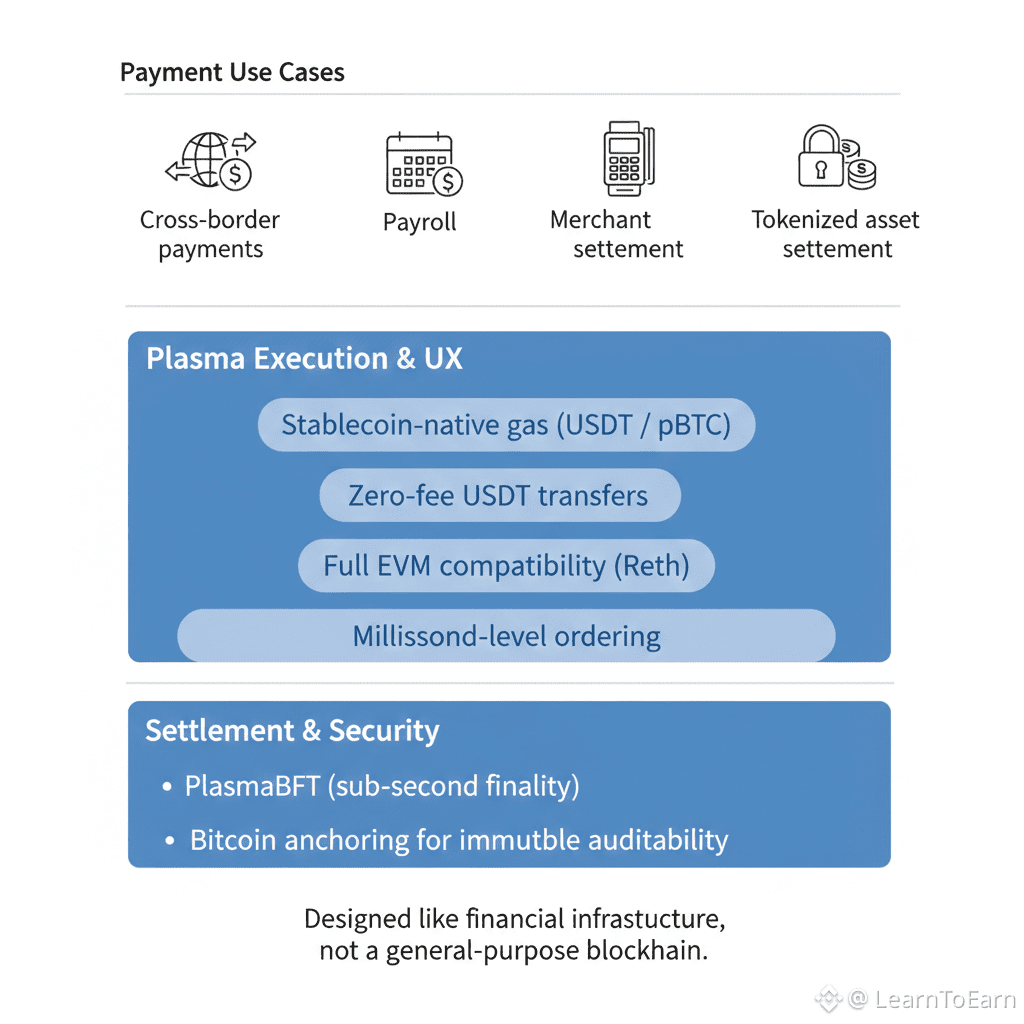
Instead of optimizing for every possible smart contract use case, Plasma optimizes for one thing done exceptionally well: moving stable value at global scale. That single decision cascades into every design choice—consensus, gas mechanics, execution environment, and even governance incentives.
The result is a blockchain where:
Fees are predictable and often zero for end users
Confirmation times feel instant, not probabilistic
Users don’t need to understand gas tokens to use money
Developers can focus on payment logic, not infrastructure workarounds
In practical terms, Plasma aims to make sending USDT feel closer to sending a WhatsApp message than executing a DeFi transaction.
The Performance Stack: Built Like Financial Infrastructure, Not a Crypto Experiment
Plasma’s technical architecture reflects systems you would expect in high-speed financial networks, not hobbyist chains. Its performance comes from three tightly integrated layers, each solving a specific bottleneck in modern blockchain payments.
1. PlasmaBFT: Finality Designed for Payments, Not Speculation
At the core of Plasma is PlasmaBFT, a pipelined version of the Fast HotStuff consensus algorithm. This matters because payments demand finality—not “probably final,” not “final after a few minutes,” but final now.
PlasmaBFT achieves this by overlapping consensus stages. Instead of waiting for one phase to complete before starting the next, the network runs proposals, votes, and commitments in parallel. This dramatically reduces idle time and unlocks sub-second confirmation paths for most transactions.
Key implications:
Payments settle fast enough for real-world commerce
Merchants don’t need to wait multiple confirmations
Applications can assume finality almost immediately
Importantly, Plasma uses a Byzantine Fault Tolerant model that remains secure even if up to one-third of validators behave maliciously or fail. But unlike many PoS chains, Plasma avoids harsh stake slashing. Instead, it penalizes poor performance through reduced rewards. This may sound subtle, but it’s crucial for institutions, which often cannot accept catastrophic capital loss as an operational risk.
This is consensus designed to be boring—in the best possible way.
2. Reth and Full EVM Compatibility: No Friction for Builders
Payments infrastructure only succeeds if developers can build on it easily. Plasma removes friction by being fully EVM bytecode-compatible, powered by Reth, a high-performance Ethereum client written in Rust.
For developers, this means:
Existing Ethereum smart contracts deploy without modification
Familiar tools work instantly
No new programming models to learn
But Plasma goes a step further by enhancing execution precision. Millisecond-level timestamps allow for accurate transaction ordering—critical for payment batching, streaming money, payroll systems, and high-throughput settlement engines.
In short, Plasma doesn’t ask developers to adapt to it. It adapts to them.
3. Bitcoin Anchoring: Settlement Credibility at the Highest Level
Where many blockchains anchor security in abstract economic models, Plasma anchors itself to something concrete: Bitcoin.
Plasma periodically commits cryptographic summaries of its state to the Bitcoin blockchain. This creates an immutable audit trail secured by the most battle-tested, censorship-resistant network on the planet.
Why this matters:
Institutions gain confidence in settlement integrity
Historical state can be independently verified
Political neutrality is preserved
This anchoring also enables Plasma’s Bitcoin bridge, allowing real BTC to enter the Plasma ecosystem as pBTC—usable in EVM-based applications while remaining verifiable against Bitcoin itself.
For global finance, this is powerful. It connects the world’s most trusted monetary base layer with a modern programmable settlement network.
Stablecoin-Native Design: Removing the Hidden Frictions of Crypto Payments
Plasma’s most important innovations aren’t flashy—they’re practical.
Zero-fee USDT transfers are possible because Plasma treats stablecoin payments as first-class citizens. Through protocol-level gas sponsorship, eligible transfers cost users nothing. This unlocks use cases that were previously impossible, like:
Micro-remittances
Streaming payments
Low-margin merchant settlements
Custom gas tokens remove another psychological barrier. Users don’t need to buy or manage XPL just to send money. Fees can be paid in USDT or pBTC, aligning the user experience with traditional finance expectations.
Future confidential payments push Plasma even further toward real-world adoption. By enabling optional privacy for sensitive transfers while preserving auditability, Plasma acknowledges a critical reality: not all payments should be public, but all payments must be accountable.
Institutional Gravity: Where Theory Meets Adoption
Plasma’s credibility isn’t theoretical—it’s operational.
Launching with billions in stablecoin liquidity and broad DeFi integration gives it immediate economic relevance. Institutional partnerships with custodians and compliance providers signal something deeper: Plasma is being evaluated not as a crypto project, but as financial infrastructure.
For enterprises, this matters more than narratives. Predictable costs, compliance tooling, and settlement guarantees are non-negotiable. Plasma is being built to meet those standards from day one.
Who Plasma Is Really For
Plasma serves two groups that are often discussed separately but deeply connected.
For individuals in emerging markets, Plasma offers something radical: dollar access without friction. No hidden fees. No waiting. No financial gatekeepers.
For institutions, Plasma offers something equally radical: a neutral, programmable, high-speed dollar settlement layer that doesn’t depend on legacy banking rails.
Together, these groups form the foundation of a parallel financial system—one that doesn’t replace existing finance overnight, but quietly outperforms it.
The Long Game: Becoming the Internet’s Money Rail
Plasma’s ambition is not to win crypto cycles. It’s to outlast them.
As stablecoins continue to absorb more of global payments, the question is no longer whether blockchain settlement will matter—but which rails will carry that value. Plasma is betting that specialization, neutrality, and infrastructure-first thinking will win.
In a world full of blockchains trying to be everything, Plasma chose to be essential.
It didn’t build a city.
It built the road the world’s money will travel on.

