
In crypto, most attention goes to hype. A token pumps. A project announces a new partnership. Charts flash green. But for serious traders and institutional participants, hype is rarely the real problem or the real solution. The problems that quietly destroy performance are the ones that rarely make headlines: slow confirmations, unpredictable fees, failed transfers, and friction that turns a clean plan into chaos.
Dusk’s advantage doesn’t scream on social media. It whispers through low and predictable transaction costs. At first glance, that might seem small. Saving a few cents per transaction hardly feels revolutionary. But in practice, it changes the way people behave on-chain. Traders stop hesitating. They rebalance positions more often. They split orders, move liquidity between venues, and interact with the chain without worrying that each step will cost them more than they planned. In traditional financial markets, smooth execution is normal. In crypto, it is rare and that rarity is where Dusk shines.
By mid-January 2026, DUSK trades around $0.07–$0.08, with daily volume in the tens of millions and circulating supply near 487 million. Low unit prices might psychologically encourage experimentation, but the bigger story is operational. Dusk is designed for regulated finance infrastructure: fast settlement, compliance, privacy with auditability, and seconds-level confirmation targets. This isn’t about gambling on price. It’s about creating a network that works efficiently when it matters.
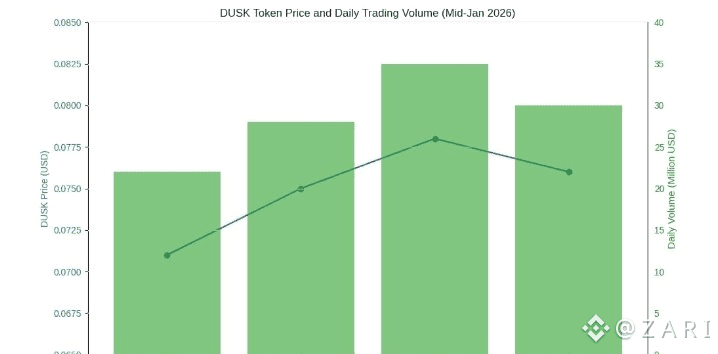
Think about what “closing a position” really means. It’s not just pressing a sell button. It’s moving collateral, bridging funds, settling transactions, reallocating capital, and sometimes repeating the process multiple times. On congested chains, hesitation is unavoidable. Traders ask themselves: “Will my transfer go through? Will fees spike? Will this delay my next move?” Each pause carries an invisible cost missed opportunities, lost profits, and frustration.
Low-fee chains like Dusk reduce these micro-frictions. Every action becomes economical. Traders can behave like disciplined professionals: adjust positions, rebalance portfolios, and manage risk actively. Execution stress drops. Decisions rely on strategy, not anxiety about costs or network delays. Over time, this subtly but powerfully changes trading behavior.
Of course, no network is perfect. Some chains achieve low fees by sacrificing decentralization or security. Dusk’s model balances purpose-built consensus and a settlement-first design to maintain speed and predictability without compromising reliability. Not all parts of the ecosystem share identical settlement times DuskEVM inherits a temporary 7-day finality from its OP Stack layer but the core principle remains: fast, cheap, predictable transactions.
The broader lesson is simple: low fees are not just about saving money. They create a cleaner, more professional trading workflow. They reduce hesitation. They allow frequent, repeated interaction without the network punishing discipline. And in crypto, behavior often matters more than hype.
In short, Dusk’s low-fee advantage is a quietly powerful edge. It enables faster closes, smoother transactions, and predictable outcomes. It doesn’t guarantee price spikes, but it builds a foundation where serious activity can happen repeatedly without the network working against its users.
When micro-actions become affordable and friction disappears, the chain stops being just another token. It becomes a tool that traders and institutions can trust to perform, every time. And in the world of crypto, that is exactly the advantage that matters.
