

Walrus is transforming how the legal world preserves and verifies evidence, turning fragile, paper-based records into tamper-evident digital assets with cryptographic certainty. By creating decentralized evidence repositories, Walrus ensures that contracts, timestamps, deposition logs, and other critical legal materials survive scrutiny across jurisdictions and endure long-term storage decay. Law firms encrypt case files locally before submitting them, producing cryptographically anchored proofs on Sui that establish chronological precedence without exposing sensitive content during discovery. Courts access reconstructed records via permissioned policies, while immutable audit trails provide accountability for spoliation defenses and appellate review decades later.
Cryptographically Verified Provenance Chains
At the core of Walrus is a system that embeds notarized timestamps through trusted execution environments, generating unassailable proofs of “first publication” that prevent backdating—a common issue in intellectual property and corporate disputes. Multi-party depositions fragment into tamper-resistant slivers, requiring unanimous witness validation to reconstruct testimony. Smart contracts automate preservation schedules, pulling court docket entries via API integrations and storing full case histories as composable Sui objects accessible internationally.
Every access is logged as an append-only zero-knowledge proof, producing courtroom-ready exhibits that demonstrate chain-of-custody without revealing sensitive metadata. Expert reports link to original datasets through Merkle proofs, allowing judges to validate analyses without handling raw terabytes. In this system, mathematical certainty replaces subjective affidavits, elevating blockchain storage to forensic-grade reliability.
Automated Discovery and Redaction
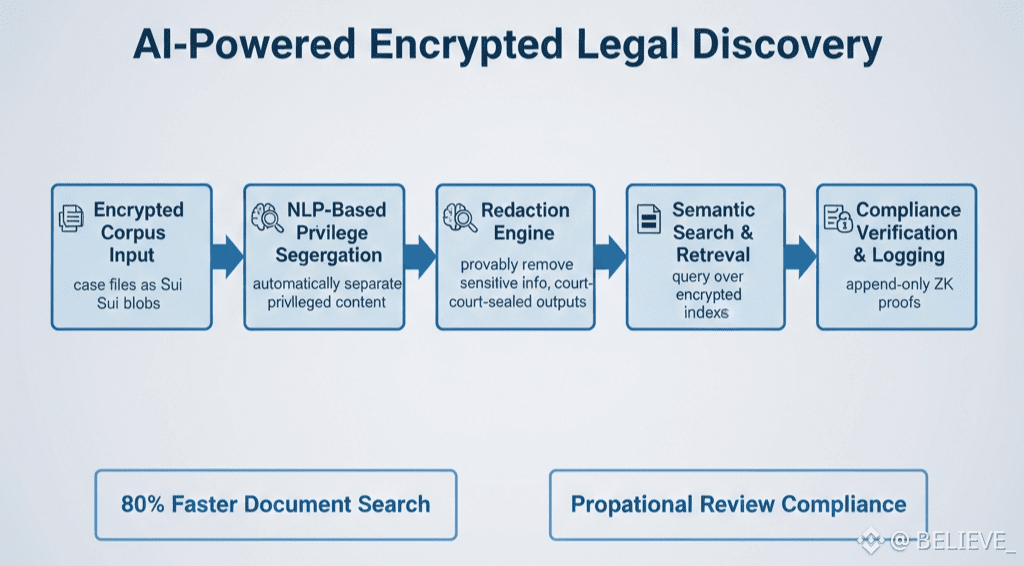
Walrus streamlines e-discovery with AI-driven protocols. Uploaded corpora are scanned against court orders, automatically segregating privileged communications via natural language processing trained on jurisdictional doctrines. Redaction engines create court-sealed versions with provable removals, preserving full reconstructions for in-camera review. Privilege logs generate as machine-readable Sui objects, replacing tedious paper-based disputes with on-chain verification games.
Semantic search over encrypted indexes surfaces relevant documents up to 80% faster than conventional review methods while maintaining legal defensibility. Predictive coding estimates recall rates audited independently, satisfying proportionality standards under Federal Rules of Civil Procedure without exhaustive human review. Multi-district litigation consolidates evidence across courts into unified blob namespaces, eliminating duplicated processing and preserving integrity.
Global Arbitration and Tribunal Integration
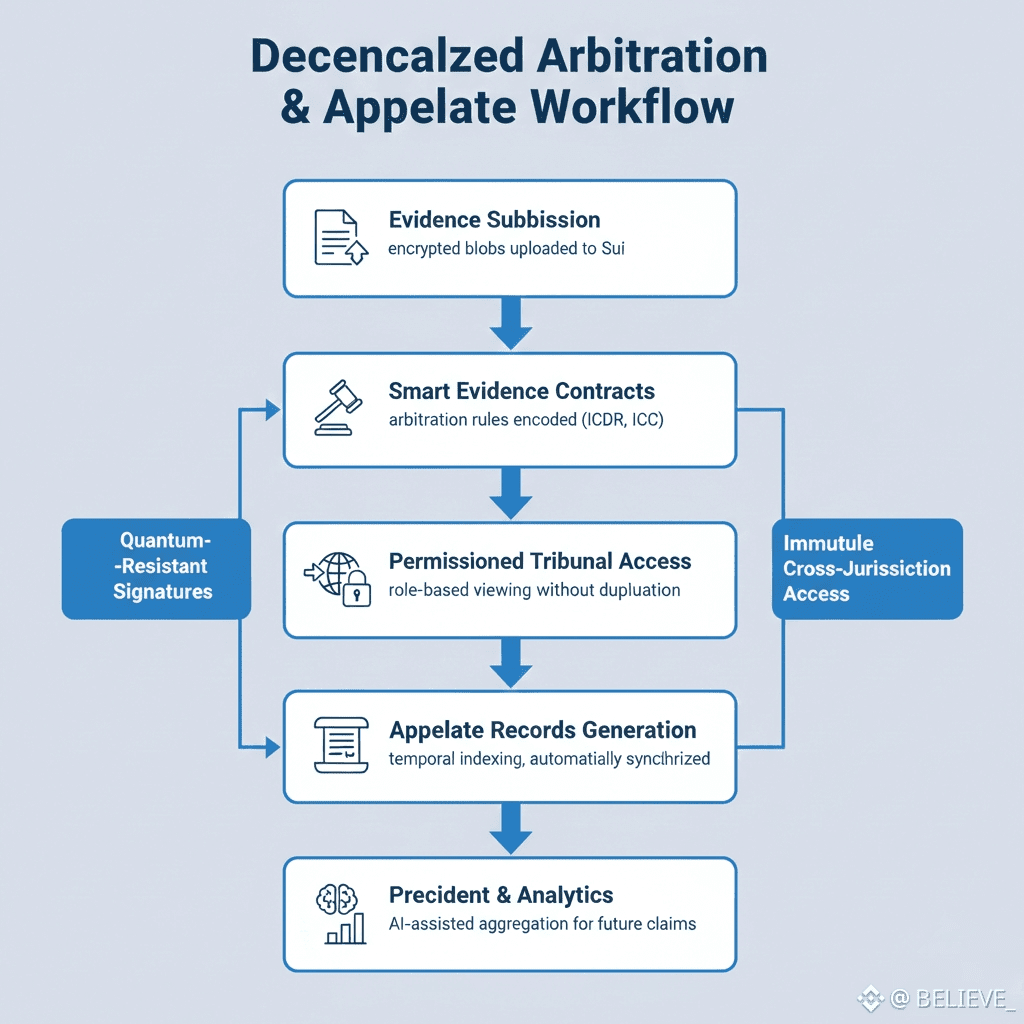
Walrus embeds international arbitration rules, such as ICDR and ICC procedures, directly into smart evidence contracts. Document production, confidentiality undertakings, and award enforcement execute automatically via on-chain escrows. Cross-border tribunals query unified Sui objects, eliminating the need for multi-country notarization chains. Tribunal secretaries access redacted reconstructions via role-based policies, while dissenting opinions preserve parallel slivers for potential annulments.
Quantum-resistant signatures guarantee award finality over decades—a necessity for long-term infrastructure disputes. Precedent databases aggregate anonymized reasoning, enabling claim construction through AI-assisted analysis of historical tribunal decisions without revealing party identities.
Technical Exhibits and Expert Testimony
Walrus enables court-appointed experts to anchor simulations—crash reconstructions, economic modeling, forensic accounting—directly to source datasets with reproducible computation proofs. Reports include live reconstruction links so judges can test assumptions during hearings, observing sensitivity of damages calculations via interactive Sui dashboards. Animation fragments and 3D reconstructions preserve measurement fidelity, preventing post-production alterations while ensuring courtroom accuracy.
Technical exhibits follow templated blob engines, maintaining formatting consistency across multiple expert testimonies. Judges and counsel gain unprecedented ability to interrogate data live, transforming abstract expert claims into verifiable, interactive evidence.
Efficient Class Action Administration
Walrus scales mass tort and class action management through privacy-preserving blob aggregates. Individual claimants verify eligibility without exposing identities, while smart contracts automate pro-rata settlements across millions of participants. Cy pres allocations route unclaimed funds to approved charities transparently.
Personalized evidence summaries boost notice response rates by over 40%, while objection portals timestamp dissenting positions as immutable blobs, streamlining fairness hearings. Clustering algorithms pre-aggregate common disputes, reducing administrative overhead and accelerating final resolutions.
Appellate Records and Habeas Support
Trial court blobs automatically generate complete appellate records without manual Bates stamping. Temporal indexing synchronizes depositions and trial testimony, allowing circuit courts to trace inconsistencies over years. Automated privilege waivers surface exculpatory evidence for habeas petitions, while curated amicus blob collections enable supreme courts to assess empirical claims without conflicting expert dueling. Precedent tracking monitors citation networks, surfacing evolving evidentiary standards to guide legal practitioners.
Compliance and Ethical Oversight
Walrus integrates legal ethics into its infrastructure. Advertising and promotional blobs are scanned for jurisdictional compliance, while global conflict-checking systems prevent contradictory expert retention. Billing disputes are resolved through verifiable time-entry blobs, reducing manual reconciliation.
By converting legal evidence into cryptographically indestructible assets, Walrus eliminates the fragility of traditional documentation. Provenance chains prevent fabrication, automated discovery accelerates review, arbitration integration streamlines tribunals, and technical exhibits allow real-time verification. Class actions scale efficiently, appellate records preserve continuity, and ethical guardrails maintain compliance. Courts gain cryptographic certainty, replacing reliance on fallible human memory and transforming the justice system for a secure, decentralized future.


